Comprehensive Overview of Tissues in Plants and Animals
Fundamentals of Tissue Structure and Classification
Understanding Tissue as a Cellular Assembly
Tissues are assemblies of cells that share similar shapes and functions, forming an intermediate organizational level between individual cells and complete organ systems. These cellular groups collaborate to create organs that perform specific biological roles.
The scientific examination of tissues is termed histology, while the study of tissue-related diseases is known as histopathology. Commonly, tissues are analyzed by embedding them in paraffin blocks and slicing thin sections for microscopic observation.
Example: A researcher studying the structure of liver tissue prepares thin sections by embedding the sample in paraffin wax. This method allows detailed visualization of cellular arrangements and identification of any pathological changes.
Solution: Embedding in paraffin stabilizes the tissue, enabling thin slicing without distortion. This technique is essential for accurate histological analysis and diagnosis.
Animal Tissue Types and Their Roles
Classification and Characteristics of Animal Tissues
Animal tissues are broadly categorized into four main types: connective, muscular, nervous, and epithelial tissues. Each type has distinct cellular compositions and functions, contributing uniquely to the organism's physiology.
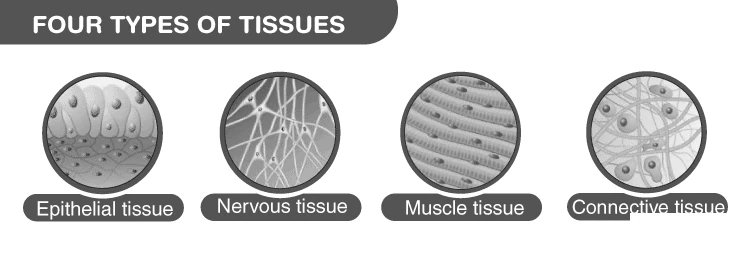
Illustration of Various Animal Tissue Types
Example: Identify the tissue type responsible for connecting bones and providing structural support in the human body.
Solution: Connective tissue, such as ligaments and tendons, connects bones and supports the skeletal framework by providing strength and flexibility.
Connective Tissue: Structure and Function
Connective tissue consists of cells dispersed within a non-living extracellular matrix. This matrix provides mechanical support and maintains the spatial arrangement of organs. Examples include blood, bone, tendons, ligaments, adipose, and areolar tissues.
Connective tissues are classified into three categories: fluid connective tissue, fibrous connective tissue, and skeletal connective tissue.
Key functions include insulation, binding organs, protection against pathogens through phagocytosis, maintaining body shape, conserving heat, storing energy, and facilitating transport of substances like nutrients and gases.
Example: Calculate the percentage of body heat conserved if connective tissue reduces heat loss by 30% in a 37°C environment.
Solution: If the body loses 100 units of heat without connective tissue, with connective tissue, heat loss is reduced by 30 units. Thus, heat conserved is 30% of total heat loss, helping maintain body temperature.
Muscle Tissue: Types and Functions
Muscle tissues generate force and enable movement, both voluntary and involuntary. They are divided into skeletal muscle (attached to bones), cardiac muscle (heart walls), and smooth muscle (walls of internal organs).
Muscle tissue supports activities such as walking, posture maintenance, organ constriction, blood circulation, and respiration control.
Example: A skeletal muscle contracts with a force of 150 N. If the muscle shortens by 0.02 m during contraction, calculate the work done.
\[ \text{Work} = \text{Force} \times \text{Displacement} = 150 \text{ N} \times 0.02 \text{ m} = 3 \text{ J} \]
Nervous Tissue: Composition and Importance
Nervous tissue forms the core of the central and peripheral nervous systems, comprising the brain, spinal cord, cranial, and spinal nerves. It facilitates communication, processes information, and coordinates bodily functions.
Functions include responding to stimuli, transmitting signals, supporting cognitive functions like memory and reasoning, and maintaining homeostasis.
Example: Explain how nervous tissue contributes to reflex actions.
Solution: Nervous tissue transmits sensory signals to the spinal cord and motor commands back to muscles rapidly, enabling quick, involuntary reflex responses to stimuli.
Epithelial Tissue: Structure and Roles
Epithelial tissue covers body surfaces and lines internal organs, including skin, reproductive tract, airways, and digestive tract linings. It serves as a protective barrier and participates in absorption, secretion, and filtration.
Functions include sensory reception, mechanical protection, selective permeability, secretion of hormones and enzymes, and defense against pathogens and physical damage.
Example: Describe how epithelial tissue protects the respiratory tract.
Solution: Epithelial cells in the respiratory tract secrete mucus that traps dust and microbes, while cilia move the mucus out, preventing infection and damage.
Classification and Functions of Plant Tissues
Overview of Plant Tissue Systems
Plant tissues are classified based on their location and cell types. The three main tissue systems are epidermis (outer protective layer), vascular tissue (transport system), and ground tissue (photosynthesis and storage).
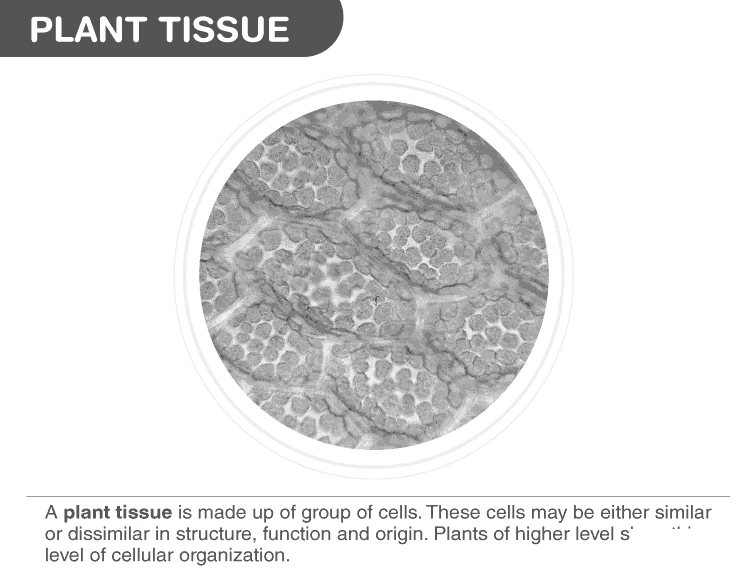
Diagram Depicting Plant Tissue Systems
Example: Identify the plant tissue responsible for transporting water from roots to leaves.
Solution: Xylem, a component of vascular tissue, transports water and minerals upward from roots to aerial parts.
Meristematic Tissue: Growth and Development
Meristematic tissues consist of actively dividing young cells that contribute to the plant's growth in length and girth. They are categorized by location into apical, lateral, and intercalary meristems.
These tissues are essential for forming new organs and facilitating both primary and secondary growth.
Example: A plant's apical meristem produces 0.5 cm of new stem length daily. Calculate the growth over a week.
\[ \text{Growth} = 0.5 \text{ cm/day} \times 7 \text{ days} = 3.5 \text{ cm} \]
Permanent Tissue: Types and Functions
Permanent tissues arise from meristematic cells that have differentiated and ceased division. They are classified into simple permanent tissues (parenchyma, collenchyma, sclerenchyma), complex permanent tissues (xylem, phloem), and secretory tissues.
Functions include providing mechanical support, storing nutrients, aiding in photosynthesis, secretion, and transport within the plant.
Example: Explain how sclerenchyma tissue contributes to fruit hardness.
Solution: Sclerenchyma cells have thick, lignified walls that provide rigidity and protection, making fruits like nuts and coconuts hard.
Quick Reference: Summary of Tissue Types and Functions
Tissue Type | Primary Function | Examples |
|---|---|---|
Connective Tissue (Animal) | Support, binding, protection, transport | Blood, bone, tendons, ligaments |
Muscle Tissue (Animal) | Movement, posture, blood circulation | Skeletal, cardiac, smooth muscles |
Nervous Tissue (Animal) | Signal transmission, coordination | Brain, spinal cord, nerves |
Epithelial Tissue (Animal) | Protection, secretion, absorption | Skin, lining of organs |
Meristematic Tissue (Plant) | Growth and organ formation | Apical, lateral, intercalary meristems |
Permanent Tissue (Plant) | Support, storage, transport | Parenchyma, xylem, phloem, sclerenchyma |
Glossary of Key Terms
Term | Definition |
|---|---|
Histology | The study of the microscopic structure of tissues. |
Extracellular Matrix | Non-living material surrounding cells in connective tissue. |
Phagocytosis | Process by which cells engulf and digest pathogens. |
Apical Meristem | Meristematic tissue at the tips of roots and shoots responsible for length growth. |
Parenchyma | Simple permanent tissue involved in storage and photosynthesis. |
Xylem | Complex tissue that transports water and minerals in plants. |
Phloem | Complex tissue that transports food in plants. |
Sclerenchyma | Supportive plant tissue with thick, lignified walls. |
Ligament | Connective tissue connecting bones to other bones. |
Cardiac Muscle | Involuntary muscle tissue found in the heart. |
Frequently Asked Questions
What distinguishes connective tissue from other animal tissues?
Connective tissue is unique because its cells are embedded in an extracellular matrix, providing structural support and connecting different body parts.
How do meristematic tissues contribute to plant growth?
Meristematic tissues contain actively dividing cells that enable plants to grow in length and girth by producing new cells.
Why is epithelial tissue important for organ protection?
Epithelial tissue forms protective barriers that prevent pathogen entry and physical damage while facilitating absorption and secretion.
What role does nervous tissue play in the body?
Nervous tissue transmits signals, processes information, and coordinates responses to maintain body functions and homeostasis.
How do plant vascular tissues differ from ground tissues?
Vascular tissues transport water, minerals, and food, whereas ground tissues mainly perform photosynthesis and store nutrients.