Fundamentals of Taxonomy: Classification and Naming of Organisms
Understanding the Science of Organism Classification
Essence and Scope of Taxonomy
Taxonomy is the branch of biology dedicated to the systematic naming, description, and categorization of all living entities, including plants and animals. This discipline relies on analyzing behavioral traits, genetic makeup, and biochemical properties to group organisms. The core activities in taxonomy include characterization, identification, and classification, which organize organisms into hierarchical groups such as kingdom, phylum, class, order, family, genus, and species.
The foundation of modern taxonomy was laid by Carolus Linnaeus, often hailed as the Father of Taxonomy. He introduced a structured method for naming and grouping species, which remains influential today. His key contributions include the hierarchical classification framework and the binomial nomenclature system, which assigns each species a two-part Latin name.
Example Problem
Question: A botanist discovers a new flowering plant species. Explain the steps they would follow to classify and name this species according to Linnaeus's system.
Solution:
Identify the plant's characteristics such as flower structure, leaf arrangement, and reproductive features.
Determine its placement within the kingdom Plantae based on seed production.
Assign it to the appropriate class and order by comparing morphological traits with known groups.
Place it in a genus that shares similar features.
Give the species a binomial name consisting of the genus name followed by a specific epithet, following Latin conventions.
Hierarchy in Linnaeus's Classification
Linnaeus divided all living things into three primary kingdoms: animals, plants, and minerals. Each kingdom was further subdivided into classes, which were broken down into orders, then genera, and finally species. This hierarchical structure allows scientists to systematically identify and categorize organisms based on shared characteristics, facilitating easier study and communication.
Example Problem
Question: Classify a domestic cat using Linnaeus's hierarchy up to the species level.
Solution:
Kingdom: Animalia
Phylum: Chordata
Class: Mammalia
Order: Carnivora
Family: Felidae
Genus: Felis
Species: Felis catus
Alpha and Beta Taxonomy Explained
Alpha taxonomy focuses on discovering, describing, and naming new taxa—groups of organisms considered as single units. This process involves detailed observation and documentation of organism traits. The term was introduced by William Bertram in the 1930s. Beta taxonomy, on the other hand, deals with organizing these taxa into a natural hierarchical system, arranging species into categories that reflect evolutionary relationships.
Example Problem
Question: Differentiate between alpha and beta taxonomy with an example.
Solution:
Alpha Taxonomy: Identifying and naming a newly found butterfly species based on its wing patterns and morphology.
Beta Taxonomy: Placing this butterfly species within the existing family and order based on its evolutionary traits.
Classification of Plants: Branches and Categories
Overview of Plant Taxonomy
Plant taxonomy is a specialized field within taxonomy that concentrates on identifying, naming, and classifying plants. The plant kingdom is broadly divided into seed-producing and non-seed-producing groups. Seed-producing plants include flowering plants, conifers, ginkgos, and cycads, which reproduce mainly through pollination. Non-seed plants such as ferns, horsetails, and mosses reproduce via spores.
Example Problem
Question: Classify a pine tree based on its reproductive method and kingdom.
Solution:
Kingdom: Plantae
Category: Seed-producing plants
Group: Gymnosperms (conifers)
Reproduction: Through pollination of exposed seeds
Seedless vs Seed-Producing Plants
Seedless plants such as ferns and mosses reproduce by releasing spores, which do not contain embryos. In contrast, seed-producing plants generate seeds that contain embryos, providing better protection and nourishment. This distinction is fundamental in plant taxonomy and helps in grouping plants based on their reproductive strategies.
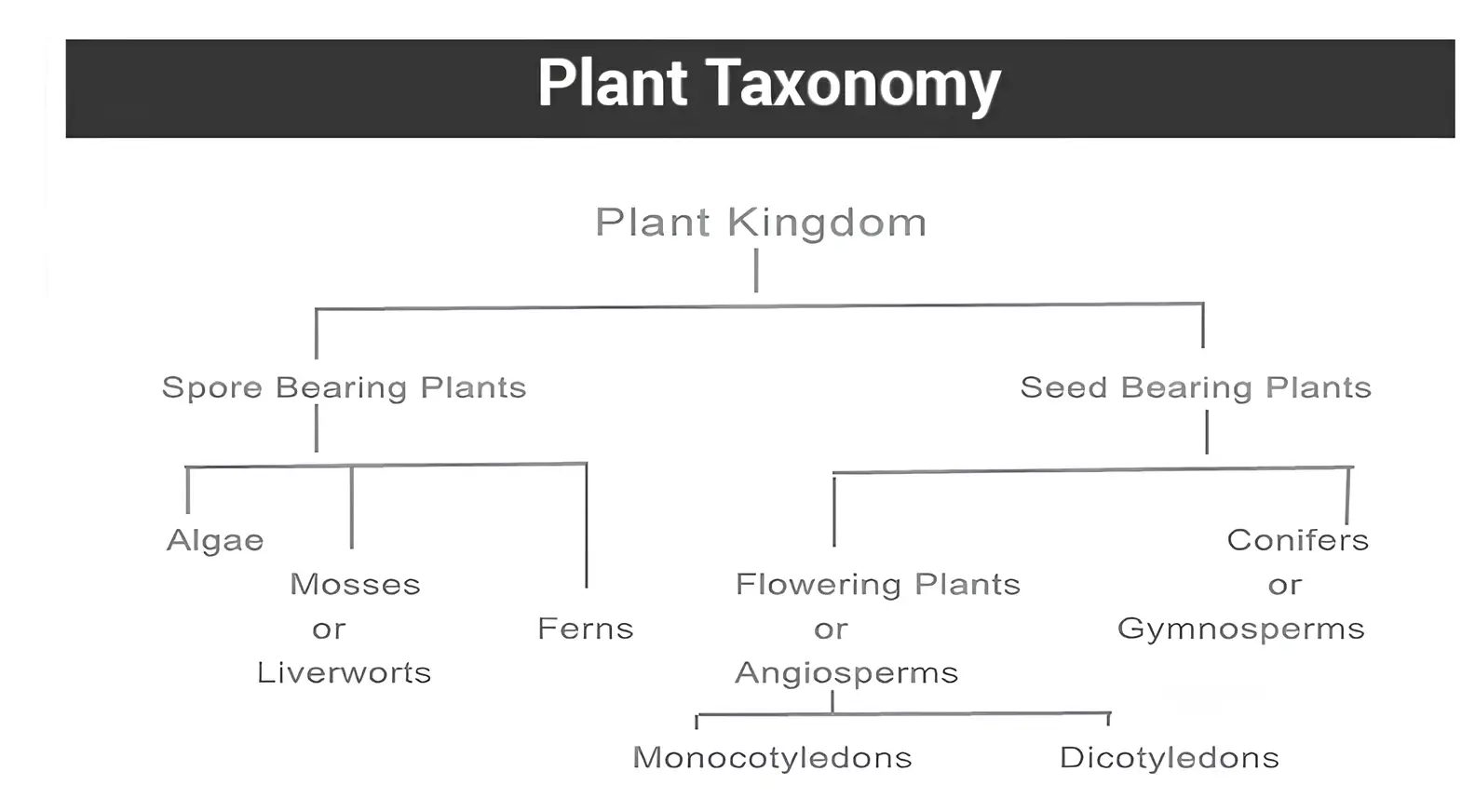
This image is a chart showing the classification of plants, called plant taxonomy. It divides plants into groups based on how they reproduce, either by spores or seeds, and further breaks down each group into smaller categories. Step-by-step explanation: 1. All plants belong to the Plant Kingdom. 2. Plants are first divided into two main groups: Spore Bearing Plants and Seed Bearing Plants. 3. Spore Bearing Plants include Algae, Mosses or Liverworts, and Ferns. These plants reproduce using spores. 4. Seed Bearing Plants are split into Conifers or Gymnosperms, and Flowering Plants or Angiosperms. 5. Flowering Plants are further divided into Monocotyledons and Dicotyledons, based on the number of seed leaves they have. This system helps scientists organize and understand different types of plants.
Example Problem
Question: Identify whether a fern is a seed-producing or seedless plant and justify your answer.
Solution:
A fern is a seedless plant.
It reproduces via spores, not seeds.
This characteristic places it in the non-seed-producing category within the plant kingdom.
Animal Classification: Taxonomic Groupings and Characteristics
Principles of Animal Taxonomy
Animal taxonomy involves the identification, naming, and classification of animals following Linnaeus's hierarchical system. Animals are grouped starting from the kingdom level and further divided into phyla, classes, orders, families, genera, and species. This systematic approach helps in understanding the diversity and evolutionary relationships among animals.
Examples of animals classified under different taxonomic groups
Example Problem
Question: Classify a frog up to the class level and state its main characteristics.
Solution:
Kingdom: Animalia
Phylum: Chordata
Class: Amphibia
Characteristics: Cold-blooded, live both in water and on land, undergo metamorphosis
Distinguishing Vertebrates and Invertebrates
The animal kingdom is broadly divided into vertebrates, which possess a backbone, and invertebrates, which lack one. Invertebrates include groups like arthropods, molluscs, and annelids, while vertebrates encompass mammals, birds, reptiles, fish, and amphibians. This division is crucial for taxonomists to organize animals based on structural features.
Example Problem
Question: Categorize a butterfly as a vertebrate or invertebrate and provide reasons.
Solution:
A butterfly is an invertebrate.
It belongs to the phylum Arthropoda, characterized by an exoskeleton and jointed legs.
It lacks a backbone, which defines invertebrates.
Quick Reference: Taxonomy at a Glance
Term | Definition | Example |
|---|---|---|
Taxonomy | Science of naming, describing, and classifying organisms | Classification of plants and animals |
Binomial Nomenclature | Two-part scientific naming system for species | Homo sapiens for humans |
Kingdom | Highest taxonomic rank grouping organisms broadly | Animalia, Plantae |
Phylum | Group of related classes within a kingdom | Chordata (animals with backbone) |
Class | Subdivision of phylum grouping similar orders | Mammalia (mammals) |
Order | Category grouping related families | Carnivora (meat-eaters) |
Family | Group of related genera | Felidae (cats) |
Genus | Group of closely related species | Felis |
Species | Basic unit of classification, organisms capable of interbreeding | Felis catus (domestic cat) |
Alpha Taxonomy | Process of discovering and naming new taxa | Describing a new insect species |
Beta Taxonomy | Arranging taxa into hierarchical classification | Grouping species into families and orders |
Glossary of Key Taxonomy Terms
Term | Meaning |
|---|---|
Taxon | A group of one or more populations of organisms seen as a unit |
Binomial Nomenclature | Two-part scientific naming system for species |
Kingdom | Highest rank in biological classification |
Phylum | Taxonomic rank below kingdom grouping related classes |
Class | Rank below phylum grouping related orders |
Order | Rank below class grouping related families |
Family | Group of related genera |
Genus | Group of closely related species |
Species | Basic unit of classification, organisms capable of interbreeding |
Alpha Taxonomy | Discovery and naming of new taxa |
Beta Taxonomy | Classification and arrangement of taxa |
Frequently Asked Questions on Taxonomy
What is the main purpose of taxonomy?
Taxonomy aims to identify, name, and classify organisms to organize biological diversity systematically.
Who is known as the Father of Taxonomy?
Carolus Linnaeus is recognized for developing the binomial nomenclature and hierarchical classification system.
What is binomial nomenclature?
It is a two-part naming system for species, consisting of the genus name followed by the species name.
How are plants classified in taxonomy?
Plants are classified based on seed production into seed-producing (like flowering plants) and seedless plants (like ferns).
What distinguishes vertebrates from invertebrates?
Vertebrates have a backbone, while invertebrates lack one; this is a primary classification criterion in animal taxonomy.