Fundamentals of Prokaryotic Cells: Structure, Function, and Reproduction
Understanding the Basics of Prokaryotic Cells
Defining Prokaryotic Cells and Their Biological Significance
Prokaryotic cells represent the simplest and most ancient form of life on Earth, primarily consisting of unicellular organisms such as bacteria and archaea. Unlike eukaryotic cells, they lack a membrane-bound nucleus, with their genetic material freely located in a cytoplasmic region called the nucleoid. These cells perform all metabolic activities within the cytoplasm, enclosed by a single membrane, and can exist independently or as parasites.
Example:
Identify which of the following organisms are prokaryotic: Amoeba, Cyanobacteria, Archaea, and Fungi.
Solution:
Amoeba: Eukaryotic organism with membrane-bound nucleus.
Cyanobacteria: Photosynthetic prokaryotes performing photosynthesis without chloroplasts.
Archaea: Prokaryotic microorganisms often found in extreme environments.
Fungi: Eukaryotic organisms with complex cellular structures.
Therefore, Cyanobacteria and Archaea are prokaryotic cells.
Distinctive Features of Prokaryotic Cells
Key Characteristics That Differentiate Prokaryotes
Prokaryotic cells exhibit several unique traits that set them apart from eukaryotic cells. They do not possess a nuclear membrane, and their genetic material is organized as a single circular chromosome without histone proteins. Organelles such as mitochondria, Golgi apparatus, chloroplasts, and lysosomes are absent. Their cell walls are composed of carbohydrates and amino acids, providing structural support. The plasma membrane functions similarly to mitochondria by hosting respiratory enzymes. Reproduction occurs mainly through asexual binary fission, while genetic exchange can happen via conjugation.
Example:
Explain why prokaryotic cells do not have mitochondria and how they generate energy.
Solution:
Prokaryotes lack membrane-bound organelles, including mitochondria.
Their plasma membrane contains enzymes that carry out respiration and energy production.
Energy generation occurs through processes embedded in the plasma membrane, such as electron transport chains.
This adaptation allows prokaryotes to efficiently produce energy without complex organelles.
Structural Components of Prokaryotic Cells
Detailed Overview of Prokaryotic Cell Anatomy
Prokaryotic cells have a simple yet functional architecture. The genetic material resides in the nucleoid region within the cytoplasm. The outermost layer is the cell wall, which maintains cell shape and protection. Some bacteria possess an additional capsule that aids in moisture retention and defense. The cytoplasm contains enzymes and ribosomes responsible for protein synthesis. The cell membrane regulates substance exchange. Appendages like pili facilitate attachment to surfaces, while flagella enable movement. Plasmids, small circular DNA molecules, exist independently of chromosomal DNA and contribute to genetic variation.
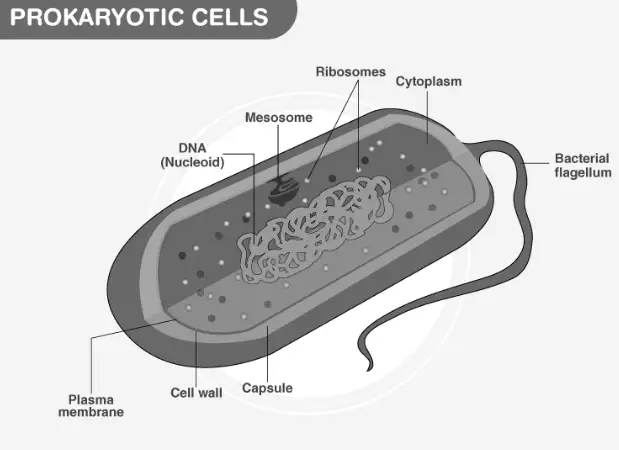
Illustration of a prokaryotic cell highlighting the absence of a true nucleus and presence of flagella
Example:
Describe the role of the capsule in bacterial cells and how it benefits survival.
Solution:
The capsule is an outer protective layer beyond the cell wall.
It helps retain moisture, preventing desiccation.
Protects bacteria from being engulfed by immune cells.
Assists in attachment to surfaces and nutrient sources.
These functions enhance bacterial survival in diverse environments.
Mechanisms of Prokaryotic Reproduction and Genetic Exchange
How Prokaryotes Multiply and Share Genetic Material
Prokaryotic organisms reproduce primarily through binary fission, an asexual process where the DNA replicates and the cell divides into two identical daughter cells. Additionally, genetic recombination occurs via conjugation, transformation, and transduction, which introduce genetic diversity. Conjugation involves direct transfer of DNA through a pilus between two bacteria. Transformation is the uptake of external DNA from the environment. Transduction uses bacteriophages to transfer genetic material between cells.
Examples and Diversity of Prokaryotic Organisms
Exploring Various Prokaryotic Life Forms and Their Adaptations
Prokaryotes include a wide range of organisms such as bacteria and archaea. Bacteria are ubiquitous, inhabiting soil, water, and even the human body. Their cell walls contain peptidoglycan, and they may have specialized structures like pili, flagella, capsules, and plasmids. Some bacteria form endospores to survive harsh conditions. Archaea resemble bacteria morphologically but differ chemically, especially in their membrane lipids and cell wall composition. They thrive in extreme environments like hot springs and salt lakes.
Example:
Compare the cell wall composition of bacteria and archaea and explain how this difference affects their environmental adaptability.
Solution:
Bacterial cell walls contain peptidoglycan, providing rigidity and shape.
Archaeal cell walls lack peptidoglycan and have unique lipids with different stereochemistry.
This difference allows archaea to survive extreme conditions such as high temperature and salinity.
Hence, cell wall composition is a key factor in their ecological niches.
Quick Reference: Summary of Prokaryotic Cell Features
Aspect | Description |
|---|---|
Genetic Material | Single circular chromosome located in nucleoid region, no nuclear membrane |
Organelles | No membrane-bound organelles; ribosomes present for protein synthesis |
Cell Wall | Composed of peptidoglycan in bacteria; varies in archaea |
Reproduction | Asexual by binary fission; genetic recombination via conjugation, transformation, transduction |
Locomotion | Flagella and pili for movement and attachment |
Additional Structures | Capsule for protection; plasmids for extra genetic information |
Energy Production | Respiratory enzymes embedded in plasma membrane |
Size and Shape | Varies: spherical (cocci), rod-shaped (bacilli), spiral (spirilla) |
Examples | Bacteria (e.g., Escherichia coli), Archaea (e.g., thermophiles) |
Evolutionary Age | Originated approximately 3.5 billion years ago |
Glossary of Key Terms Related to Prokaryotic Cells
Term | Definition |
|---|---|
Binary Fission | A form of asexual reproduction where a cell divides into two identical daughter cells. |
Capsule | A protective outer layer found in some bacteria that aids in moisture retention and defense. |
Conjugation | Transfer of genetic material between bacterial cells via a pilus. |
Cytoplasm | Gel-like substance inside the cell where metabolic activities occur. |
Nucleoid | Region in prokaryotic cells containing the circular DNA without a nuclear membrane. |
Peptidoglycan | A polymer forming the bacterial cell wall, composed of sugars and amino acids. |
Plasmid | Small, circular DNA molecules in bacteria that carry extra genetic information. |
Ribosome | Cellular structure responsible for protein synthesis. |
Transduction | Transfer of genetic material between bacteria via bacteriophages (viruses). |
Transformation | Uptake and incorporation of external DNA by a bacterial cell. |
Frequently Asked Questions About Prokaryotic Cells
What are the main structural components of a prokaryotic cell?
Prokaryotic cells consist of a cell wall, plasma membrane, capsule (in some), pili, flagella, ribosomes, plasmids, cytoplasm, and a nucleoid region containing DNA.
How do prokaryotic cells differ structurally from eukaryotic cells?
Prokaryotes lack a true nucleus and membrane-bound organelles such as mitochondria and chloroplasts, which are present in eukaryotic cells. Their DNA is circular and free in the cytoplasm.
What is the process of binary fission in prokaryotes?
Binary fission is an asexual reproduction method where the DNA replicates, the cell elongates, and divides into two genetically identical daughter cells.
Why is prokaryotic cell division simpler than eukaryotic cell division?
Because prokaryotes lack a nuclear membrane and complex organelles, their DNA replication and cell division processes are less complicated and faster than in eukaryotes.
When did prokaryotic cells first appear on Earth?
Prokaryotic cells are believed to have evolved around 3.5 billion years ago, making them the earliest known life forms.