Comprehensive Overview of the Nephron: Kidney’s Functional Unit
Understanding the Nephron and Its Architecture
Defining the Nephron and Its Role
The nephron serves as the fundamental structural and operational unit within the kidney. Each nephron is a microscopic tubular structure composed primarily of a renal corpuscle and an associated renal tubule. The term “nephron” originates from the Greek word nephros, meaning kidney. Human kidneys contain millions of these nephrons, each contributing to the vital process of blood filtration and urine formation.
Detailed Anatomy of the Nephron
The nephron is a slender, elongated tube, typically measuring between 30 to 60 millimeters in length. One end of this tube expands into a double-layered, cup-shaped structure known as the Bowman’s capsule, which envelops a dense network of capillaries called the glomerulus. Together, these two components form the renal corpuscle, the initial site of blood filtration.
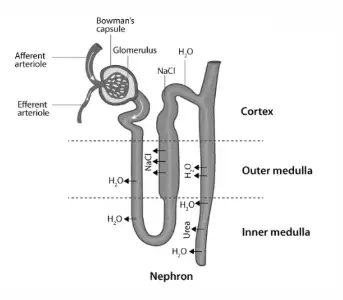
Illustration of the nephron highlighting the renal corpuscle and tubule system
Primary Components: Renal Corpuscle and Tubule
The nephron is divided into two main parts:
Renal Corpuscle: Comprising the glomerulus and Bowman’s capsule, it initiates the filtration of blood.
Renal Tubule: A convoluted and segmented tube responsible for reabsorption and secretion processes essential for urine formation.
Exploring the Renal Tubule: Structure and Function
Segments of the Renal Tubule and Their Roles
The renal tubule extends from the Bowman’s capsule and is subdivided into three distinct regions based on their structure and function:
Proximal Convoluted Tubule (PCT): Located near the glomerulus within the renal cortex, this segment is the primary site for reabsorbing vital substances.
Loop of Henle: A U-shaped loop that dips into the renal medulla, consisting of descending and ascending limbs with differing permeability characteristics.
Distal Convoluted Tubule (DCT): Situated in the cortex, this segment fine-tunes ion exchange and connects to the collecting duct.
The tubule’s main function is to reclaim essential molecules and water from the filtrate through active and passive transport mechanisms, while also secreting certain ions to maintain homeostasis.
Proximal Convoluted Tubule: The Reabsorption Hub
After blood filtration in the glomerulus, the filtrate enters the PCT where the majority of reabsorption occurs. This segment actively recovers glucose, amino acids, proteins, a significant portion of electrolytes, and water. The epithelial lining of the PCT, composed of simple cuboidal cells with microvilli, increases the surface area to optimize absorption. Additionally, the PCT selectively secretes ions such as hydrogen, ammonia, and potassium into the filtrate, while absorbing bicarbonate ions to regulate acid-base balance.
Loop of Henle: Creating Concentration Gradients
The loop of Henle consists of two limbs with contrasting permeability:
Descending limb: Permeable to water but impermeable to electrolytes, allowing water to exit and concentrate the filtrate.
Ascending limb: Impermeable to water but permeable to electrolytes, facilitating the reabsorption of sodium and chloride ions, which dilutes the filtrate.
This differential permeability establishes an osmotic gradient crucial for water reabsorption in later segments.
Distal Convoluted Tubule: Final Adjustments
The DCT connects to the collecting duct and plays a pivotal role in fine-tuning the filtrate composition. It secretes ions such as hydrogen, potassium, and ammonia into the filtrate and reabsorbs bicarbonate ions. Additionally, the DCT conditionally reabsorbs sodium and water depending on the body's needs, thus contributing to pH regulation and electrolyte balance.
Collecting Duct: Concentrating the Urine
The collecting duct is a straight tube where secretion of hydrogen and potassium ions continues to maintain electrolyte balance. It is also the primary site for water reabsorption under the influence of antidiuretic hormone (ADH), enabling the production of concentrated urine.
Renal Corpuscle and Nephron Classification
Structure and Function of the Renal Corpuscle
The renal corpuscle consists of the glomerulus, a tuft of capillaries, enclosed by the Bowman’s capsule. Blood enters the glomerulus via the afferent arteriole and exits through the efferent arteriole. The smaller diameter of the efferent arteriole maintains elevated pressure within the glomerulus, facilitating filtration.
The Bowman’s capsule has three layers:
Outer Parietal Layer: Composed of epithelial cells with tiny pores approximately 12 nm wide.
Basement Membrane: A selectively permeable middle layer that filters molecules based on size and charge.
Inner Visceral Layer: Contains podocytes with finger-like extensions called pedicels that wrap around capillaries, aiding filtration.
Types of Nephrons Based on Location and Structure
Nephrons are categorized into two types depending on their position and loop length:
Cortical Nephrons: Constituting about 80% of nephrons, these have short loops of Henle and are primarily located within the renal cortex.
Juxtamedullary Nephrons: Making up roughly 20%, these nephrons have long loops extending deep into the medulla, playing a key role in urine concentration.
Essential Functions and Summary of the Nephron
Key Roles of the Nephron in Body Homeostasis
The nephron’s primary responsibility is to filter blood, remove waste products, and regulate water and electrolyte balance. Blood enters the glomerulus under high pressure, allowing small molecules to pass into the Bowman’s capsule as filtrate. As this filtrate travels through the renal tubule, essential substances like glucose, amino acids, and water are reabsorbed, while waste and excess ions are secreted into the tubule.
Throughout this journey, the filtrate becomes increasingly concentrated, culminating in urine formation. The purified blood returns to circulation via renal blood vessels, free from toxins and surplus substances. The urine then flows through collecting ducts to the bladder for storage and eventual excretion.
Summary of Kidney and Nephron Functions
Maintaining acid-base balance by regulating pH.
Reabsorbing nutrients and essential ions.
Controlling blood pressure through fluid balance.
Excreting metabolic wastes and excess substances.
Secreting hormones involved in red blood cell production and electrolyte regulation.
Quick Reference: Nephron Components and Their Functions
Nephron Part | Location | Main Function |
|---|---|---|
Bowman’s Capsule | Renal Cortex | Encases glomerulus; initiates filtration of blood |
Glomerulus | Renal Cortex | Filters blood plasma under pressure |
Proximal Convoluted Tubule (PCT) | Renal Cortex | Reabsorbs glucose, amino acids, electrolytes, and water; secretes ions |
Loop of Henle | Renal Medulla | Creates osmotic gradient; reabsorbs water and electrolytes selectively |
Distal Convoluted Tubule (DCT) | Renal Cortex | Fine-tunes ion exchange; regulates pH and electrolyte balance |
Collecting Duct | Renal Medulla | Secretes ions; reabsorbs water to concentrate urine |
Glossary of Key Terms Related to Nephron
Term | Definition |
|---|---|
Nephron | The microscopic functional unit of the kidney responsible for filtering blood and forming urine. |
Glomerulus | A network of capillaries within the renal corpuscle where blood filtration begins. |
Bowman’s Capsule | A double-walled cup-like structure surrounding the glomerulus that collects filtrate. |
Proximal Convoluted Tubule (PCT) | The first segment of the renal tubule where most reabsorption occurs. |
Loop of Henle | A U-shaped portion of the tubule that establishes concentration gradients in the medulla. |
Distal Convoluted Tubule (DCT) | The segment of the tubule involved in selective reabsorption and secretion. |
Collecting Duct | A tube that collects urine from multiple nephrons and concentrates it. |
Podocytes | Specialized cells in the visceral layer of Bowman’s capsule with foot-like projections aiding filtration. |
Renal Corpuscle | The combination of the glomerulus and Bowman’s capsule where filtration starts. |
Ultrafiltrate | The fluid filtered from blood plasma into the nephron before modification into urine. |
Frequently Asked Questions About the Nephron
What is the primary role of the nephron in the kidney?
The nephron filters blood to remove waste products, regulates water and electrolyte balance, and forms urine.
How does the nephron filter blood effectively?
The glomerulus filters blood plasma under pressure, allowing small molecules to pass into the Bowman’s capsule while retaining blood cells and large proteins.
Which two main parts constitute the nephron?
The nephron consists of the renal corpuscle (glomerulus and Bowman’s capsule) and the renal tubule (PCT, loop of Henle, DCT, and collecting duct).
Where are nephrons located within the kidney?
Nephrons are distributed in the renal cortex and medulla; the renal corpuscle, PCT, and DCT are in the cortex, while the loop of Henle and collecting ducts extend into the medulla.
What is the function of Bowman’s capsule?
Bowman’s capsule surrounds the glomerulus and collects the filtrate produced by blood filtration, initiating urine formation.