Detailed Overview of the Human Stomach Structure and Function
Structural Composition and Role of the Stomach in Digestion
General Anatomy and Functional Importance of the Stomach
The stomach is a hollow, J-shaped organ located in the digestive tract between the oesophagus and the small intestine. It acts as a temporary reservoir where food undergoes secondary digestion. This organ not only stores ingested food but also mechanically processes it through muscular contractions, preparing it for further digestion and absorption in the intestines.
Its unique saclike structure allows expansion to accommodate varying food volumes, while its muscular walls facilitate mixing and breakdown of food particles.
Solution:
Given mass \( m = 600 \text{ g} \) and density \( \rho = 1 \text{ g/cm}^3 \), volume \( V \) is calculated by:
\[ V = \frac{m}{\rho} = \frac{600 \text{ g}}{1 \text{ g/cm}^3} = 600 \text{ cm}^3 \]
Thus, the stomach must expand to hold approximately 600 cm³ of food.
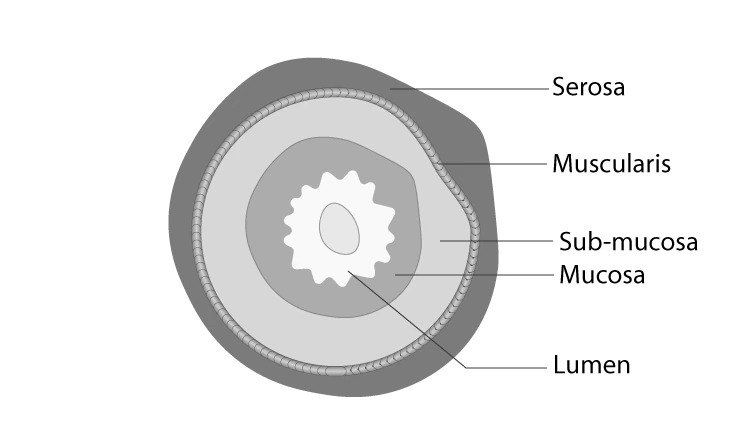
Innermost Layer: Mucosa and Its Secretory Functions
The mucosa forms the stomach's innermost lining and consists primarily of epithelial cells resting on a loose connective tissue called the lamina propria. This layer houses specialized cells responsible for secreting mucus, which protects the stomach lining from acidic gastric juices.
Additionally, mucosal glands within this layer produce hydrochloric acid (HCl) and the enzyme pepsinogen, which is converted to pepsin, aiding in protein digestion.
Solution:
The molarity \( M \) is given as 0.1 mol/L, so the total moles of HCl secreted daily is:
\[ n = M \times V = 0.1 \text{ mol/L} \times 2 \text{ L} = 0.2 \text{ mol} \]
This amount maintains the acidic environment necessary for digestion.
Supporting Layer: Submucosa and Its Role in Nourishment and Protection
The submucosa is a dense connective tissue layer situated beneath the mucosa. It provides structural support and connects the mucosa to the muscularis layer. This layer contains an extensive network of blood vessels, lymphatics, and nerves, which supply nutrients and remove waste products.
Submucosal glands also secrete mucus, contributing to the lubrication and protection of the stomach lining.
Solution:
- Blood vessels deliver oxygen and nutrients to stomach tissues.
- They facilitate removal of carbon dioxide and metabolic wastes.
- They transport absorbed substances to other body parts.
- They support immune responses by carrying immune cells.
Muscular Layer: Muscularis and Its Contribution to Food Movement
The muscularis is the thickest layer of the stomach wall, composed of smooth muscle fibers arranged in three orientations: outer longitudinal, middle circular, and inner oblique layers. This unique arrangement enables powerful contractions known as peristalsis, which mix and propel food through the digestive tract.
These coordinated movements facilitate mechanical digestion and ensure thorough mixing of food with gastric secretions.
Solution:
Number of waves per minute = 3
Total time = 2 hours = 120 minutes
Total waves = \(3 \times 120 = 360\)
Therefore, 360 peristaltic waves occur in 2 hours.
Outermost Layer: Serosa and Its Protective Function
The serosa is the external covering of the stomach, consisting of connective tissue layers continuous with the peritoneum of the abdominal cavity. This membrane reduces friction between the stomach and surrounding organs during digestive movements.
It also provides structural integrity and protection against physical damage.
Solution:
- Acts as a smooth, slippery surface reducing friction.
- Allows free movement of the stomach within the abdominal cavity.
- Protects the stomach from external mechanical injuries.
- Maintains the position of the stomach by anchoring it to surrounding tissues.
Summary Table: Key Layers of the Stomach and Their Functions
| Layer | Composition | Primary Function |
|---|---|---|
| Mucosa | Epithelial cells, lamina propria, mucosal glands | Secretion of mucus, HCl, and digestive enzymes; protection and digestion |
| Submucosa | Dense connective tissue, blood vessels, lymphatics, nerves | Supports mucosa; supplies nutrients and removes waste; mucus secretion |
| Muscularis | Three layers of smooth muscle fibers (longitudinal, circular, oblique) | Facilitates peristalsis and mechanical digestion |
| Serosa | Connective tissue continuous with peritoneum | Protects stomach; reduces friction with adjacent organs |
Glossary of Terms Related to Stomach Anatomy
| Term | Definition |
|---|---|
| Alimentary Canal | The continuous muscular digestive tube from mouth to anus |
| Gastric Juice | Digestive fluid secreted by stomach glands containing HCl and enzymes |
| Hydrochloric Acid (HCl) | Strong acid secreted by stomach lining aiding digestion and killing microbes |
| Lamina Propria | Loose connective tissue layer beneath the epithelium in mucosa |
| Muscularis | Layer of smooth muscle responsible for stomach contractions |
| Mucosa | Innermost lining of the stomach involved in secretion and absorption |
| Peristalsis | Wave-like muscular contractions that move food through the digestive tract |
| Pepsin | Enzyme that breaks down proteins into peptides in the stomach |
| Serosa | Outer protective membrane covering the stomach |
| Submucosa | Connective tissue layer supporting mucosa and containing vessels and nerves |
Frequently Asked Questions About the Stomach
What is the main function of the stomach in digestion?
The stomach primarily stores food, mechanically breaks it down through muscular contractions, and chemically digests proteins using gastric juices.
Why does the stomach have multiple muscle layers?
Multiple muscle layers allow complex movements like churning and peristalsis, which mix food with digestive enzymes and propel it forward.
How does the mucosa protect the stomach lining?
The mucosa secretes mucus that forms a protective barrier preventing damage from acidic gastric juices.
What role does the submucosa play in stomach health?
It supplies blood, lymph, and nerve signals to the stomach tissues and supports the mucosa structurally.
How does the serosa contribute to stomach function?
The serosa reduces friction between the stomach and other organs, allowing smooth movement during digestion.