Comprehensive Overview of Plant Structure and Function
Root System: Structure and Adaptations
Understanding Root Systems and Their Types
Roots are vital for plant survival, anchoring the plant and absorbing water and nutrients from the soil. The entire collection of roots in a plant is called the root system. There are two primary root system types: the taproot system and the fibrous root system. Taproots feature a dominant central root with smaller lateral branches, enabling deep soil penetration and food storage. In contrast, fibrous roots consist of numerous thin, branching roots that spread out near the soil surface, enhancing absorption efficiency.
Example: A plant has a root system with a main root extending 25 meters deep and several lateral roots branching out. Identify the root system type and explain its advantages.
Solution:
The described root system is a taproot system because of the prominent central root penetrating deeply. Advantages include:
- Access to deep water reserves during drought.
- Strong anchorage in soil.
- Storage of nutrients to support the plant in adverse conditions.
Comparing Monocot and Dicot Root Anatomy
Angiosperms are divided into monocots and dicots based on seed structure, and their roots differ anatomically. Dicot roots typically have a central vascular cylinder with xylem and phloem arranged in a star shape, surrounded by a pericycle and cortex. They often possess a multilayered cortex and lack a distinct central pith. Monocot roots, however, have vascular bundles arranged in a ring with a prominent central pith and more numerous xylem bundles. Monocots usually do not undergo secondary growth.
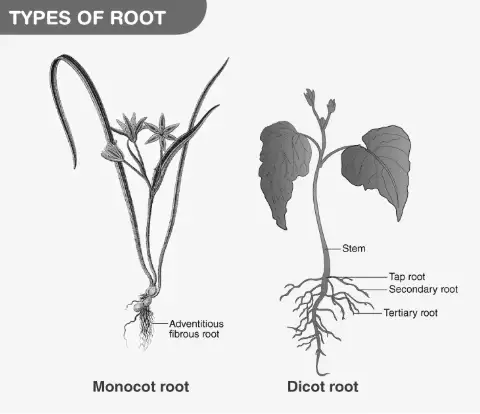
Illustration of Various Root Types
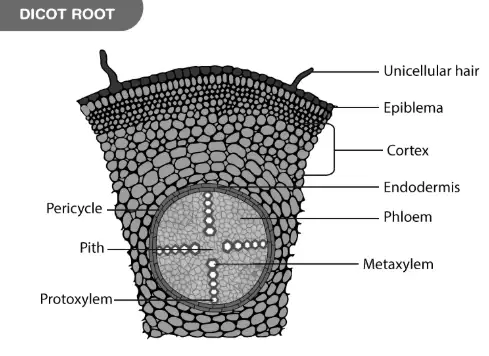
Anatomical Structure of a Dicot Root
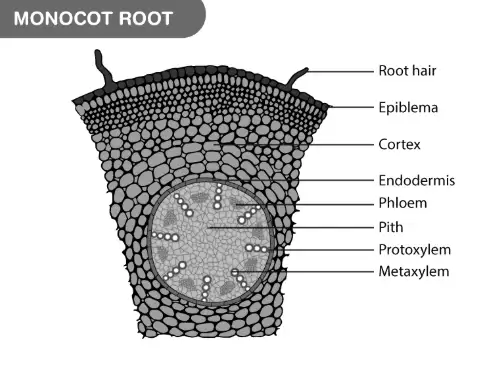
Anatomical Structure of a Monocot Root
Example: A root cross-section shows a large central pith and six xylem bundles arranged in a ring. Determine if the root belongs to a monocot or dicot and justify.
Solution:
The presence of a large central pith and six xylem bundles arranged in a ring indicates a monocot root. Dicots typically lack a prominent pith and have fewer xylem bundles arranged in a star shape.
Root Modifications for Specialized Functions
Roots adapt to various environmental and physiological needs. Some roots enlarge to store food, such as carrots and sweet potatoes. Others develop specialized structures like pneumatophores in swamp plants (e.g., Rhizophora) to facilitate oxygen intake in waterlogged soils. These modifications enhance survival and functionality in diverse habitats.
Example: Identify the type of root modification in a plant growing in marshy soil that has upward-growing roots for air intake.
Solution:
The plant exhibits pneumatophores, specialized aerial roots that help in gas exchange by protruding above waterlogged soil to access oxygen.
Stem Anatomy and Its Functional Adaptations
Structural Features of Dicot and Monocot Stems
Stems provide support and transport pathways between roots and leaves. In dicot stems, vascular bundles are arranged in a ring, with a distinct cortex and pith. The epidermis is covered by a thin cuticle and contains stomata and trichomes. The cortex includes parenchyma, collenchyma, and sclerenchyma cells, which contribute to metabolism, mechanical support, and storage. Monocot stems differ by having scattered vascular bundles surrounded by sclerenchymatous sheaths and a large parenchymatous ground tissue. They lack a defined cortex and pith and do not show secondary growth.
Example: A stem cross-section reveals vascular bundles scattered throughout the ground tissue without a clear ring arrangement. Identify the plant type and explain.
Solution:
The scattered vascular bundles indicate a monocot stem. Dicots have vascular bundles arranged in a ring, while monocots have them dispersed.
Specialized Stem Modifications and Their Roles
Stems can transform to fulfill additional roles beyond support and transport. Rhizomes are horizontal underground stems that store nutrients (e.g., ginger). Tendrils are slender, coiling stems that assist climbing plants (e.g., Passiflora). Tubers like potatoes serve as storage organs. Bulbs, such as onions, consist of layered fleshy leaves surrounding a short stem. Stolons are horizontal stems that grow above ground and help in vegetative propagation (e.g., jasmine).
Example: Describe the function of a tuber and provide an example.
Solution:
A tuber is a swollen underground stem that stores food reserves to support the plant during unfavorable conditions. An example is the potato.
Leaf Structure and Its Adaptations for Photosynthesis
Internal Organization of Dicot and Monocot Leaves
Leaves are the primary sites of photosynthesis, producing food and oxygen essential for life. Dicot leaves (dorsiventral) have distinct upper and lower epidermis layers covered by a cuticle. The mesophyll between these layers contains palisade parenchyma cells rich in chloroplasts for photosynthesis and spongy parenchyma with air spaces for gas exchange. Vascular bundles form the veins, surrounded by bundle sheath cells. Dicot leaves exhibit reticulate venation with a network of veins.
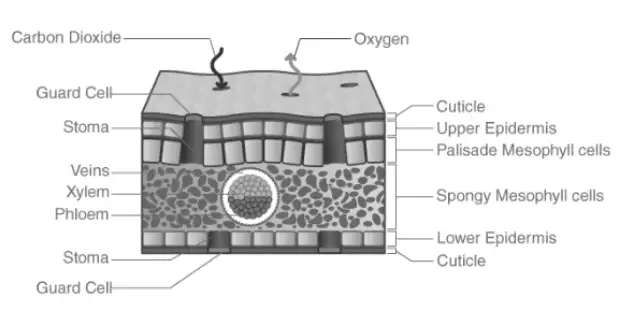
Internal Anatomy of a Typical Leaf
Monocot leaves (isobilateral) have similar layers on both upper and lower surfaces, each with stomata. The mesophyll is not differentiated into palisade and spongy layers but contains bulliform cells that help in leaf folding to reduce water loss. Venation in monocots is parallel.
Example: A leaf cross-section shows stomata on both surfaces and lacks distinct palisade and spongy layers. Identify the leaf type.
Solution:
These features correspond to an isobilateral (monocot) leaf, which has stomata on both sides and undifferentiated mesophyll.
Leaf Modifications for Specialized Functions
Leaves can adapt to serve functions beyond photosynthesis. For instance, in cacti, leaves are modified into spines to reduce water loss and protect against herbivores. Some plants have carnivorous leaves that trap insects for nutrients. Additionally, certain insects mimic leaves for camouflage, illustrating the ecological importance of leaf structure.
Example: Explain the adaptive advantage of spines in cactus leaves.
Solution:
Spines reduce surface area, minimizing water loss in arid environments, and protect the plant from herbivores.
Quick Reference: Summary of Plant Organ Structures
Plant Part | Key Features | Primary Function | Examples |
|---|---|---|---|
Root | Taproot or fibrous; vascular bundles; cortex; pericycle | Anchorage, absorption, storage | Carrot (taproot), rice (fibrous) |
Stem | Vascular bundles in ring (dicot) or scattered (monocot); cortex; pith | Support, transport, storage | Ginger (rhizome), potato (tuber) |
Leaf | Upper/lower epidermis; mesophyll; vascular bundles; stomata | Photosynthesis, gas exchange | Rose (dicot leaf), maize (monocot leaf) |
Glossary of Key Terms
Term | Definition |
|---|---|
Taproot | Main central root growing vertically downward with lateral branches. |
Fibrous Root | Thin, branching roots spreading horizontally near soil surface. |
Pericycle | Layer of cells just inside the endodermis, involved in lateral root formation. |
Vascular Bundle | Complex of xylem and phloem tissues for transport of water and nutrients. |
Cortex | Layer of parenchyma cells between epidermis and vascular tissue. |
Pith | Central region of parenchyma cells in stems or roots. |
Mesophyll | Photosynthetic tissue in leaves between epidermal layers. |
Stomata | Small pores on leaf surfaces for gas exchange. |
Rhizome | Horizontal underground stem for storage and vegetative propagation. |
Tendril | Slender, coiling stem used by climbing plants for support. |
Frequently Asked Questions
What are the main components of plant anatomy?
Plant anatomy primarily includes the study of roots, stems, and leaves, focusing on their tissue and cellular structures.
Why is understanding plant anatomy important?
It helps in comprehending how plants grow, adapt, and function, which is essential for agriculture, horticulture, and environmental science.
What is parthenocarpy?
Parthenocarpy is the development of fruit without fertilization, resulting in seedless fruits.
How do monocot and dicot roots differ?
Dicot roots have a star-shaped xylem arrangement and lack a central pith, while monocot roots have vascular bundles in a ring with a prominent pith.
What modifications do stems undergo?
Stems can modify into rhizomes, tubers, tendrils, bulbs, and stolons to aid in storage, support, climbing, and propagation.