Comprehensive Overview of Cellular Respiration
Fundamentals of Energy Production in Living Cells
Understanding the Biochemical Process of Respiration
Respiration is a vital biochemical mechanism through which living cells generate energy. This process involves the breakdown of complex organic molecules, primarily glucose, to release energy stored in chemical bonds. The energy released is captured in the form of adenosine triphosphate (ATP), which cells utilize to perform essential functions. Respiration occurs universally across all life forms, from unicellular organisms to complex multicellular beings.
It is important to note that respiration is not merely breathing; rather, it is a cellular process involving oxidation reactions that produce energy.
Example: Explain why respiration is considered a metabolic process and not just a physical process like breathing.
Solution:
Respiration involves chemical reactions inside cells that convert glucose into energy.
It includes oxidation of organic molecules, producing ATP, carbon dioxide, and water.
Breathing is a physical process of gas exchange, whereas respiration is biochemical energy production.
Varieties of Cellular Respiration
Energy Generation with Oxygen: Aerobic Respiration
Aerobic respiration is a cellular process that requires oxygen to efficiently convert glucose into energy. This pathway is predominant in most plants and animals. Oxygen acts as the final electron acceptor, enabling complete oxidation of glucose molecules, which results in a high yield of ATP.
The overall chemical reaction for aerobic respiration can be represented as:
\[ \text{C}_6\text{H}_{12}\text{O}_6 + 6\text{O}_2 \rightarrow 6\text{CO}_2 + 6\text{H}_2\text{O} + \text{Energy (ATP)} \]
Energy Production Without Oxygen: Anaerobic Respiration
Anaerobic respiration occurs in the absence of oxygen and is common in certain microorganisms like yeast and some bacteria. This process yields less energy compared to aerobic respiration and produces byproducts such as alcohol and carbon dioxide.
The simplified chemical equation for anaerobic respiration in yeast is:
\[ \text{C}_6\text{H}_{12}\text{O}_6 \rightarrow 2\text{C}_2\text{H}_5\text{OH} + 2\text{CO}_2 + \text{Energy (ATP)} \]
Example: Identify the main products formed when glucose undergoes anaerobic respiration in yeast.
Solution:
Two molecules of ethanol (\(\text{C}_2\text{H}_5\text{OH}\)) are produced.
Two molecules of carbon dioxide (\(\text{CO}_2\)) are released.
Energy is released in the form of ATP, but in smaller amounts than aerobic respiration.
Key Stages of Cellular Respiration
Initial Breakdown: Glycolysis
Glycolysis is the first step in the respiration process, occurring in the cytoplasm of cells. During glycolysis, one glucose molecule is split into two molecules of pyruvic acid. This step generates a small amount of ATP and reduces NAD+ to NADH, which carries electrons to later stages.
Illustration of the Glycolysis pathway
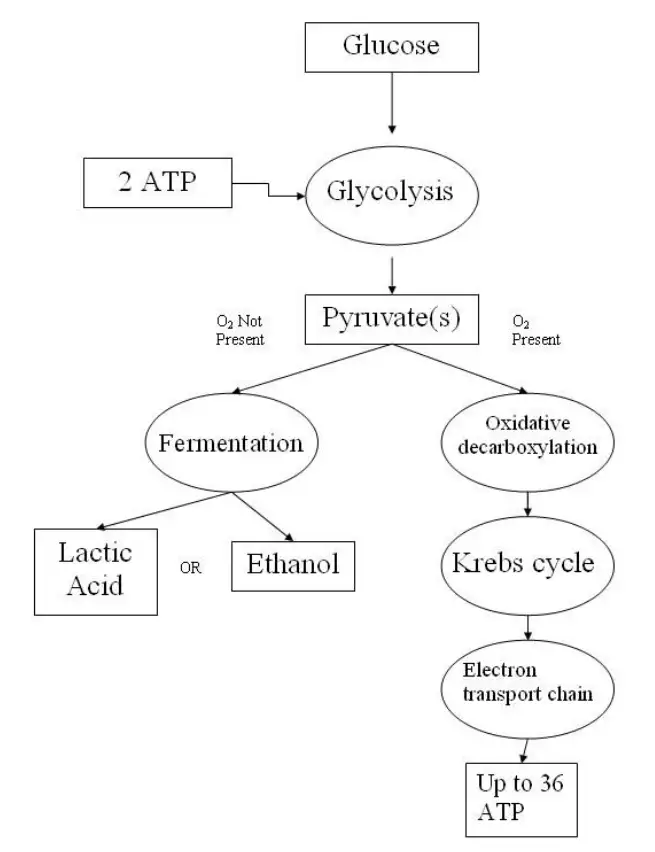
Pyruvate produced here is transported into mitochondria for further oxidation in aerobic organisms.
Example: Describe the net ATP gain from glycolysis when one molecule of glucose is metabolized.
Solution:
Glycolysis produces 4 ATP molecules in total.
However, 2 ATP molecules are consumed during the initial steps.
Therefore, net gain = \(4 - 2 = 2\) ATP molecules per glucose.
Electron Transport and ATP Synthesis: Oxidative Phosphorylation
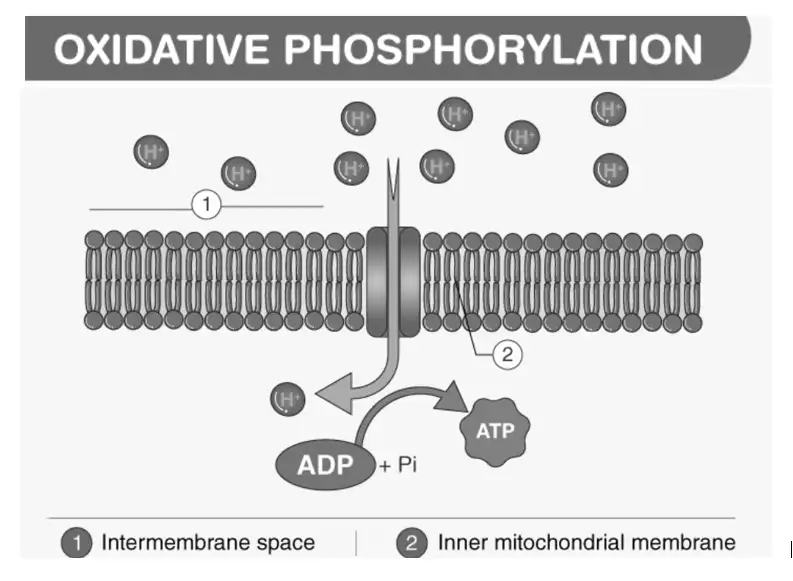
Oxidative phosphorylation is the stage where most ATP is generated. It occurs in the inner mitochondrial membrane, where electrons from NADH and FADH₂ are transferred through a chain of carriers to oxygen, the final electron acceptor. This electron flow drives the synthesis of ATP from ADP and inorganic phosphate.
Phases of Respiration - Oxidative Phosphorylation
Example: Explain why oxygen is essential in oxidative phosphorylation.
Solution:
Oxygen acts as the final electron acceptor in the electron transport chain.
It combines with electrons and protons to form water, preventing electron backup.
This maintains the flow of electrons, enabling continuous ATP production.
Energy Release Cycle: Citric Acid Cycle
Also known as the Krebs cycle or tricarboxylic acid (TCA) cycle, this phase takes place in the mitochondrial matrix. Acetyl-CoA derived from pyruvate enters this cycle, where it undergoes a series of reactions producing ATP, NADH, and FADH₂. These electron carriers then feed into oxidative phosphorylation.
Each turn of the cycle yields two ATP molecules and releases carbon dioxide as a waste product.
Example: How many ATP molecules are produced directly in one complete turn of the citric acid cycle?
Solution:
Each cycle produces 2 ATP molecules directly.
Additional energy is captured in NADH and FADH₂ for later ATP synthesis.
Respiration in Plants and Autotrophs
Cellular Respiration in Green Plants
In autotrophic organisms like green plants, respiration occurs primarily in mitochondria, similar to animals. Even though plants produce glucose via photosynthesis, they still require respiration to convert this glucose into usable energy for cellular activities.
Respiration in plants is aerobic and follows the same chemical principles as in animals, involving glycolysis, the citric acid cycle, and oxidative phosphorylation.
Example: Where does cellular respiration take place in plant cells and why?
Solution:
Respiration occurs in mitochondria within plant cells.
Mitochondria provide the necessary enzymes and environment for efficient ATP production.
Energy produced supports growth, repair, and other metabolic functions.
Quick Reference: Summary of Cellular Respiration
Aspect | Description | Location | Energy Yield (ATP) |
|---|---|---|---|
Glycolysis | Breakdown of glucose to pyruvate | Cytoplasm | 2 ATP (net) |
Citric Acid Cycle | Oxidation of acetyl-CoA producing electron carriers | Mitochondrial matrix | 2 ATP (direct) |
Oxidative Phosphorylation | Electron transport chain and ATP synthesis | Inner mitochondrial membrane | ~34 ATP |
Aerobic Respiration | Complete oxidation of glucose with oxygen | Cells with mitochondria | ~38 ATP per glucose |
Anaerobic Respiration | Partial breakdown of glucose without oxygen | Cytoplasm | 2 ATP per glucose |
Glossary of Key Terms
Term | Definition |
|---|---|
ATP (Adenosine Triphosphate) | Primary energy carrier molecule in cells. |
Glycolysis | Initial stage of respiration breaking glucose into pyruvate. |
Citric Acid Cycle | Series of reactions producing energy carriers in mitochondria. |
Oxidative Phosphorylation | Process of ATP generation via electron transport chain. |
Aerobic Respiration | Respiration requiring oxygen for complete glucose oxidation. |
Anaerobic Respiration | Energy production without oxygen, yielding less ATP. |
Pyruvate | End product of glycolysis, precursor for further oxidation. |
Electron Transport Chain | Series of protein complexes transferring electrons to oxygen. |
Acetyl-CoA | Molecule entering the citric acid cycle derived from pyruvate. |
Fermentation | Anaerobic process producing energy and byproducts like alcohol. |
Frequently Asked Questions
What is the role of ATP in cellular respiration?
ATP acts as the main energy currency, storing and supplying energy for cellular activities.
Can respiration occur without oxygen?
Yes, anaerobic respiration occurs without oxygen but produces less energy and different byproducts.
Where does the citric acid cycle take place?
It occurs in the mitochondrial matrix of eukaryotic cells.
Why is oxygen essential in aerobic respiration?
Oxygen serves as the final electron acceptor, allowing continuous electron flow and ATP production.
What distinguishes aerobic from anaerobic respiration?
Aerobic respiration requires oxygen and yields more ATP, while anaerobic respiration does not use oxygen and produces less energy.