Comprehensive Overview of Polysaccharides: Types, Traits, and Roles
Understanding Polysaccharides: Structure and Significance
Defining Polysaccharides and Their Biological Importance
Polysaccharides are large biomolecules formed by the linkage of numerous monosaccharide units. These macromolecules play a vital role in living organisms by serving as energy reservoirs and providing structural integrity. Depending on the monosaccharide composition, polysaccharides are classified as either homopolysaccharides, containing identical sugar units, or heteropolysaccharides, composed of diverse monosaccharides.
Structurally, polysaccharides may exist as unbranched linear chains or as branched molecules, influencing their physical properties and biological functions.
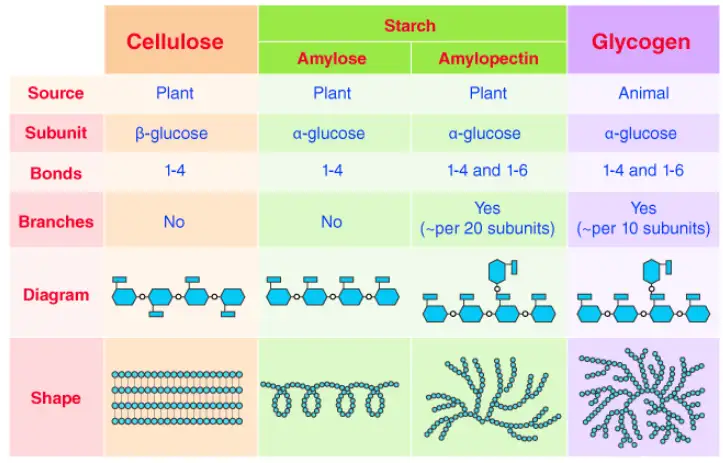
Illustration of polysaccharide molecular chains
Key Features of Polysaccharides
Distinctive Properties and Physical Characteristics
Polysaccharides exhibit several unique traits that differentiate them from simpler carbohydrates. They generally lack sweetness and are often insoluble in water due to their hydrophobic nature. Unlike simple sugars, polysaccharides do not crystallize upon drying and can be isolated as white powders.
These macromolecules possess high molecular weights and exist in compact forms within cells, rendering them osmotically inactive. Their elemental composition maintains a hydrogen to oxygen ratio of 2:1, consistent with carbohydrate chemistry.
Example: A sample of a polysaccharide is tested for solubility and taste. It is found to be insoluble in water and tasteless. Based on these observations, explain why these properties are typical for polysaccharides.
Solution:
Polysaccharides have large, complex structures that prevent easy dissolution in water, making them mostly insoluble.
The absence of free aldehyde or ketone groups results in a lack of sweetness.
The hydrophobic interactions and extensive hydrogen bonding contribute to their insolubility and tasteless nature.
Classification of Polysaccharides Based on Monosaccharide Composition
Homopolysaccharides: Uniform Sugar Chains
Homopolysaccharides consist of repeating units of the same monosaccharide. They serve various biological functions, from energy storage to structural support. Examples include:
Glycogen: A highly branched glucose polymer found predominantly in animals and fungi, acting as a primary energy reserve.
Cellulose: Composed of β-glycosidic linked glucose units, it forms the rigid cell walls in plants, providing mechanical strength.
Starch: A mixture of amylose (linear) and amylopectin (branched) chains, starch is the main carbohydrate storage in plants.
Inulin: Made up of fructofuranose units, it is found in tubers like dahlia and artichoke and serves as a storage carbohydrate.
Heteropolysaccharides: Diverse Sugar Compositions
Complex Polysaccharides with Multiple Monosaccharide Types
Heteropolysaccharides are composed of different monosaccharide units, often contributing to specialized biological roles such as cellular communication and structural support. Notable examples include:
Hyaluronic Acid: Contains D-glucuronic acid and N-acetyl-glucosamine; found in connective tissues and skin, it provides lubrication and structural integrity.
Heparin: Composed of D-glucuronic acid, L-iduronic acid, and N-sulfo-D-glucosamine; it functions as an anticoagulant and is present in mast cells and blood.
Chondroitin-4-sulfate: Made of D-glucuronic acid and N-acetyl-D-galactosamine-4-O-sulfate; it is a key component of cartilage.
Gamma Globulin: Contains N-acetyl-hexosamine, D-mannose, and D-galactose; it is involved in immune responses and is found in blood plasma.
Biological Roles and Functional Importance of Polysaccharides
How Polysaccharides Support Life Processes
Polysaccharides fulfill critical functions in both plants and animals. They act as energy stores, structural elements, and mediators of cellular communication. Their hydrophobic nature, due to extensive hydrogen bonding, prevents water penetration, maintaining molecular stability.
Additionally, polysaccharides influence nutrient and water transport by modulating concentration gradients. Many polysaccharides form covalent bonds with lipids and proteins, creating glycolipids and glycoproteins that facilitate intercellular signaling.
Structurally, cellulose in plant cell walls and chitin in fungi and insects provide mechanical support and protection.
Polysaccharides contributing to cellular structure and function
Example: Explain why cellulose provides rigidity to plant cell walls but starch does not.
Solution:
Cellulose consists of β-glycosidic linkages forming straight, rigid chains that pack tightly, creating strong fibers.
Starch has α-glycosidic linkages and branched structures, making it more flexible and suitable for energy storage rather than structural support.
The hydrogen bonding between cellulose chains enhances its tensile strength, essential for plant rigidity.
Quick Reference: Summary of Polysaccharide Characteristics and Types
Aspect | Description | Examples |
|---|---|---|
Basic Structure | Long chains of monosaccharides linked by glycosidic bonds | Glucose polymers, fructose polymers |
Homopolysaccharides | Composed of identical monosaccharides | Glycogen, Cellulose, Starch, Inulin |
Heteropolysaccharides | Contain different types of monosaccharides | Hyaluronic Acid, Heparin, Chondroitin-4-sulfate, Gamma Globulin |
Solubility | Generally insoluble in water | Most polysaccharides |
Biological Role | Energy storage, structural support, cell signaling | Starch, Cellulose, Glycoproteins |
Taste | Non-sweet | All polysaccharides |
Glossary of Key Terms Related to Polysaccharides
Term | Definition |
|---|---|
Polysaccharide | A carbohydrate polymer made of many monosaccharide units linked by glycosidic bonds. |
Monosaccharide | The simplest form of carbohydrate, consisting of a single sugar unit. |
Homopolysaccharide | A polysaccharide composed of identical monosaccharide units. |
Heteropolysaccharide | A polysaccharide made up of different types of monosaccharides. |
Glycosidic Bond | Covalent bond linking monosaccharides in a carbohydrate chain. |
Cellulose | A structural polysaccharide forming plant cell walls, composed of β-glucose units. |
Starch | A storage polysaccharide in plants, consisting of amylose and amylopectin. |
Glycogen | A branched polysaccharide serving as energy storage in animals and fungi. |
Chitin | A structural polysaccharide found in fungi and insect exoskeletons. |
Glycoprotein | A molecule consisting of a protein covalently bonded to a carbohydrate. |
Frequently Asked Questions About Polysaccharides
What distinguishes homopolysaccharides from heteropolysaccharides?
Homopolysaccharides are made up of identical monosaccharide units, whereas heteropolysaccharides contain two or more different types of monosaccharides.
Why are polysaccharides generally insoluble in water?
Their large size, extensive hydrogen bonding, and hydrophobic regions reduce their solubility in water.
How do polysaccharides contribute to energy storage?
Polysaccharides like starch and glycogen store glucose units that can be broken down to release energy when needed.
What role does cellulose play in plants?
Cellulose forms the rigid cell wall in plants, providing structural support and protection.
How do polysaccharides participate in cell signaling?
When covalently linked to proteins or lipids, polysaccharides form glycoproteins and glycolipids that help transmit signals between cells.