Comprehensive Overview of the Plasma Membrane Structure and Function
Fundamentals of the Plasma Membrane
Essential Characteristics and Role of the Cell Boundary
The plasma membrane, often called the cell membrane, is a vital structure enveloping every cell, creating a distinct boundary between the cell's interior and its external environment. In plant and bacterial cells, this membrane is closely associated with a rigid cell wall located externally. The plasma membrane primarily consists of a lipid bilayer that exhibits selective permeability, enabling it to regulate the passage of substances into and out of the cell effectively.
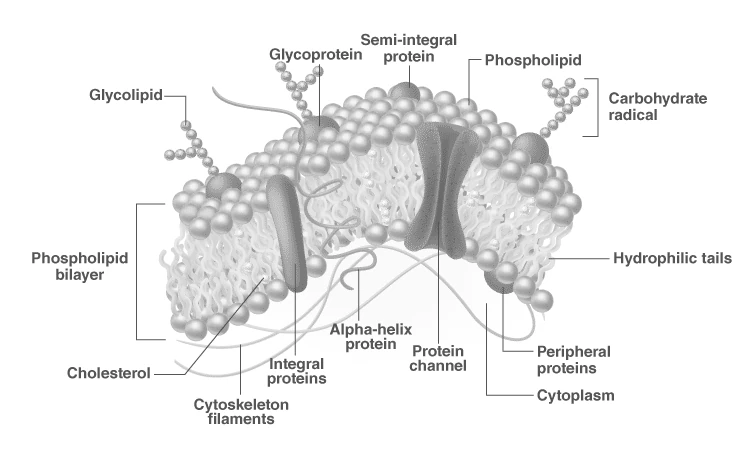
Embedded within this lipid matrix are various proteins, including integral proteins that span the membrane and peripheral proteins attached to its surfaces. These proteins facilitate numerous functions such as transport, enzymatic activity, and maintaining the cell's shape. The membrane's selective permeability ensures that only specific organic molecules and ions traverse the membrane, maintaining cellular homeostasis.
Example Problem: Calculating Membrane Thickness
The thickness of a typical plasma membrane ranges between 5 and 10 nanometers. If a cell has a membrane thickness of 7.5 nm, express this thickness in micrometers.
Solution:
We know that \(1 \text{ micrometer} = 1000 \text{ nanometers}\).
Therefore, thickness in micrometers is:
\[ \frac{7.5 \text{ nm}}{1000} = 0.0075 \text{ micrometers} \]
Hence, the plasma membrane thickness is \(0.0075 \text{ micrometers}\).
Key Components Constituting the Plasma Membrane
Structural Elements and Their Functions
The plasma membrane is a complex assembly of several components that work in harmony to maintain cellular integrity and function. The primary constituents include:
- Phospholipids: These molecules form the fundamental bilayer fabric of the membrane, with hydrophilic heads facing outward and hydrophobic tails inward, creating a semi-permeable barrier.
- Integral Proteins: Embedded within the bilayer, these proteins often span the membrane and facilitate transport and communication.
- Peripheral Proteins: Located on the membrane surfaces, these proteins assist in signaling and structural support without penetrating the hydrophobic core.
- Cholesterol: Interspersed among phospholipids, cholesterol molecules modulate membrane fluidity and stability across temperature variations.
- Carbohydrates: Attached to lipids (forming glycolipids) or proteins (forming glycoproteins) on the extracellular side, carbohydrates play a crucial role in cell recognition and adhesion.
Phospholipids naturally arrange themselves into bilayers due to their amphipathic nature, while proteins embedded within regulate selective permeability and cellular interactions.
Example Problem: Identifying Membrane Components
A membrane sample contains molecules that are hydrophobic and interspersed between phospholipid tails, contributing to membrane rigidity. Which component is this most likely to be?
Solution:
- The hydrophobic molecules located between phospholipid tails are characteristic of cholesterol.
- Cholesterol stabilizes the membrane by modulating fluidity and preventing excessive movement of phospholipids.
- Therefore, the described molecules are cholesterol molecules.
Structural Models Explaining Plasma Membrane Organization
Fluid Mosaic and Micellar Models
The plasma membrane's architecture is best described by the fluid mosaic model, which portrays the membrane as a dynamic and flexible matrix composed of a mosaic of lipids, proteins, and carbohydrates. Proposed in 1972 by Singer and Nicolson, this model highlights the fluidity imparted by phospholipids and cholesterol, allowing proteins to move laterally within the bilayer.
The membrane thickness typically ranges from 5 to 10 nanometers, with the proportion of lipids and proteins varying among different cell types. For example, mitochondrial inner membranes contain approximately 24% lipids and 76% proteins, whereas myelin membranes have a higher lipid content of about 76%.
Phospholipids are amphipathic molecules with hydrophilic phosphate heads and hydrophobic fatty acid tails, which self-assemble into bilayers. Integral proteins span the membrane, often with hydrophobic regions interacting with lipid tails and hydrophilic regions exposed to aqueous environments. Peripheral proteins attach loosely to membrane surfaces, aiding in various cellular functions.
Alternatively, the micellar model, proposed in 1963 by Hilleir and Hoffman, suggests that membranes consist of globular micelle-like subunits with lipid cores and hydrophilic surfaces. These micelles pack densely, with proteins forming monolayers on either side, and water-filled pores existing between micelles to facilitate transport.
Example Problem: Calculating Lipid and Protein Percentages
A certain cell membrane contains 30% lipids and 70% proteins. If the total membrane mass is 200 micrograms, calculate the mass of lipids and proteins separately.
Solution:
Mass of lipids:
\[ 200 \times \frac{30}{100} = 60 \text{ micrograms} \]
Mass of proteins:
\[ 200 \times \frac{70}{100} = 140 \text{ micrograms} \]
Thus, the membrane contains 60 micrograms of lipids and 140 micrograms of proteins.
Summary Table: Plasma Membrane Essentials
| Component | Location | Function | Characteristic |
|---|---|---|---|
| Phospholipids | Bilayer | Forms semi-permeable barrier | Amphipathic (hydrophilic head, hydrophobic tails) |
| Integral Proteins | Embedded in bilayer | Transport, signaling, structural support | Span membrane, hydrophobic and hydrophilic regions |
| Peripheral Proteins | Membrane surfaces | Enzymatic activity, cell signaling | Loosely attached, not embedded |
| Cholesterol | Between phospholipid tails | Regulates fluidity and stability | Hydrophobic, modulates membrane properties |
| Carbohydrates | Extracellular surface | Cell recognition, adhesion | Form glycolipids and glycoproteins |
Glossary of Key Terms
| Term | Definition |
|---|---|
| Plasma Membrane | The selectively permeable membrane enclosing the cell, regulating substance movement. |
| Phospholipid Bilayer | A double layer of phospholipids forming the fundamental structure of membranes. |
| Integral Proteins | Proteins embedded within the lipid bilayer, often spanning the membrane. |
| Peripheral Proteins | Proteins attached to the membrane surface without penetrating the hydrophobic core. |
| Cholesterol | A lipid molecule that modulates membrane fluidity and stability. |
| Glycoproteins | Proteins with carbohydrate chains attached, involved in cell recognition. |
| Glycolipids | Lipids with carbohydrate groups, contributing to cell surface interactions. |
| Fluid Mosaic Model | A model describing the plasma membrane as a fluid combination of lipids and proteins. |
| Micellar Model | A model proposing membranes consist of globular micelle units with lipid cores. |
| Selective Permeability | The property of membranes allowing certain molecules to pass while blocking others. |
Frequently Asked Questions
What are the main components of the plasma membrane?
The plasma membrane primarily consists of a phospholipid bilayer, integral and peripheral proteins, cholesterol, and carbohydrates attached as glycoproteins and glycolipids.
How does the plasma membrane maintain cell shape?
It anchors the cytoskeleton inside the cell and interacts with the extracellular matrix, providing structural support and maintaining the cell's shape.
What is the role of cholesterol in the membrane?
Cholesterol modulates membrane fluidity and stability, preventing excessive movement of phospholipids and maintaining membrane integrity across temperature changes.
Why is the plasma membrane described as selectively permeable?
Because it allows only specific molecules and ions to pass through while blocking others, thus controlling the internal environment of the cell.
What distinguishes integral proteins from peripheral proteins?
Integral proteins are embedded within and often span the membrane, while peripheral proteins are attached loosely to the membrane surfaces without penetrating the hydrophobic core.