Comprehensive Overview of Mollusca Phylum
Fundamental Traits of Molluscs
Distinctive Features and Biological Organization
Molluscs are soft-bodied animals characterized by bilateral symmetry and a triploblastic structure with a true coelom. They possess a mantle, a thin fleshy layer that envelops their internal organs, and a muscular foot used for movement. Most molluscs have a calcareous shell protecting their body, although some species lack this feature.
These animals exhibit an organ system level of complexity, including a well-developed digestive system featuring a radula, a specialized rasping organ for feeding. Their respiratory system varies, utilizing gills, pulmonary sacs, or the general body surface for gas exchange. Circulation is typically open, with blood containing copper-based pigment haemocyanin, giving it a blue or green hue.
Diverse forms of Mollusca showcasing their soft bodies and shells
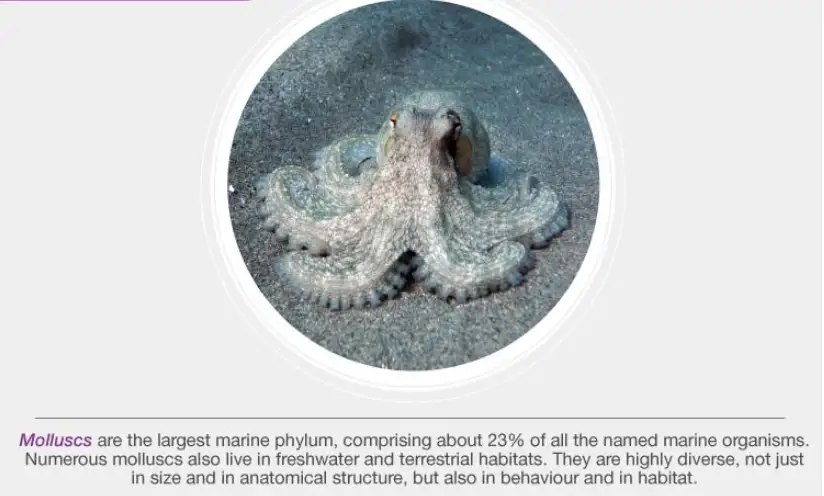
The nervous system consists of paired ganglia and nerves, with sensory organs such as tentacles, eyes, osphradia (chemical sensors), and statocysts (balance organs). Most molluscs have separate sexes, though some are hermaphroditic, and reproduction can involve internal or external fertilization, generally leading to oviparous development with indirect life stages.
Example: A newly discovered mollusc species has a mantle, a radula, and uses gills for respiration. It has separate sexes and an open circulatory system. Identify the phylum and explain two key features that support your identification.
Solution:
The organism belongs to the phylum Mollusca because:
- It has a mantle, a defining characteristic of molluscs.
- The presence of a radula indicates a molluscan feeding adaptation.
- Gills for respiration and an open circulatory system are typical of molluscs.
- Separate sexes align with common reproductive traits in this phylum.
Classification and Diversity within Mollusca
Major Classes and Their Unique Adaptations
The phylum Mollusca is divided into several classes, each exhibiting distinct morphological and ecological traits. These classes include Aplacophora, Monoplacophora, Polyplacophora, Gastropoda, Scaphopoda, Pelecypoda (Bivalvia), and Cephalopoda.
Aplacophorans are worm-like, lacking shells and a distinct head, covered with spicules. Monoplacophorans have a simple, bilaterally symmetrical body with external gills. Polyplacophorans, or chitons, have a flattened body with eight dorsal plates and a strong radula.
Gastropods, such as snails and slugs, possess a spiral shell and a well-developed head with tentacles and eyes. Scaphopods are tubular marine molluscs without eyes or tentacles and have a reduced foot. Bivalves have laterally compressed bodies enclosed in two shells and lack a distinct head, often burrowing in sediment. Cephalopods, including octopuses and squids, are highly advanced with tentacles, a reduced or absent shell, and direct development.
Example: A marine mollusc has a flattened body with eight overlapping plates on its back and a strong radula. Identify its class and describe two adaptations that help it survive in its habitat.
Solution:
The mollusc belongs to the class Polyplacophora.
- The eight dorsal plates provide protection while allowing flexibility.
- The strong radula helps scrape algae and other food from rocks, aiding in feeding.
These adaptations enable it to cling to and feed on hard substrates in marine environments.
Ecological Roles and Human Significance of Molluscs
Environmental Impact and Economic Importance
Molluscs inhabit diverse environments, from deep oceans to moist terrestrial areas. They contribute significantly to ecosystems as bioindicators, especially bivalves, which reflect the health of aquatic habitats. Some species, like snails and slugs, can become agricultural pests.
Humans benefit from molluscs as sources of food, such as squids and clams, and materials like pearls and shells used in jewelry. Certain molluscs produce natural pearls, prized for their beauty. Additionally, some freshwater molluscs possess green glands functioning similarly to vertebrate livers, aiding in detoxification.
Cephalopods like octopuses have unique defense mechanisms, including ink glands and advanced nervous systems, making them fascinating subjects of study.
Example: Explain how bivalve molluscs serve as bioindicators in aquatic ecosystems and mention one human use of these molluscs.
Solution:
- Bivalves filter large volumes of water, accumulating pollutants and toxins, which reflect the water quality.
- Monitoring their health helps assess environmental changes and pollution levels.
- Humans use bivalves as a food source and for harvesting pearls, which have economic value.
Quick Reference: Mollusca Essentials
Aspect | Details |
|---|---|
Body Symmetry | Bilateral |
Body Organization | Triploblastic, coelomate, organ system level |
Body Parts | Head, visceral mass, muscular foot, mantle |
Respiration | Gills, pulmonary sacs, or body surface |
Circulatory System | Open, with haemocyanin pigment |
Excretory Organs | Pair of metanephridia |
Nervous System | Paired ganglia and nerves |
Reproduction | Mostly separate sexes, some hermaphrodites; oviparous with indirect development |
Classes | Aplacophora, Monoplacophora, Polyplacophora, Gastropoda, Scaphopoda, Pelecypoda, Cephalopoda |
Human Uses | Food, pearls, jewelry, bioindicators |
Glossary of Key Terms
Term | Definition |
|---|---|
Coelomate | Animals with a true body cavity lined by mesoderm |
Radula | A rasping tongue-like organ used for feeding |
Metanephridia | Excretory organs that remove nitrogenous waste |
Osphradium | Chemoreceptive organ that tests water quality |
Statocyst | Balance organ that helps maintain equilibrium |
Haemocyanin | Copper-containing pigment that carries oxygen in blood |
Oviparous | Reproduction by laying eggs |
Indirect Development | Life cycle includes larval stages before adulthood |
Myogenic Heart | Heart that generates its own contractions |
Bioindicator | Organism used to monitor environmental health |
Frequently Asked Questions
What defines the phylum Mollusca?
Mollusca are soft-bodied, bilaterally symmetrical animals with a mantle, muscular foot, and often a calcareous shell. They have a radula for feeding and an open circulatory system.
How do molluscs breathe?
Respiration occurs through gills, pulmonary sacs, or directly through the body surface depending on the species and habitat.
What are the main classes of Mollusca?
The major classes include Aplacophora, Monoplacophora, Polyplacophora, Gastropoda, Scaphopoda, Pelecypoda, and Cephalopoda.
Why are bivalves important as bioindicators?
Bivalves filter water and accumulate pollutants, making them useful for assessing the health of aquatic ecosystems.
What is the significance of the radula in molluscs?
The radula is a specialized feeding organ that scrapes or cuts food, essential for the mollusc's nutrition.