Comprehensive Overview of Bacterial Morphology and Classification
Fundamental Characteristics and Structure of Bacteria
Key Attributes of Bacterial Cells
Bacteria are unicellular organisms classified as prokaryotes, meaning they lack a defined nucleus and membrane-bound organelles. They are ubiquitous, thriving in diverse environments including extreme habitats such as hot springs, polar ice, and deep ocean trenches where most life forms cannot survive.
Their cellular DNA is free-floating within the cytoplasm, not enclosed in chromatin structures as seen in eukaryotic cells. Typically, bacterial cells are about one-tenth the size of human cells, with an average diameter near \(1 \, \mu m\) (\(10^{-6} \, \text{m}\)).
The outermost layer is a rigid cell wall composed primarily of peptidoglycan (also called murein), which provides mechanical strength and shape. Bacteria exhibit a variety of shapes and arrangements, which are crucial for their identification and classification. Some bacteria possess external structures such as flagella or pili that aid in movement or attachment.
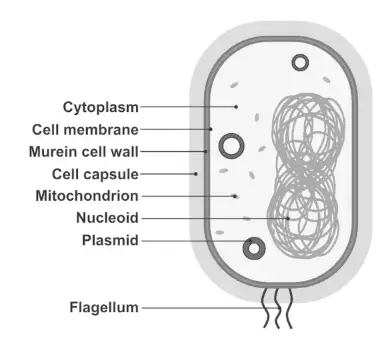
Illustration of a typical bacterial cell
Example Problem
A bacterial cell has a diameter of \(1.2 \, \mu m\). Calculate its approximate volume assuming it is spherical. Use the formula for the volume of a sphere \(V = \frac{4}{3} \pi r^3\).
Solution:
Radius \(r = \frac{1.2}{2} = 0.6 \, \mu m = 0.6 \times 10^{-6} \, \text{m}\)
\[ V = \frac{4}{3} \pi (0.6 \times 10^{-6})^3 = \frac{4}{3} \pi (2.16 \times 10^{-19}) \approx 9.05 \times 10^{-19} \, \text{m}^3 \]
Thus, the bacterial cell volume is approximately \(9.05 \times 10^{-19} \, \text{m}^3\).
Understanding Bacterial Cell Morphology and Its Impact
Significance of Bacterial Shape and Structure
The morphology of bacteria is a defining characteristic that not only helps in species identification but also influences their pathogenic potential and adaptability. The shape affects motility, nutrient absorption, and interaction with the environment.
The bacterial cell wall's composition, mainly peptidoglycan polymers consisting of alternating N-acetylglucosamine (NAG) and N-acetylmuramic acid (NAM) linked with peptide chains, determines the cell's shape and rigidity. Variations in the thickness and arrangement of this layer result in diverse bacterial forms.
Example Problem
Explain how the thickness of the peptidoglycan layer affects the Gram staining result of bacteria.
Answer:
Gram-positive bacteria have a thick peptidoglycan layer that retains the crystal violet stain, appearing purple under a microscope.
Gram-negative bacteria possess a thin peptidoglycan layer and an outer membrane, which does not retain the crystal violet but takes up the counterstain (safranin), appearing pink.
This difference is crucial for bacterial classification and antibiotic treatment strategies.
Dimensions and Size Variability Among Bacteria
Typical Size Range and Comparison
Bacteria generally measure around \(2 \, \mu m\) in length and \(0.5 \, \mu m\) in diameter, though sizes vary widely across species. They are significantly smaller than eukaryotic cells, roughly one-tenth their size, which allows for rapid reproduction and adaptation.
Example Problem
If a bacterium is \(3 \, \mu m\) long and \(0.7 \, \mu m\) wide, estimate its surface area assuming a cylindrical shape with hemispherical ends. Use the formula:
\[ \text{Surface Area} = 2 \pi r h + 4 \pi r^2 \]
where \(r\) is radius and \(h\) is the cylindrical height.
Solution:
Radius \(r = \frac{0.7}{2} = 0.35 \, \mu m\)
Cylindrical height \(h = 3 - 2 \times 0.35 = 2.3 \, \mu m\)
\[ \text{Surface Area} = 2 \pi (0.35)(2.3) + 4 \pi (0.35)^2 = 5.06 + 1.54 = 6.6 \, \mu m^2 \]
The approximate surface area is \(6.6 \, \mu m^2\).
Classification Based on Bacterial Shapes and Arrangements
Varieties of Bacterial Morphologies
Bacteria are categorized primarily by their shapes, which include spherical (cocci), rod-shaped (bacilli), spiral, and comma-shaped (vibrio). These forms are further subdivided based on cell arrangements and structural features.
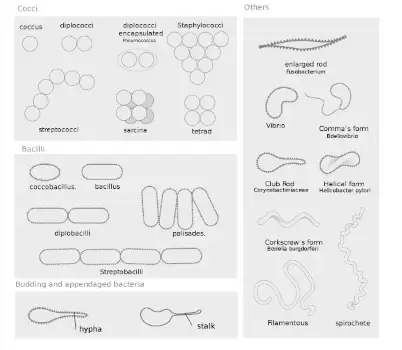
Diverse bacterial shapes and their typical forms
1. Spherical Bacteria (Cocci)
Cocci bacteria are round or oval and may appear singly or in groups of two, four, eight, or more. Their cell walls can be either thick (Gram-positive) or thin (Gram-negative), influencing their staining properties.
The arrangement depends on the plane of cell division:
Monococcus: Single spherical cells.
Diplococcus: Pairs of cells, e.g., Neisseria species.
Streptococcus: Chains formed by division in one plane, e.g., Streptococcus pyogenes.
Tetrads: Groups of four cells dividing in two planes, e.g., Micrococcus.
Staphylococcus: Irregular grape-like clusters due to division in three planes, e.g., Staphylococcus aureus.
Sarcinae: Cubic packets of eight cells, e.g., Sarcina ventriculi.
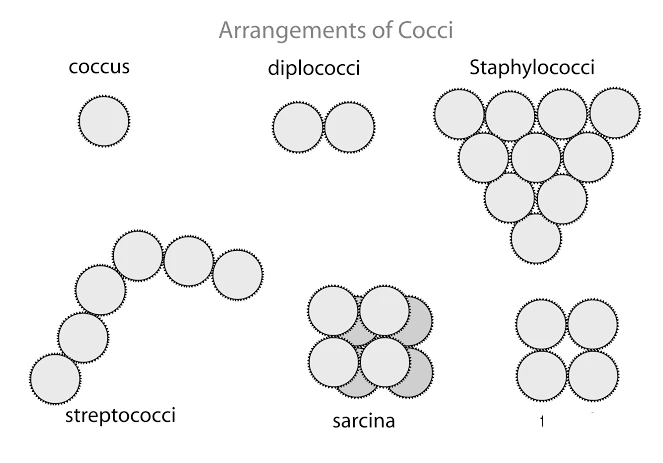
Different arrangements of cocci bacteria
Example Problem
Identify the arrangement type of spherical bacteria that form clusters resembling grape bunches and name a common species.
Answer:
The described arrangement is Staphylococcus, characterized by irregular clusters formed by division in three planes.
A common species is Staphylococcus aureus, known for causing skin infections.
2. Rod-Shaped Bacteria (Bacilli)
Bacilli are elongated, rod-like bacteria that may exist singly or in chains. They can be Gram-positive or Gram-negative and are found in various environments.
Some bacilli form resistant endospores, enabling survival under harsh conditions such as extreme heat or radiation. Examples include Bacillus anthracis (causative agent of anthrax) and Bacillus cereus (food poisoning).
Based on arrangement, bacilli are classified as:
Bacillus: Single rods, e.g., Bacillus cereus.
Diplobacilli: Pairs of rods, e.g., Klebsiella rhinoscleromatis.
Streptobacilli: Chains formed by division in one plane, e.g., Streptobacillus moniliformis.
Coccobacilli: Short rods resembling cocci, e.g., Haemophilus influenzae.
Palisades: Rods arranged side-by-side like a fence, e.g., Corynebacterium diphtheriae.

Different arrangements of bacilli bacteria
Example Problem
Explain why some bacilli bacteria can survive extreme environmental conditions.
Answer:
Certain bacilli form endospores, which are dormant, tough, and resistant structures.
Endospores protect the bacteria from heat, radiation, and disinfectants.
This adaptation allows survival for years until favorable conditions return.
3. Spiral and Helical Bacteria
Spiral-shaped bacteria have a twisted or helical form and are divided into two main types based on their flexibility and flagella:
Spirillum: Rigid, Gram-negative bacteria with external flagella, e.g., Spirillum species.
Spirochete: Thin, flexible bacteria with internal flagella, often pathogenic, e.g., Treponema pallidum causing syphilis.
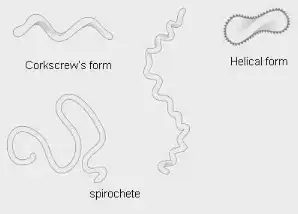
Differentiate between spirillum and spirochete bacteria based on their motility and structure.
Answer:
Spirillum bacteria are rigid with external flagella, enabling movement.
Spirochetes are flexible with internal periplasmic flagella, allowing corkscrew motion.
Spirochetes are often associated with serious diseases.
4. Comma-Shaped Bacteria (Vibrio)
Vibrio bacteria have a curved, comma-like shape and are mostly Gram-negative. They are facultative anaerobes with two independently replicating chromosomes.
These bacteria are known to cause foodborne illnesses such as cholera.
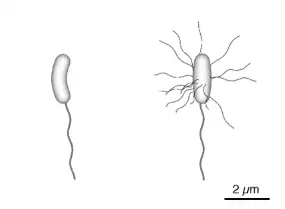
Vibrio bacteria exhibiting curved shape
Example Problem
Name a disease caused by Vibrio bacteria and describe its shape.
Answer:
Vibrio cholerae causes cholera, a severe diarrheal disease.
These bacteria have a curved, comma-like shape.
Additional Bacterial Morphologies
Beyond the main shapes, bacteria exhibit diverse forms including:
Filamentous: Long thread-like structures, e.g., Candidatus savagella.
Star-shaped: Resembling stars, e.g., Stella humosa.
Rectangular: Box-shaped bacteria, e.g., halophilic Haloarcula vallismortis.
Pleomorphic: Capable of shape changes due to environmental stress, e.g., Mycoplasma pneumoniae.
Appendaged: Bacteria with stalks or buds, e.g., Hypomicrobium.
Trichome: Chains of cells covered with a sheath, e.g., Thiothrix nivea.
Lobed: Irregular lobed shapes found in extreme environments, e.g., Sulfolobus acidocaldarius.
Fusiform: Spindle-shaped with tapered ends, e.g., Fusobacterium necrophorum.
Stalked: Cells with a stalk formed by asymmetrical division, e.g., Caulobacter crescentus.
Sheathed: Cells enclosed in a sheath, often aquatic, e.g., Leptothrix.
Quick Reference: Summary of Bacterial Morphology
Shape | Description | Examples | Gram Stain |
|---|---|---|---|
Cocci | Spherical cells; arrangements vary (chains, clusters, pairs) | Staphylococcus aureus, Streptococcus pyogenes | Positive or Negative |
Bacilli | Rod-shaped; single or chains; may form endospores | Bacillus anthracis, Escherichia coli | Positive or Negative |
Spiral | Helical or corkscrew-shaped; rigid or flexible | Spirillum, Treponema pallidum | Negative |
Vibrio | Comma-shaped curved rods | Vibrio cholerae | Negative |
Others | Filamentous, star-shaped, pleomorphic, stalked, etc. | Mycoplasma pneumoniae, Caulobacter crescentus | Varies |
Glossary of Key Terms
Term | Definition |
|---|---|
Prokaryote | Organism lacking a membrane-bound nucleus and organelles. |
Peptidoglycan | Polymer forming bacterial cell walls, composed of sugars and amino acids. |
Gram-positive | Bacteria with thick peptidoglycan walls retaining crystal violet stain. |
Gram-negative | Bacteria with thin peptidoglycan walls and outer membrane, not retaining crystal violet. |
Endospore | Dormant, resistant structure formed by some bacteria for survival. |
Cocci | Spherical-shaped bacteria. |
Bacilli | Rod-shaped bacteria. |
Flagella | Whip-like appendages used for bacterial motility. |
Diplococcus | Pair arrangement of cocci bacteria. |
Streptobacilli | Chain arrangement of rod-shaped bacteria. |
Frequently Asked Questions
What is the typical shape of Bacillus bacteria?
Bacillus bacteria are rod-shaped and can be either Gram-positive or Gram-negative.
Why do some bacteria have a rod shape?
The rod shape provides symmetry and allows bacteria to localize proteins efficiently, aiding in cellular processes.
How do cocci bacteria appear under a microscope?
Cocci are spherical and may appear flattened when packed together, forming various arrangements like chains or clusters.
What diseases are caused by cocci bacteria?
Cocci bacteria are responsible for illnesses such as pneumonia, food poisoning, and skin infections.
How does bacterial morphology affect its pathogenicity?
The shape influences motility, nutrient uptake, and interaction with host tissues, impacting the bacteria's ability to cause disease.