Comprehensive Overview of Mitochondria: Structure and Functions
Understanding the Role and Nature of Mitochondria
Fundamental Characteristics and Biological Importance
Mitochondria, often referred to as the cell's "power plants," are specialized organelles enclosed by two membranes, located within the cytoplasm of eukaryotic cells. Their primary role is to convert nutrients into usable energy in the form of adenosine triphosphate (ATP), which powers various cellular activities.
These organelles are essential for cellular respiration, hosting numerous biochemical reactions that break down food molecules. The name "mitochondrion" originates from Greek, where "mitos" means thread and "chondrion" means granule, reflecting their thread-like appearance under a microscope. The discovery of mitochondria dates back to 1890 by Richard Altmann, a German pathologist.
Example: If a eukaryotic cell requires energy to perform a task, which organelle is primarily responsible for generating this energy and how does it achieve this?
Solution:
The mitochondrion is the organelle responsible for energy production.
It converts glucose and oxygen into ATP through cellular respiration.
ATP then serves as the energy currency for cellular processes.
Detailed Architecture of Mitochondria
Structural Components and Their Functions
Mitochondria are rod-shaped organelles measuring approximately 0.6 to 1.2 micrometres in diameter, present in both plant and animal cells. They consist of an outer membrane, an inner membrane with folds, and an internal fluid called the matrix.
The outer membrane is smooth and contains proteins called porins that allow molecules to pass freely. The inner membrane is intricately folded into structures known as cristae, which increase the surface area to facilitate energy production. This membrane is selectively permeable, allowing only specific molecules like oxygen and ATP to pass.
The matrix inside the mitochondrion contains enzymes, mitochondrial DNA, ribosomes, and other molecules essential for synthesizing ATP and regulating mitochondrial functions.
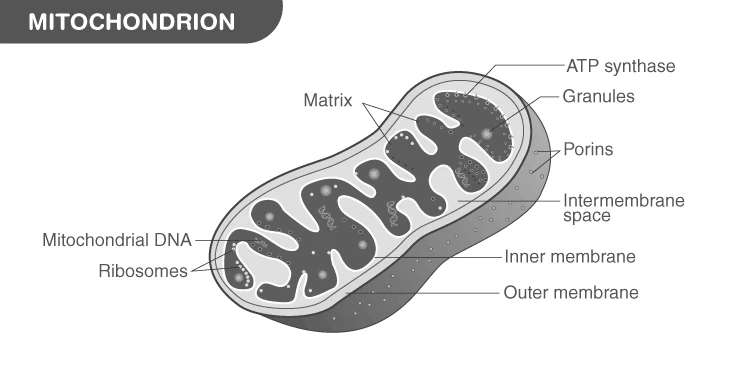
Illustration of Mitochondrion Structure
Example: Calculate the surface area increase if the inner membrane of a mitochondrion folds to create cristae that triple the original inner membrane surface area of 2 µm².
Solution:
The original inner membrane surface area is \( 2 \text{ µm}^2 \).
With cristae, the surface area increases threefold:
\[ 3 \times 2 = 6 \text{ µm}^2 \]
Thus, the folded inner membrane surface area is \( 6 \text{ µm}^2 \), enhancing the capacity for ATP production.
Vital Functions and Health Implications of Mitochondria
Energy Production and Cellular Regulation
The mitochondrion's chief function is to generate energy through oxidative phosphorylation, a process that synthesizes ATP by utilizing oxygen and nutrients. Beyond energy production, mitochondria regulate the cell's metabolism, support cell growth and division, and participate in detoxifying harmful substances like ammonia in liver cells.
They also play a crucial role in apoptosis, the programmed cell death mechanism, and help maintain calcium ion balance within the cell. Additionally, mitochondria contribute to hormone synthesis and influence cellular processes such as differentiation, signaling, and aging.
Example: A liver cell detoxifies ammonia using mitochondria. If the mitochondria in this cell are damaged, what cellular processes might be affected and why?
Solution:
Energy production would decrease, limiting ATP availability.
Detoxification of ammonia would be impaired, leading to toxic buildup.
Cell growth and apoptosis regulation could be disrupted, affecting cell health.
Calcium ion balance might be disturbed, impacting cellular signaling.
Mitochondria's Role in Cellular Activities
Quick Reference: Key Points on Mitochondria
Aspect | Details |
|---|---|
Shape and Size | Rod-shaped, 0.6–1.2 µm diameter |
Membranes | Double membrane: outer smooth, inner folded (cristae) |
Matrix Contents | Enzymes, mitochondrial DNA, ribosomes, ions |
Main Function | ATP production via oxidative phosphorylation |
Additional Roles | Metabolic regulation, apoptosis, detoxification, hormone synthesis |
Selective Permeability | Inner membrane allows oxygen and ATP passage only |
Disorders | Alpers Disease, Barth Syndrome, Kearns-Sayre Syndrome |
Glossary of Essential Terms
Term | Definition |
|---|---|
Adenosine Triphosphate (ATP) | Primary energy carrier molecule in cells. |
Apoptosis | Programmed cell death process. |
Cristae | Folds of the inner mitochondrial membrane increasing surface area. |
Matrix | Viscous fluid inside mitochondria containing enzymes and DNA. |
Oxidative Phosphorylation | Process of ATP production using oxygen in mitochondria. |
Porins | Proteins in the outer membrane allowing molecule passage. |
Selective Permeability | Ability of membrane to allow certain molecules to pass. |
Cellular Respiration | Metabolic process converting nutrients into energy. |
Mitochondrial DNA | Genetic material found within mitochondria. |
Detoxification | Removal of toxic substances from cells. |
Frequently Asked Questions
What defines mitochondria and their main role?
Mitochondria are double-membraned organelles in eukaryotic cells responsible for producing ATP, the cell's energy currency.
Why are mitochondria often called the cell's powerhouse?
Because they generate most of the cell's ATP through cellular respiration, supplying energy for cellular functions.
Can you describe the structure of mitochondria briefly?
Mitochondria are rod-shaped organelles with an outer membrane and a highly folded inner membrane forming cristae, enclosing the matrix.
What are cristae and their significance?
Cristae are folds of the inner membrane that increase surface area, enhancing the mitochondrion's ability to produce ATP.
What is contained within the mitochondrial matrix?
The matrix contains enzymes, mitochondrial DNA, ribosomes, and molecules essential for ATP synthesis and mitochondrial function.