Fundamentals of Genetic Inheritance: Mendel’s Foundational Laws
Understanding the Basics of Genetic Transmission
Inheritance refers to the process by which offspring receive genetic traits from their parents. This transmission of characteristics forms the foundation of heredity and explains how traits persist or vary across generations.
In the mid-19th century, Gregor Johann Mendel pioneered the study of genetics through meticulous experiments on pea plants. His observations revealed consistent patterns in how traits were passed down, leading to the formulation of fundamental principles now known as Mendel’s Laws of Inheritance.
These laws—Law of Dominance, Law of Segregation, and Law of Independent Assortment—were derived from controlled breeding experiments involving contrasting traits in pea plants. Mendel’s initial focus was on crosses involving a single trait, known as monohybrid crosses.
He noticed that certain traits disappeared in the first generation (F1) but reappeared in the second generation (F2), which was crucial in developing his laws.
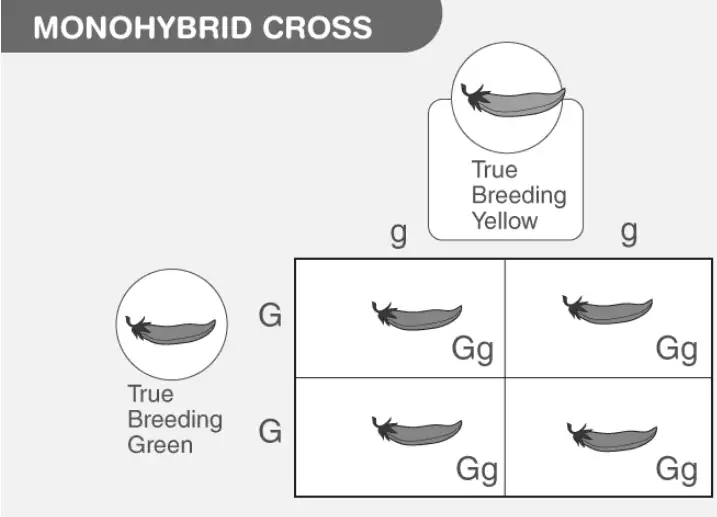
This image shows a monohybrid cross using pea pods to demonstrate inheritance of color. It crosses a true breeding green pod (GG) with a true breeding yellow pod (gg) and shows the genotype of offspring. Step-by-step explanation: 1. Identify parent plants: One is true breeding green (GG) and the other is true breeding yellow (gg). 2. Write down the possible gametes: Green parent produces G, yellow parent produces g. 3. Set up a Punnett square with G and g on the sides. 4. Fill in the squares by combining alleles from each parent. 5. All offspring have the genotype Gg, meaning they carry both green and yellow alleles. 6. Because green (G) is dominant, all offspring will have green pods, showing how dominant and recessive traits work.
Dominance in Hereditary Traits
Principles Behind the Law of Dominance
Mendel’s Law of Dominance explains that when two parents with pure, contrasting traits are crossed, the offspring in the first generation (F1) will express only one of those traits—the dominant one. The other trait, termed recessive, remains hidden in the phenotype but can reappear in later generations.
This law highlights that each trait is governed by paired factors (now known as alleles). When these alleles differ (heterozygous condition), one allele masks the expression of the other.
For example, in a cross between tall and short pea plants, the tall trait dominates, so all F1 plants appear tall. The recessive short trait is not visible in this generation but is still present genetically.
Thus, the Law of Dominance states that recessive traits are suppressed by dominant traits in heterozygous individuals.
Illustrative Example: Cross of Contrasting Pea Plants
Problem: Consider a cross between pure tall pea plants (genotype TT) and pure dwarf pea plants (genotype tt). Predict the phenotype and genotype of the F1 generation.
Solution:
Step 1: Identify parental genotypes:
Parent 1 (Tall): \( TT \)
Parent 2 (Dwarf): \( tt \)
Step 2: Gametes produced:
Parent 1 produces gametes with allele \( T \)
Parent 2 produces gametes with allele \( t \)
Step 3: F1 genotype:
\[ \text{F1} = Tt \]
Step 4: Phenotype of F1:
Since \( T \) is dominant over \( t \), all F1 plants will be tall.
Answer: All offspring in F1 generation will be tall with genotype \( Tt \).
Separation of Alleles During Gamete Formation
Exploring the Law of Segregation
The Law of Segregation states that during the formation of gametes (sex cells), the two alleles for a trait separate so that each gamete carries only one allele. This ensures that offspring inherit one allele from each parent.
This principle is based on the process of meiosis, where paired alleles segregate into different gametes, preventing blending of traits.
In the context of a monohybrid cross, this law explains why both dominant and recessive traits can reappear in the second generation (F2) in a predictable ratio.
Key concepts underlying this law include:
Genes exist in multiple forms called alleles.
Allelic pairs separate during gamete formation, so each gamete carries a single allele.
Organisms inherit two alleles for each trait, one from each parent.
One allele may be dominant while the other is recessive.
Example Problem: Predicting F2 Generation Ratios
Problem: If two heterozygous tall pea plants (genotype \( Tt \)) are crossed, determine the genotypic and phenotypic ratios of the F2 generation.
Solution:
Step 1: Parental genotypes:
Both parents: \( Tt \)
Step 2: Possible gametes:
Each parent produces gametes with alleles \( T \) or \( t \).
Step 3: Punnett square for F2:
\[ \begin{array}{c|cc} & T & t \\ \hline T & TT & Tt \\ t & Tt & tt \\ \end{array} \]
Step 4: Genotypic ratio:
\[ TT : Tt : tt = 1 : 2 : 1 \]
Step 5: Phenotypic ratio:
Since \( T \) is dominant, both \( TT \) and \( Tt \) are tall, and \( tt \) is dwarf.
\[ \text{Tall} : \text{Dwarf} = 3 : 1 \]
Answer: The F2 generation will have a 3:1 ratio of tall to dwarf plants, confirming the Law of Segregation.
Summary of Mendel’s Inheritance Principles
Law | Key Concept | Significance |
|---|---|---|
Law of Dominance | Dominant traits mask recessive traits in heterozygotes | Explains why only one trait appears in F1 generation |
Law of Segregation | Alleles separate during gamete formation | Ensures each gamete carries a single allele |
Law of Independent Assortment | Genes for different traits assort independently | Accounts for genetic variation in offspring |
Glossary of Key Genetic Terms
Term | Definition |
|---|---|
Allele | Different forms of a gene controlling a trait |
Dominant Trait | Trait that masks the presence of another allele |
Recessive Trait | Trait masked by a dominant allele in heterozygotes |
Genotype | The genetic makeup of an organism for a trait |
Phenotype | The observable physical or biochemical characteristics |
Homozygous | Having two identical alleles for a trait |
Heterozygous | Having two different alleles for a trait |
Monohybrid Cross | Cross involving one pair of contrasting traits |
Gamete | Sex cell carrying one allele for each gene |
Meiosis | Cell division producing gametes with half the chromosome number |
Frequently Asked Questions
What does the Law of Dominance explain?
It states that when two contrasting traits are inherited, only the dominant trait is expressed in the first generation, while the recessive trait remains hidden.
Can you summarize the Law of Segregation?
This law explains that allele pairs separate during gamete formation, so each gamete carries only one allele for each gene.
Could you provide an example illustrating the Law of Dominance?
Crossing pure tall and pure dwarf pea plants results in all tall offspring in the first generation, demonstrating dominance of the tall trait.
What are the three fundamental laws proposed by Mendel?
Mendel’s three laws are: Law of Segregation, Law of Dominance, and Law of Independent Assortment.
Are there any limitations to the Law of Segregation?
This law applies only to traits controlled by a single gene pair with clear dominance; it does not hold for traits with incomplete dominance or co-dominance.