Understanding Urine Formation and Fluid Balance Regulation
Fundamentals of Excretion and Waste Removal
Defining the Excretion Process
Excretion is a crucial biological function that eliminates harmful substances and metabolic wastes from living organisms. Both plants and animals generate various waste materials during their metabolic activities. While plants primarily release waste through transpiration, animals expel waste in multiple forms such as urine, sweat, feces, and tears. Among these, urine serves as the principal medium for waste removal in humans and many animals.
Answer:
- Urine contains dissolved nitrogenous wastes like urea and creatinine, which are toxic if accumulated.
- It is produced continuously by the kidneys filtering blood plasma.
- Urine also helps maintain the body's fluid and electrolyte balance.
- Other excretory forms like sweat and tears remove smaller amounts of waste.
Stages Involved in the Production of Urine
Overview of Urine Generation
Urine formation is a vital function performed by the kidneys, which filter blood to remove waste substances. The nephron, the kidney's functional unit, carries out this process. Normal human urine is composed of approximately 95% water and 5% dissolved solids, including nitrogenous wastes and ions. The formation of urine occurs through three sequential phases: filtration, reabsorption, and secretion.
Answer:
- Water: about 95%
- Solid wastes (urea, ammonia, creatinine): about 5%
- Electrolytes such as sodium, potassium, and calcium ions are also present in small amounts.
Detailed Mechanism Behind Urine Formation
Step 1: Filtration at the Glomerulus
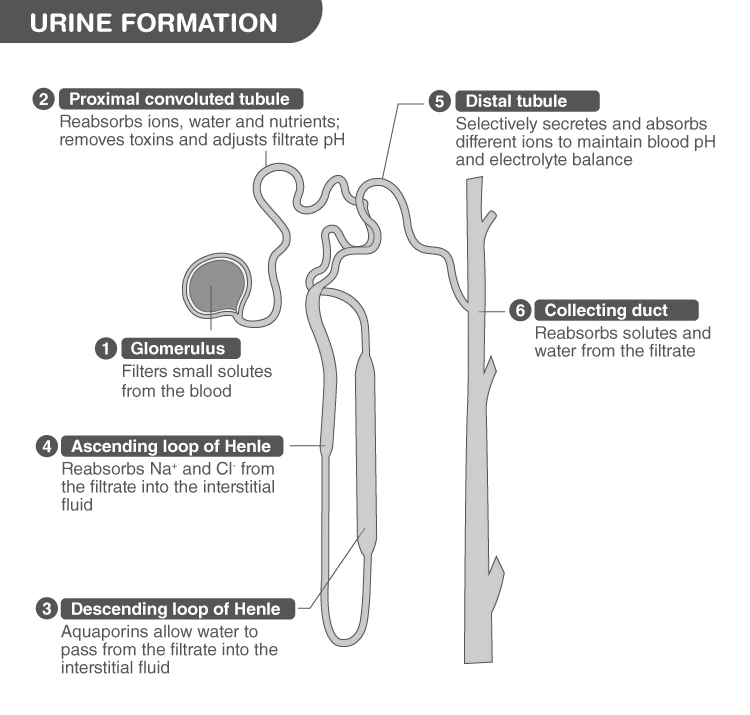
The initial phase of urine production is glomerular filtration, which takes place in the glomerulus. Blood plasma is filtered through three layers: the endothelial lining of glomerular capillaries, a basement membrane, and the epithelial cells of Bowman's capsule. This selective filtration allows water and small solutes to pass into the nephron while retaining larger molecules like proteins in the bloodstream. This process is often called ultrafiltration due to its fine selectivity.
Answer:
- The filtration barrier is selectively permeable, allowing only small molecules to pass.
- Proteins are large molecules that cannot cross the basement membrane and epithelial layers.
- This prevents loss of essential proteins from the blood into urine.
Step 2: Reabsorption of Essential Substances
Following filtration, the majority of the filtrate is reclaimed by the renal tubules through reabsorption. Approximately 99% of the filtered water and solutes are actively and passively transported back into the bloodstream. This process ensures that vital nutrients and water are conserved, preventing excessive loss from the body.
Solution:
Given that 99% of filtrate is reabsorbed,
\[ \text{Reabsorbed volume} = 0.99 \times 180 = 178.2 \text{ liters} \]
Thus, only about 1.8 liters of fluid remain to be excreted as urine.
Step 3: Tubular Secretion and Final Urine Formation
The last phase involves tubular secretion, where specific ions such as hydrogen and potassium are actively secreted into the tubular fluid. This step is essential for maintaining the body's acid-base balance and electrolyte homeostasis. The secreted substances combine with the filtrate to form urine, which then flows into collecting ducts and eventually to the bladder for excretion.
Answer:
- Hydrogen ions are secreted into the filtrate to reduce acidity in the blood.
- This secretion helps regulate the acid-base balance, preventing acidosis.
- Potassium ion secretion also helps maintain electrolyte balance.
Regulation of Body Fluid Balance through Osmoregulation
Maintaining Fluid and Electrolyte Homeostasis
Osmoregulation refers to the body's ability to control the concentration and volume of body fluids, ensuring stable osmotic pressure in the blood. This process is vital for homeostasis and is primarily managed by the kidneys. For instance, during hot weather, although water intake may increase, urine output often decreases and becomes more concentrated due to water loss through sweating. The kidneys respond by reabsorbing more water to maintain fluid balance.
Answer:
- Excessive sweating causes significant water loss from the body.
- To compensate, kidneys reabsorb more water, reducing urine volume.
- This results in urine with higher solute concentration.
Summary Table: Key Points on Urine Formation and Osmoregulation
| Aspect | Details |
|---|---|
| Primary Steps in Urine Formation | Glomerular filtration, tubular reabsorption, tubular secretion |
| Urine Composition | 95% water; 5% wastes including urea, ammonia, creatinine, and ions (Na+, K+, Ca2+) |
| Osmoregulation Function | Maintains blood osmotic pressure and fluid balance for homeostasis |
| Kidney's Role | Filters blood, regulates solute and water levels via urine production |
| Effect of Environment | Adjusts urine concentration and volume based on hydration and temperature |
Glossary of Important Terms
| Term | Definition |
|---|---|
| Excretion | Process of removing metabolic waste and toxins from the body |
| Nephron | Functional unit of the kidney responsible for urine formation |
| Glomerulus | Network of capillaries where blood filtration begins |
| Bowman's Capsule | Structure surrounding the glomerulus that collects filtrate |
| Ultrafiltration | Selective filtration of blood plasma excluding large molecules like proteins |
| Reabsorption | Process of reclaiming water and solutes from filtrate back into blood |
| Tubular Secretion | Active transport of substances from blood into the nephron tubule |
| Osmoregulation | Regulation of water and solute concentrations to maintain osmotic balance |
| Homeostasis | Maintenance of stable internal conditions in the body |
| Creatinine | Waste product from muscle metabolism excreted in urine |
Frequently Asked Questions
What is the biological significance of excretion?
Excretion removes harmful metabolic wastes and toxins, preventing their accumulation and maintaining the body's internal balance.
How does egestion differ from excretion?
Egestion is the elimination of undigested food as feces, while excretion involves removal of metabolic wastes like urea and carbon dioxide.
List the three main processes involved in urine formation.
The processes are: (a) Glomerular filtration, (b) Tubular reabsorption, and (c) Tubular secretion.
Define osmoregulation in simple terms.
Osmoregulation is the control of water and solute levels in the body to keep fluids balanced and stable.
What does ultrafiltration mean in kidney function?
Ultrafiltration is the process where blood plasma is filtered through a membrane, allowing small molecules to pass while blocking larger ones like proteins.