Comprehensive Overview of Angiosperm Life Cycle and Reproduction
Understanding Angiosperms: Characteristics and Classification
Defining Flowering Plants and Their Distinctive Features
Angiosperms, commonly known as flowering plants, represent the most widespread group of vascular plants globally. These plants are characterized by their ability to produce seeds enclosed within a fruit, a feature that distinguishes them from gymnosperms, whose seeds remain exposed. Angiosperms possess well-developed root and shoot systems, enabling them to thrive in diverse environments.
Examples of angiosperms include familiar plants such as roses, lilies, tomatoes, rice, wheat, and mangoes. Their reproductive structures, the flowers, can be either bisexual or unisexual, facilitating sexual reproduction through seed formation.
Taxonomic Placement and Evolutionary Insights
Angiosperms belong to the kingdom Plantae and are classified under the division Spermatophyta, which encompasses all seed-bearing plants. Within this division, angiosperms form the infradivision Angiospermae, previously known as Magnoliophyta. This group is further divided into two major classes:
Monocotyledons (Liliopsida): Plants like bananas with a single cotyledon.
Dicotyledons (Magnoliopsida): Plants such as sunflowers with two cotyledons, including some primitive species bearing orthotropous ovules.
The origin of angiosperms remains a subject of scientific intrigue, with Darwin famously referring to it as an "abominable mystery." Fossil evidence suggests their emergence during the Cretaceous period.
Example
Question: Identify whether the following plants are angiosperms or gymnosperms: pine tree, sunflower, mango tree, and cycad.
Answer:
Pine tree: Gymnosperm (seeds not enclosed in fruit)
Sunflower: Angiosperm (flowering plant with seeds in fruit)
Mango tree: Angiosperm
Cycad: Gymnosperm
Reproductive Cycle and Development in Angiosperms
Life Cycle Overview and Alternation of Generations
The life cycle of angiosperms exhibits a clear alternation between the diploid sporophyte and the haploid gametophyte stages. The dominant phase is the sporophyte, which produces two types of spores: larger megaspores and smaller microspores, a condition known as heterospory.
Microspores develop into pollen grains, which serve as the male gametophytes, while megaspores give rise to the female gametophytes or embryo sacs. The production of gametes occurs through meiosis, ensuring genetic diversity.
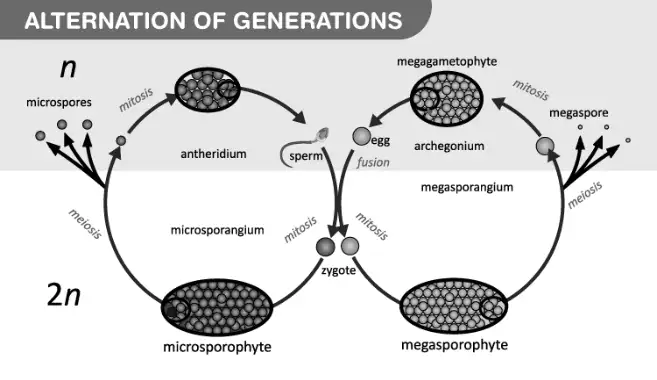
Diagram illustrating alternation of generations in angiosperms
Formation and Structure of Male and Female Gametophytes
Within the anthers, microsporangia undergo meiosis to produce haploid microspores. These microspores then divide mitotically to form pollen grains, each containing two cells: a generative cell that produces sperm and a pollen tube cell that facilitates sperm delivery.
Conversely, the ovule houses the megasporangium, protected by integuments and the ovary wall. A megasporocyte inside undergoes meiosis to yield four megaspores, but only the largest survives to develop into the embryo sac through successive mitotic divisions, resulting in an eight-nucleate structure comprising:
Two synergid cells aiding fertilisation
One egg cell
Two polar nuclei at the center
Three antipodal cells at the opposite end
Example
Question: Describe the cellular composition of a mature angiosperm embryo sac and the role of each cell type.
Answer:
Egg cell: Fuses with sperm to form the zygote.
Synergids: Guide the pollen tube to the egg cell.
Polar nuclei: Fuse with a sperm to form the triploid endosperm.
Antipodal cells: Their function is less clear but may support the embryo sac.
Double Fertilisation and Its Agricultural Importance
Mechanism and Outcomes of Double Fertilisation
Double fertilisation is a unique process in angiosperms where two sperm cells delivered by the pollen tube fertilise different cells within the embryo sac. One sperm merges with the egg cell to form a diploid zygote, while the other fuses with the two polar nuclei to create a triploid cell that develops into the endosperm, a nutritive tissue supporting the embryo.
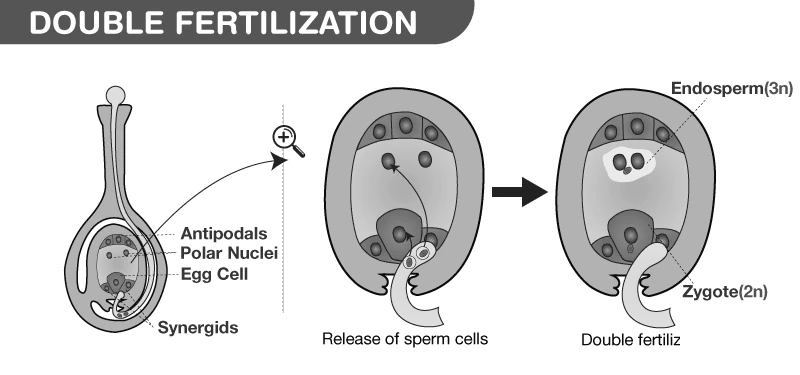
Illustration of double fertilisation in angiosperms
The fertilised ovule matures into a seed containing the embryo and endosperm, while the ovary develops into a fruit, aiding seed dispersal.
Economic and Ecological Significance
Angiosperms form the backbone of global agriculture, providing essential food crops and raw materials. The double fertilisation process enhances seed viability by producing endosperm, which nourishes the developing embryo, thereby improving germination success and crop yields.
Example
Question: Explain why double fertilisation is advantageous for angiosperm seed development and agricultural productivity.
Answer:
It ensures formation of both the embryo and nutritive endosperm.
Endosperm provides food reserves, supporting embryo growth.
Improves seed viability and germination rates.
Leads to better crop yields and food security.
Quick Reference: Key Points on Angiosperm Biology
Aspect | Details |
|---|---|
Definition | Flowering plants producing seeds enclosed in fruits |
Classification | Kingdom Plantae, Division Spermatophyta, Infradivision Angiosperms |
Classes | Monocots (Liliopsida) and Dicots (Magnoliopsida) |
Reproductive Structure | Flower (unisexual or bisexual) |
Life Cycle | Alternation of generations: dominant sporophyte and reduced gametophyte |
Gametophytes | Microspores → pollen grains (male), Megaspores → embryo sac (female) |
Fertilisation | Double fertilisation producing zygote and endosperm |
Seed Components | Embryo, cotyledons, radicle, and endosperm |
Fruit Formation | Develops from ovary post-fertilisation |
Economic Importance | Major source of food, fiber, and raw materials worldwide |
Glossary of Essential Terms
Term | Meaning |
|---|---|
Angiosperm | Plants that produce flowers and seeds enclosed within fruits |
Gymnosperm | Seed plants with exposed seeds, not enclosed in fruits |
Sporophyte | The diploid phase producing spores in the plant life cycle |
Gametophyte | The haploid phase producing gametes |
Microspore | Small spore that develops into male gametophyte (pollen grain) |
Megaspore | Large spore that develops into female gametophyte (embryo sac) |
Double Fertilisation | Process where one sperm fertilises egg and another fertilises polar nuclei |
Endosperm | Triploid tissue providing nourishment to the developing embryo |
Ovule | Structure containing the female gametophyte and developing seed |
Pollination | Transfer of pollen from anther to stigma |
Frequently Asked Questions
What role do microsporophylls play in angiosperms?
Microsporophylls are specialized leaf-like structures that bear microsporangia, where microspores develop into pollen grains, the male gametophytes.
How do angiosperms differ from gymnosperms?
Angiosperms produce seeds enclosed within fruits and have flowers, while gymnosperms bear naked seeds without fruit and usually lack flowers.
What are the main classes of angiosperms and their differences?
Angiosperms are divided into monocots, with one cotyledon and parallel leaf venation, and dicots, with two cotyledons and net-like leaf venation.
What is the significance of double fertilisation in angiosperms?
Double fertilisation ensures formation of both the embryo and nutritive endosperm, enhancing seed development and viability.
Is Capsella classified as an angiosperm?
Yes, Capsella is a genus of flowering plants and is classified as an angiosperm.