Comprehensive Overview of Kingdom Monera
Fundamental Traits of Monerans
Core Features and Cellular Structure
Kingdom Monera comprises the earliest known microorganisms characterized by their prokaryotic cell structure, meaning they lack a membrane-bound nucleus. These organisms are predominantly unicellular and thrive in moist environments ranging from hot springs and deep oceans to snow and even as parasites within other living beings.
Monerans possess 70S ribosomes and their genetic material exists as naked DNA, not enclosed within a nuclear membrane. They lack membrane-bound organelles such as mitochondria, lysosomes, plastids, Golgi bodies, endoplasmic reticulum, and centrosomes. Their rigid cell wall is primarily composed of peptidoglycan, and locomotion is often facilitated by flagella.
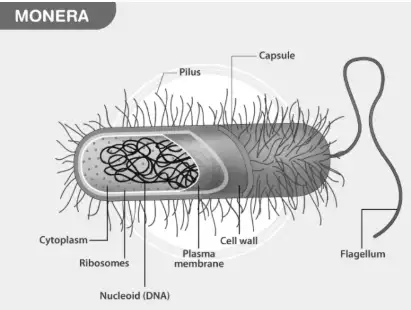
Microscopic representation of Kingdom Monera
Monerans reproduce mainly through asexual methods such as binary fission or budding. They play a vital role in ecosystems as decomposers and exhibit diverse nutritional modes including autotrophic, parasitic, heterotrophic, and saprophytic lifestyles.
Example Problem
Question: A unicellular organism has a rigid cell wall made of peptidoglycan, lacks a nucleus, and moves using a flagellum. It reproduces by binary fission. Identify the kingdom it belongs to and explain two key features supporting your answer.
Solution:
The organism is a member of Kingdom Monera because it is unicellular and prokaryotic (no nucleus).
The presence of a peptidoglycan cell wall is characteristic of monerans, especially bacteria.
Reproduction by binary fission is typical of prokaryotic unicellular organisms.
Locomotion by flagella is common in many monerans.
Diversity in Bacterial Forms and Nutrition
Shapes and Nutritional Strategies of Bacteria
Bacteria, a major group within Monera, exhibit a variety of shapes including spherical (cocci), rod-shaped (bacilli), comma-shaped (vibrios), spiral (spirilla), filamentous, stalked, and budded forms. These shapes influence their mobility and interaction with the environment.
Nutrition in bacteria is versatile. Autotrophic bacteria synthesize their own food using inorganic substances such as carbon dioxide, hydrogen, hydrogen sulfide, and ammonia. Heterotrophic bacteria depend on organic matter and can be saprotrophs (decomposers), parasites, or symbionts.
Example Problem
Question: A rod-shaped bacterium uses inorganic compounds like \( \text{H}_2\text{S} \) and \( \text{CO}_2 \) to produce its food. Classify its nutritional mode and describe its shape.
Solution:
The bacterium is autotrophic because it synthesizes food from inorganic substances.
Its shape is bacillus, which means rod-shaped.
Such bacteria are often found in environments rich in inorganic compounds.
Structural Adaptations: Pili and Flagella
Bacteria are often surrounded by pili, short hair-like appendages that assist in attachment and sexual reproduction, and flagella, longer whip-like structures that enable movement. Some bacteria also have a protective capsule outside the cell wall, while others like Mycoplasma lack a cell wall entirely.
Example Problem
Question: Explain the role of pili and flagella in bacterial cells and how they contribute to bacterial survival.
Solution:
Pili: Help bacteria attach to surfaces and other cells, facilitating conjugation (sexual reproduction) and pathogenicity.
Flagella: Provide motility, allowing bacteria to move toward favorable environments or away from harmful stimuli.
Both structures enhance bacterial adaptability and survival in diverse habitats.
Classification and Ecological Roles of Monerans
Subgroups within Kingdom Monera
Kingdom Monera is divided into three primary sub-kingdoms: Archaebacteria, Eubacteria, and Cyanobacteria, each with distinct characteristics and habitats.
Archaebacteria are ancient bacteria that inhabit extreme environments such as highly saline areas (halophiles), hot acidic springs (thermoacidophiles), and marshy regions producing methane (methanogens). Their unique cell wall structure enables survival under harsh conditions, and they are autotrophic.
Eubacteria, or true bacteria, have rigid peptidoglycan cell walls and often move using flagella. Some possess pili for sexual reproduction and host attachment. They are classified as gram-positive or gram-negative based on cell wall properties and staining behavior. Examples include Rhizobium and Clostridium.
Cyanobacteria, also called blue-green algae, are photosynthetic bacteria containing chlorophyll, carotenoids, and phycobilins. They inhabit aquatic environments and some species fix atmospheric nitrogen, contributing to soil fertility. Examples include Nostoc, Anabaena, and Spirulina.
Example Problem
Question: Identify the sub-kingdom of a bacterium that thrives in hot springs, has a unique cell wall structure, and obtains energy autotrophically.
Solution:
The bacterium belongs to Archaebacteria due to its habitat in extreme conditions like hot springs.
Its unique cell wall structure differentiates it from other bacteria.
Its autotrophic nutrition confirms its classification within Archaebacteria.
Environmental Importance and Applications
Monerans play crucial roles in ecosystems by decomposing organic matter and participating in the nitrogen cycle, enriching soil fertility. They are also instrumental in producing food products and antibiotics. Methanogens aid in sewage treatment, and many organisms depend on archaebacteria as a food source.
Example Problem
Question: Describe two ecological benefits of monerans and provide an example of their application in industry or environment.
Solution:
Monerans decompose dead organic material, recycling nutrients back into the ecosystem.
They fix atmospheric nitrogen, enhancing soil fertility for plant growth.
Methanogens are used in sewage treatment to break down waste and produce biogas.
Quick Reference: Key Points on Kingdom Monera
Aspect | Details |
|---|---|
Cell Type | Prokaryotic (no true nucleus) |
Cellularity | Unicellular |
Cell Wall Composition | Peptidoglycan (except some like Mycoplasma) |
Organelles | No membrane-bound organelles; 70S ribosomes present |
Reproduction | Asexual (binary fission, budding); sexual by conjugation |
Nutrition | Autotrophic, heterotrophic, parasitic, saprophytic |
Major Groups | Archaebacteria, Eubacteria, Cyanobacteria |
Locomotion | Flagella and pili |
Ecological Role | Decomposers, nitrogen fixation, sewage treatment |
Examples | Rhizobium, Clostridium, Nostoc, Anabaena |
Glossary of Important Terms
Term | Definition |
|---|---|
Prokaryote | Organism lacking a membrane-bound nucleus |
Binary Fission | Asexual reproduction by cell division into two identical cells |
Peptidoglycan | Polymer forming the bacterial cell wall |
Pili | Short hair-like structures aiding in attachment and conjugation |
Flagella | Long whip-like appendages used for movement |
Autotrophic | Organisms that produce their own food from inorganic substances |
Heterotrophic | Organisms that obtain food from organic sources |
Archaebacteria | Ancient bacteria living in extreme environments |
Cyanobacteria | Photosynthetic bacteria also known as blue-green algae |
Conjugation | Sexual reproduction process involving exchange of genetic material |
Frequently Asked Questions
What defines organisms in Kingdom Monera?
Monerans are unicellular prokaryotes without a true nucleus, mostly found in moist environments, and lacking membrane-bound organelles.
How do monerans obtain their nutrition?
They exhibit diverse nutritional modes including autotrophy, heterotrophy, parasitism, and saprophytism, depending on the species.
Where are monerans commonly found?
They inhabit moist environments such as hot springs, oceans, snow, and can also live as parasites inside other organisms.
How is Kingdom Monera classified?
It is divided into three sub-kingdoms: Archaebacteria, Eubacteria, and Cyanobacteria, each with unique features and habitats.
What are the modes of reproduction in monerans?
Monerans primarily reproduce asexually by binary fission or budding, and some undergo sexual reproduction through conjugation.