Comprehensive Insights into Fungi: Structure, Classification, and Applications
Fundamentals of Fungi and Their Biological Identity
Defining Fungi and Their Ecological Presence
Fungi represent a diverse group of eukaryotic organisms encompassing yeasts, molds, and mushrooms, all categorized under the kingdom Fungi. These organisms possess cell walls and are found ubiquitously across various environments. Unlike plants, fungi are heterotrophic, relying on external organic sources for nutrition.
Common examples include the black mold that appears on bread left in humid conditions, edible mushrooms, and yeast cells utilized in baking and brewing industries. Many fungi are also responsible for skin infections and other diseases. Their preference for warm, moist habitats is a key factor in their growth and proliferation.
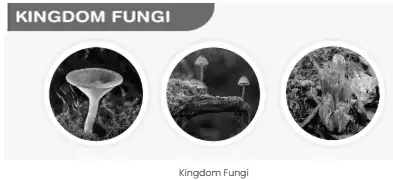
Visual representation of Kingdom Fungi
Example: Identify which of the following organisms belong to the kingdom Fungi: (a) Mushroom, (b) Algae, (c) Yeast, (d) Moss.
Solution: Mushroom and yeast are fungi as they have chitinous cell walls and are heterotrophic. Algae and moss belong to different kingdoms; algae are photosynthetic protists, and mosses are plants.
Structural Features and Cellular Composition of Fungi
Understanding the Morphology and Cellular Organization
Most fungi exhibit a filamentous architecture composed of thread-like structures called hyphae, which collectively form a network known as mycelium. Exceptions include unicellular fungi like yeast. The fungal cell wall is primarily composed of chitin and polysaccharides, providing rigidity and protection.
Within the cell wall lies the protoplast, which contains the cell membrane, cytoplasm, organelles, and a well-defined nucleus. The nucleus is characterized by dense chromatin threads enclosed within a nuclear membrane, indicative of their eukaryotic nature.
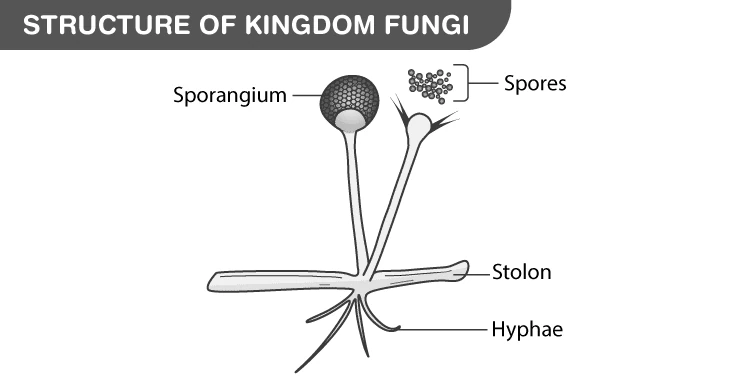
Microscopic view of fungal hyphae forming mycelium
Example: Describe the structural difference between yeast and filamentous fungi.
Solution:
Yeast are unicellular fungi that reproduce mainly by budding.
Filamentous fungi consist of multicellular hyphae forming a mycelium network.
Yeast lack the extensive mycelial network seen in filamentous fungi.
Distinctive Traits and Biological Characteristics of Fungi
Key Features Defining Fungal Organisms
Fungi are eukaryotic, non-motile, and non-vascular organisms that obtain nutrients heterotrophically. They may exist as single cells or as filamentous forms. Reproduction occurs via spores, and many fungi exhibit alternation of generations during their life cycle.
Unlike plants, fungi lack chlorophyll and cannot photosynthesize; instead, they store energy as starch. Chitin biosynthesis is a hallmark of their cell walls. Fungi do not have an embryonic stage and develop directly from spores. Both sexual and asexual reproduction modes are observed, with some fungi producing pheromones to facilitate sexual reproduction. Parasitic fungi can infect hosts, causing diseases.
Example: List three characteristics that differentiate fungi from plants.
Solution:
Fungi lack chlorophyll and cannot perform photosynthesis.
Fungal cell walls contain chitin, whereas plant cell walls contain cellulose.
Fungi are heterotrophic; plants are autotrophic.
Systematic Grouping and Classification of Fungi
Organizing Fungi Based on Nutrition and Reproductive Structures
Fungi are classified by their nutritional modes into saprophytic, parasitic, and symbiotic groups. Saprophytic fungi feed on dead organic matter (e.g., Rhizopus, Penicillium), parasitic fungi derive nutrients from living hosts (e.g., Puccinia), and symbiotic fungi engage in mutually beneficial relationships, such as lichens (algae and fungi) and mycorrhiza (fungi and plant roots).
Classification based on spore formation divides fungi into:
Zygomycetes: Produce zygospores sexually and sporangiospores asexually; hyphae lack septa. Example: Mucor.
Ascomycetes: Known as sac fungi; sexual spores are ascospores, asexual spores are conidiospores. Example: Saccharomyces.
Basidiomycetes: Include mushrooms; sexual spores are basidiospores, asexual reproduction by conidia or budding. Example: Agaricus.
Deuteromycetes: Imperfect fungi with no known sexual reproduction; reproduce asexually by conidia. Example: Trichoderma.
Example: Classify the following fungi based on their spore formation: (a) Mushroom, (b) Yeast, (c) Mucor.
Solution:
(a) Mushroom - Basidiomycetes (basidiospores)
(b) Yeast - Ascomycetes (ascospores and budding)
(c) Mucor - Zygomycetes (zygospores and sporangiospores)
Modes of Reproduction in Fungi: Sexual and Asexual Strategies
Exploring Fungal Reproductive Mechanisms
Fungi reproduce through both sexual (teleomorph) and asexual (anamorph) methods. Vegetative reproduction occurs via budding, fragmentation, or fission. Asexual reproduction involves spores such as conidia, zoospores, or sporangiospores, while sexual reproduction produces ascospores, basidiospores, or oospores.
In some fungi, sexual reproduction includes a unique dikaryophase where two haploid nuclei coexist before fusing into a diploid nucleus. This intermediate stage is crucial for genetic recombination and diversity.
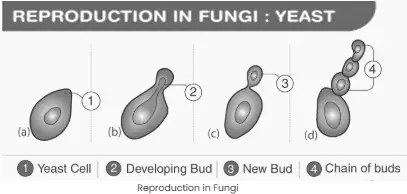
Budding process in yeast cells
Example: Explain the difference between sexual and asexual reproduction in fungi.
Solution:
Asexual reproduction produces genetically identical spores without fusion of nuclei.
Sexual reproduction involves fusion of haploid nuclei to form diploid cells, increasing genetic variation.
Vegetative reproduction such as budding is a form of asexual reproduction.
Economic and Ecological Importance of Fungi
Beneficial Roles and Practical Applications
Fungi are vital to ecosystems and human industries. They contribute to nutrient recycling by decomposing organic matter. Edible mushrooms serve as nutritious food sources. Many fungi produce antibiotics, such as penicillin from Penicillium, which are crucial in medicine.
Additionally, fungi act as biocontrol agents by targeting pests, reducing the need for chemical pesticides. However, fungi can also cause food spoilage, leading to economic losses.
Example: List three ways fungi benefit humans and the environment.
Solution:
Decomposition and nutrient recycling in ecosystems.
Production of antibiotics for disease treatment.
Use as food, such as edible mushrooms.
Summary Table: Quick Reference on Fungi
Aspect | Details |
|---|---|
Cell Type | Eukaryotic |
Cell Wall Composition | Chitin and polysaccharides |
Nutrition | Heterotrophic (saprophytic, parasitic, symbiotic) |
Reproduction | Sexual (ascospores, basidiospores) and asexual (conidia, sporangiospores) |
Structure | Unicellular (yeast) or multicellular (hyphae and mycelium) |
Storage | Starch |
Examples | Mushrooms, molds, yeasts, truffles |
Economic Importance | Food, medicine, biocontrol, decomposition |
Glossary of Key Terms Related to Fungi
Term | Definition |
|---|---|
Hyphae | Thread-like filaments forming the body of multicellular fungi. |
Mycelium | A network of hyphae constituting the main body of a fungus. |
Chitin | A polysaccharide forming the fungal cell wall, providing strength. |
Saprophytic | Organisms that feed on dead organic matter. |
Parasitic | Organisms that derive nutrients from living hosts, often harming them. |
Symbiotic | A mutually beneficial relationship between two different species. |
Conidia | Asexual spores produced by fungi for reproduction. |
Zygospore | Sexual spore formed by fusion of two haploid cells in Zygomycetes. |
Ascospore | Sexual spore produced inside an ascus in Ascomycetes. |
Basidiospore | Sexual spore produced on a basidium in Basidiomycetes. |
Frequently Asked Questions About Fungi
Which organisms are classified under the kingdom Fungi?
Fungi include eukaryotic organisms such as yeasts, molds, and mushrooms characterized by chitinous cell walls and heterotrophic nutrition.
How are fungi categorized based on their nutrition?
Fungi are classified as saprophytic (feeding on dead matter), parasitic (feeding on living hosts), or symbiotic (mutually beneficial relationships).
What is the main difference between fungi and plants?
Fungi lack chlorophyll and cannot photosynthesize, whereas plants are autotrophic and contain chlorophyll.
What are the major classes of fungi based on spore formation?
The main classes are Zygomycetes, Ascomycetes, Basidiomycetes, and Deuteromycetes, distinguished by their sexual and asexual spores.
Can fungi reproduce both sexually and asexually?
Yes, fungi reproduce through both sexual spores (e.g., ascospores, basidiospores) and asexual spores (e.g., conidia, sporangiospores), as well as vegetative methods like budding.