Comprehensive Overview of Human Kidney Structure and Function
Fundamental Anatomy of the Human Kidney
General Features and External Structure
The kidneys are paired organs shaped like beans, essential for regulating the body's water balance and eliminating metabolic waste. Positioned beneath the diaphragm and behind the peritoneal lining, each kidney typically measures between 10 and 12 centimeters in length. Their surface includes a concave border featuring a small notch known as the renal hilum, which serves as the entry and exit point for blood vessels and the ureter.
Encasing the kidney is a resilient fibrous layer called the renal capsule, which is further cushioned by a surrounding layer of perirenal fat. This protective covering shields the organ from physical damage and external shocks.
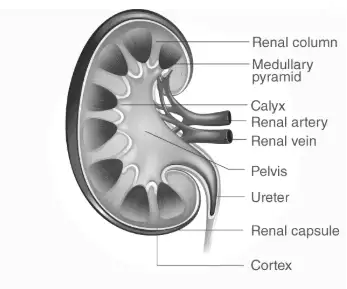
Illustration of the human kidney with labeled parts
The kidney's internal structure is divided into two primary regions: the outer renal cortex and the inner renal medulla. The cortex envelops the medulla, which is organized into pyramid-shaped segments called renal pyramids. Surrounding these pyramids are the renal calyces—cup-like chambers that collect urine and channel it into the funnel-shaped renal pelvis, which connects to the ureter.
Blood supply to the kidney is maintained by the renal artery, while the renal vein drains filtered blood, eventually joining the inferior vena cava. The kidney's functional units, called nephrons, span both the cortex and medulla, performing filtration and urine formation.
Example Problem
Question: If a kidney measures 11 cm in length and 6 cm in width, calculate its approximate surface area assuming an elliptical shape using the formula \( \text{Area} = \pi \times \frac{\text{length}}{2} \times \frac{\text{width}}{2} \).
Solution:
Given length \( l = 11 \text{ cm} \) and width \( w = 6 \text{ cm} \), the surface area is:
\[ \text{Area} = \pi \times \frac{11}{2} \times \frac{6}{2} = \pi \times 5.5 \times 3 = 16.5\pi \approx 51.84 \text{ cm}^2 \]
Thus, the kidney's approximate surface area is \( 51.84 \text{ cm}^2 \).
Microscopic Functional Units: The Nephrons
Nephron Structure and Role in Filtration
Nephrons are microscopic tubules that serve as the kidney's fundamental functional units, with roughly one million nephrons present in each kidney. Each nephron consists of two main parts: the renal corpuscle and the renal tubule. The renal corpuscle acts as the filtration site, while the tubule processes the filtered fluid.
The renal corpuscle comprises the Bowman’s capsule, a double-walled cup-like structure, enclosing a network of tiny blood vessels called the glomerulus. Blood enters the glomerulus through afferent arterioles, where water and solutes are filtered out and collected in the Bowman’s capsule as filtrate.
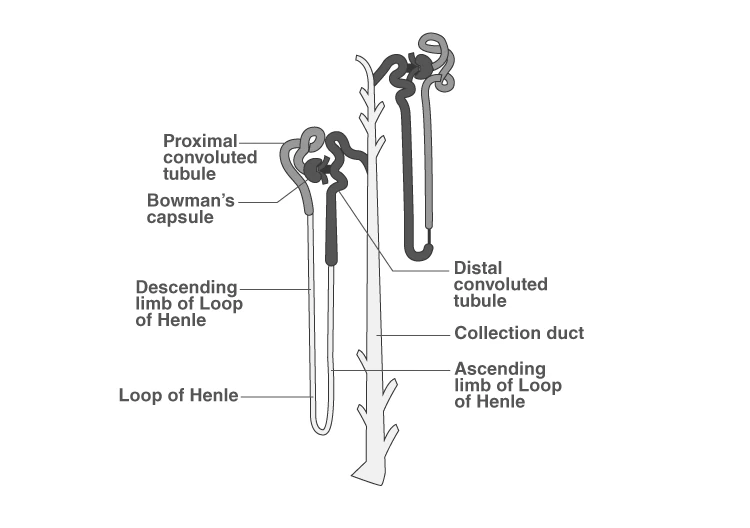
Detailed nephron diagram highlighting its components
The filtrate then travels through the renal tubule, which includes the proximal convoluted tubule, loop of Henle, distal convoluted tubule, and collecting duct. During this passage, selective reabsorption and secretion occur, adjusting the filtrate composition to form urine.
Example Problem
Question: A nephron tubule is 40 mm long. If the filtrate takes 8 minutes to pass through the entire tubule, calculate the average speed of filtrate flow in millimeters per minute.
Solution:
Length of tubule \( L = 40 \text{ mm} \), time \( t = 8 \text{ min} \).
Average speed \( v = \frac{L}{t} = \frac{40}{8} = 5 \text{ mm/min} \).
Therefore, the filtrate moves at an average speed of \( 5 \text{ mm/min} \) through the nephron tubule.
Kidney Functions and Urine Formation Process
Physiological Roles and Urine Production
The kidneys play a vital role in maintaining homeostasis by filtering blood, removing waste products, and regulating water and electrolyte balance. The nephrons filter blood plasma, reabsorb essential substances, secrete unwanted materials, and ultimately produce urine.
Urine formation involves three key processes: filtration at the glomerulus, selective reabsorption in the tubules, and secretion of additional wastes. The final urine collects in the renal calyces, flows into the renal pelvis, and is transported via the ureter to the bladder for storage.
Example Problem
Question: If a nephron filters 120 mL of plasma per minute and reabsorbs 99% of the filtrate, calculate the volume of urine produced per minute.
Solution:
Filtrate volume \( V_f = 120 \text{ mL/min} \), reabsorption rate = 99%.
Volume reabsorbed \( V_r = 0.99 \times 120 = 118.8 \text{ mL/min} \).
Urine volume \( V_u = V_f - V_r = 120 - 118.8 = 1.2 \text{ mL/min} \).
Hence, the nephron produces approximately \( 1.2 \text{ mL} \) of urine per minute.
Quick Reference: Kidney and Nephron Essentials
Component | Description | Function |
|---|---|---|
Renal Capsule | Fibrous protective covering | Protects kidney from injury |
Renal Cortex | Outer kidney layer | Contains nephrons and blood vessels |
Renal Medulla | Inner kidney region with pyramids | Supports urine collection and concentration |
Renal Hilum | Concave notch on kidney | Entry/exit for vessels and ureter |
Nephron | Microscopic functional unit | Filters blood and forms urine |
Glomerulus | Capillary network in Bowman’s capsule | Filters blood plasma |
Bowman’s Capsule | Double-walled cup around glomerulus | Collects filtrate from blood |
Proximal Convoluted Tubule | First segment of nephron tubule | Reabsorbs nutrients and water |
Loop of Henle | U-shaped tubule segment | Concentrates urine by water reabsorption |
Collecting Duct | Final tubule segment | Transports urine to renal pelvis |
Glossary of Key Terms
Term | Definition |
|---|---|
Renal Capsule | A tough fibrous layer surrounding the kidney |
Renal Cortex | The outer region of the kidney containing nephrons |
Renal Medulla | The inner part of the kidney composed of pyramids |
Renal Hilum | Indentation where vessels and ureter enter/exit |
Nephron | The microscopic functional unit of the kidney |
Glomerulus | A network of capillaries involved in filtration |
Bowman’s Capsule | Double-walled structure enclosing the glomerulus |
Proximal Convoluted Tubule | Segment of nephron tubule for reabsorption |
Loop of Henle | U-shaped tubule segment concentrating urine |
Collecting Duct | Final channel transporting urine to pelvis |
Frequently Asked Questions
What is the primary function of the renal corpuscle?
The renal corpuscle filters blood plasma, initiating urine formation by separating water and solutes from blood.
How does the kidney protect itself from physical damage?
The kidney is shielded by a tough fibrous renal capsule and a surrounding layer of perirenal fat that cushions it against trauma.
What role does the loop of Henle play in urine formation?
It concentrates urine by reabsorbing water and salts, helping maintain the body's fluid and electrolyte balance.
How many nephrons are typically found in a human kidney?
Each human kidney contains approximately one million nephrons, which perform the essential filtration functions.
Where does the urine go after it leaves the collecting duct?
Urine flows from the collecting ducts into the renal calyces, then into the renal pelvis, and finally through the ureter to the bladder.