Comprehensive Overview of Biomolecules and Their Functions
Fundamentals of Biomolecules in Living Cells
Understanding Biomolecules and Their Role
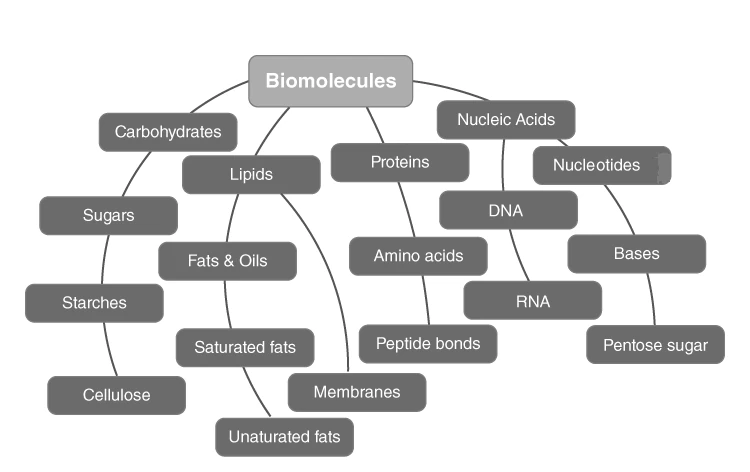
Biomolecules are organic compounds that form the structural and functional basis of all living cells. These molecules include carbohydrates, proteins, lipids, and nucleic acids, each playing a vital role in maintaining life processes. They differ in their chemical structures, physical properties such as solubility, and biological functions. The elemental composition of cells primarily involves carbon, hydrogen, oxygen, nitrogen, and phosphorus, which are integral to these biomolecules.
Biomolecules can exist as linear chains or cyclic structures, and their diversity allows them to participate in various metabolic pathways essential for life.
Example Problem
Question: Identify the primary elements found in biomolecules and explain why these elements are essential for cellular functions.
Solution:
- The main elements in biomolecules are carbon (C), hydrogen (H), oxygen (O), nitrogen (N), and phosphorus (P).
- Carbon forms the backbone of organic molecules due to its ability to form four covalent bonds, allowing complex structures.
- Hydrogen and oxygen are involved in forming functional groups and contribute to molecule polarity and solubility.
- Nitrogen is a key component of amino acids and nucleotides, essential for proteins and nucleic acids.
- Phosphorus is critical in energy transfer molecules like ATP and forms part of the nucleic acid backbone.
Classification and Characteristics of Biomolecules
Carbohydrates: Structure and Biological Importance
Carbohydrates are large biomolecules composed of sugar units called monosaccharides. These sugars can link together to form disaccharides or polysaccharides, depending on the number of sugar units involved. Carbohydrates serve as a primary energy source and are products of metabolic pathways such as photosynthesis. Their structures range from simple sugars like glucose to complex polymers like starch and cellulose.
They are generally water-soluble and play roles in energy storage, structural support, and cell recognition.
Example Problem
Question: Calculate the molecular formula of a disaccharide formed by two glucose units (each glucose: \( C_6H_{12}O_6 \)) after condensation.
Solution:
When two glucose molecules combine, a water molecule (\( H_2O \)) is removed during the formation of a glycosidic bond.
\[ \text{Molecular formula} = 2 \times C_6H_{12}O_6 - H_2O = C_{12}H_{24}O_{12} - H_2O = C_{12}H_{22}O_{11} \]
Thus, the disaccharide has the formula \( C_{12}H_{22}O_{11} \).
Proteins: Composition and Functional Diversity
Proteins are complex polymers made from 20 different amino acids linked by peptide bonds. Each amino acid consists of a central carbon atom bonded to an amino group, a carboxyl group, a hydrogen atom, and a unique side chain (R group). The sequence and nature of these amino acids determine the protein's structure and function. Proteins perform a wide range of biological roles including catalysis, transport, and structural support.
Among the 20 amino acids, some are essential and must be obtained through diet, while others are synthesized by the body.
Example Problem
Question: Describe the peptide bond formation between two amino acids and write the chemical equation representing this reaction.
Solution:
Peptide bonds form through a condensation reaction between the amino group of one amino acid and the carboxyl group of another, releasing a water molecule.
\[ \text{Amino acid}_1 - NH_2 + \text{Amino acid}_2 - COOH \rightarrow \text{Amino acid}_1 - NH - CO - \text{Amino acid}_2 + H_2O \]
This covalent bond links amino acids into polypeptide chains, forming proteins.
Lipids: Structure and Biological Roles
Lipids are hydrophobic molecules including fats, oils, waxes, phospholipids, and steroids. The simplest lipids are fatty acids, which consist of a carboxyl group attached to a long hydrocarbon chain that can be saturated or unsaturated. Fatty acids combine with glycerol to form triglycerides, which serve as energy storage molecules. Phospholipids, containing two fatty acid tails and a phosphate-containing head, are fundamental components of cellular membranes, providing structural integrity and selective permeability.
Example Problem
Question: Explain why phospholipids form bilayers in aqueous environments and describe the orientation of their hydrophobic and hydrophilic parts.
Solution:
- Phospholipids have hydrophilic (water-attracting) phosphate heads and hydrophobic (water-repelling) fatty acid tails.
- In water, phospholipids arrange themselves so that the hydrophobic tails face inward, away from water, while the hydrophilic heads face outward towards the water.
- This arrangement forms a bilayer, which is the basic structure of cell membranes, creating a barrier that controls substance movement.
Nucleic Acids: Genetic Information Carriers
Nucleic acids, such as DNA and RNA, are polymers made of nucleotide monomers. Each nucleotide consists of a nitrogenous base, a sugar (deoxyribose in DNA and ribose in RNA), and a phosphate group. Nitrogenous bases are categorized as purines or pyrimidines. Nucleotides link via phosphodiester bonds to form long chains that store and transmit genetic information essential for cellular function and heredity.
Example Problem
Question: Illustrate the formation of a phosphodiester bond between two nucleotides and explain its significance.
Solution:
A phosphodiester bond forms between the 3' hydroxyl group of one nucleotide's sugar and the 5' phosphate group of the next nucleotide, releasing water.
\[ \text{Nucleotide}_1 - 3' - OH + \text{Nucleotide}_2 - 5' - PO_4^{2-} \rightarrow \text{Nucleotide}_1 - 3' - O - PO_2 - O - 5' - \text{Nucleotide}_2 + H_2O \]
This bond creates the sugar-phosphate backbone of nucleic acids, providing structural stability.
Summary Table for Quick Review
| Biomolecule | Monomer Units | Key Elements | Primary Function | Example |
|---|---|---|---|---|
| Carbohydrates | Monosaccharides | C, H, O | Energy source and storage | Glucose, Starch |
| Proteins | Amino acids | C, H, O, N, S | Structural, enzymatic, transport | Enzymes, Hemoglobin |
| Lipids | Fatty acids and glycerol | C, H, O | Energy storage, membrane structure | Triglycerides, Phospholipids |
| Nucleic Acids | Nucleotides | C, H, O, N, P | Genetic information storage | DNA, RNA |
Glossary of Key Terms
| Term | Definition |
|---|---|
| Amino Acid | Building block of proteins containing an amino group, carboxyl group, and side chain. |
| Carbohydrate | Organic compound made of sugar units serving as energy sources. |
| Fatty Acid | Long hydrocarbon chain with a carboxyl group, component of lipids. |
| Glycosidic Bond | Covalent bond linking sugar molecules in carbohydrates. |
| Hydrophobic | Water-repelling property of molecules or parts of molecules. |
| Hydrophilic | Water-attracting property of molecules or parts of molecules. |
| Nucleotide | Monomer of nucleic acids composed of a base, sugar, and phosphate. |
| Peptide Bond | Covalent bond formed between amino acids in proteins. |
| Phosphodiester Bond | Linkage between nucleotides in nucleic acids. |
| Polysaccharide | Polymer of many sugar units forming complex carbohydrates. |
Frequently Asked Questions
What defines a biomolecule?
Biomolecules are organic compounds present in living cells, including carbohydrates, proteins, lipids, and nucleic acids, essential for life functions.
How are carbohydrates classified?
Carbohydrates are classified based on the number of sugar units: monosaccharides (single), disaccharides (two), and polysaccharides (many).
What is the significance of essential amino acids?
Essential amino acids cannot be synthesized by the body and must be obtained through diet to support protein synthesis.
Why are lipids important for cells?
Lipids provide energy storage, form cell membranes, and act as signaling molecules due to their hydrophobic nature.
What role do nucleic acids play in heredity?
Nucleic acids store and transmit genetic information, enabling inheritance and guiding protein synthesis.