Comprehensive Overview of Human Teeth and Their Functions
Human Dentition: Structure and Purpose
Overview of Teeth in Humans
Teeth are rigid, calcified structures unique to vertebrates, essential for breaking down food into manageable pieces for digestion. Unlike some animals that swallow food whole, humans rely on teeth to cut, tear, and grind food before swallowing. These teeth are supported by jaw muscles and aided by saliva, which lubricates the food for easier swallowing.
Humans possess a variety of teeth types, each specialized for distinct functions such as slicing, tearing, and crushing. The arrangement and number of teeth are often represented by a dental formula, which expresses the count of each type in the upper and lower jaws.
Adult humans typically have 32 permanent teeth, including wisdom teeth, which usually emerge between ages 17 and 25. These teeth are composed primarily of collagen proteins and calcium minerals, making them some of the hardest tissues in the body. Teeth also contribute significantly to speech articulation.
Children are born without teeth and initially rely on milk teeth, which begin to appear as they start consuming solid foods. By around age 3, most children have a full set of 20 primary teeth, which are gradually replaced by permanent teeth starting around age 6.
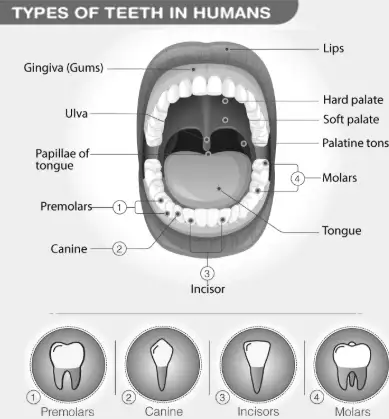
Diagram illustrating various types of human teeth
Example Problem
Question: If an adult human has 8 incisors, 4 canines, 8 premolars, and 12 molars, how many teeth are there in total? Verify the total count.
Solution:
Calculate the total number of teeth by summing all types:
\[ 8 \text{ (incisors)} + 4 \text{ (canines)} + 8 \text{ (premolars)} + 12 \text{ (molars)} = 32 \text{ teeth} \]
Therefore, the total number of teeth in an adult human is 32.
Classification and Roles of Different Teeth
Incisors: The Cutting Tools
Incisors are located at the front of the mouth and have sharp, thin edges designed to slice food into smaller pieces. Humans have eight incisors, evenly split between the upper and lower jaws. Their primary role is to initiate the process of mastication by cutting food.
Example Problem
Question: A person has 4 incisors in the upper jaw and 4 in the lower jaw. If two incisors are damaged, what fraction of the total incisors remain functional?
Solution:
Total incisors = 4 + 4 = 8
Functional incisors = 8 - 2 = 6
Fraction functional = \( \frac{6}{8} = \frac{3}{4} \)
Hence, three-fourths of the incisors are still functional.
Canines: The Tearing Teeth
Situated at the corners of the dental arches, canines are pointed and elongated teeth designed to grip and tear tougher food items such as meat. Humans have four canines, two in each jaw. Their sharpness aids in breaking down food that requires more force than incisors can provide.
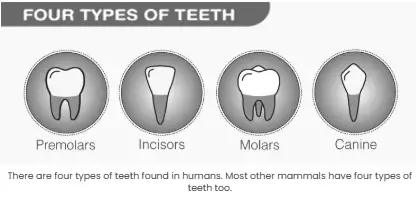
Visual representation of the four types of human teeth
Example Problem
Question: If a person loses one canine tooth from the upper jaw, what percentage of the total canines remain?
Solution:
Total canines = 4
Remaining canines = 4 - 1 = 3
Percentage remaining = \( \frac{3}{4} \times 100 = 75\% \)
Therefore, 75% of the canines remain intact.
Premolars: Crushing and Grinding Specialists
Located behind the canines, premolars have broad, flat surfaces with ridges that are ideal for crushing and grinding food into smaller, digestible pieces. Humans have eight premolars, with four in each jaw. These teeth serve as a transition between tearing and grinding functions.
Example Problem
Question: Calculate the total number of premolars in both jaws if each side of the upper and lower jaws has two premolars.
Solution:
Number of premolars per side = 2
Total sides = 4 (left and right of upper and lower jaws)
Total premolars = \( 2 \times 4 = 8 \)
Thus, there are 8 premolars in total.
Molars: The Powerhouses of Grinding
Molars are the largest and strongest teeth, featuring broad, flat surfaces designed for thorough grinding of food. Adults have 12 molars in total, six in each jaw. Among these, four are wisdom teeth, which typically emerge between ages 17 and 25. Wisdom teeth often require removal due to alignment issues and potential infections.
Example Problem
Question: If an adult has 12 molars including 4 wisdom teeth, how many molars excluding wisdom teeth are present?
Solution:
Total molars = 12
Wisdom teeth = 4
Molars excluding wisdom teeth = \( 12 - 4 = 8 \)
Therefore, there are 8 molars apart from the wisdom teeth.
Dental Development and Replacement Patterns
Milk Teeth and Permanent Teeth in Humans
Humans are diphyodonts, meaning they develop two successive sets of teeth during their lifetime. The first set, known as milk or primary teeth, typically appears by age 3 and consists of 20 teeth. These are gradually replaced by 32 permanent teeth starting around age 6, completing by early adulthood.
During the transition phase, individuals have a mix of milk and permanent teeth, referred to as the mixed dentition stage. This process ensures that teeth are appropriately sized and positioned for adult chewing needs.
Example Problem
Question: A child has 20 milk teeth. If 5 of these have been replaced by permanent teeth, how many milk teeth remain?
Solution:
Total milk teeth = 20
Replaced teeth = 5
Remaining milk teeth = \( 20 - 5 = 15 \)
Thus, 15 milk teeth remain.
Continuous Tooth Replacement in Other Vertebrates
Unlike humans, some vertebrates such as certain fish and reptiles are polyphyodonts, meaning they continuously replace their teeth throughout life. This adaptation allows them to maintain effective dentition despite wear or loss. Among mammals, only a few species like elephants, kangaroos, and manatees exhibit this trait.
Example Problem
Question: If a polyphyodont fish replaces its teeth every 3 months, how many times will it replace its teeth in 2 years?
Solution:
Number of months in 2 years = \( 2 \times 12 = 24 \)
Replacements = \( \frac{24}{3} = 8 \)
The fish will replace its teeth 8 times in 2 years.
Summary and Key Concepts
Type of Tooth | Location | Function | Number in Adults |
|---|---|---|---|
Incisors | Front of mouth | Cutting food into pieces | 8 (4 upper, 4 lower) |
Canines | Corners of dental arches | Gripping and tearing food | 4 (2 upper, 2 lower) |
Premolars | Behind canines | Crushing and grinding food | 8 (4 upper, 4 lower) |
Molars | Back of mouth | Grinding food thoroughly | 12 (6 upper, 6 lower, including 4 wisdom teeth) |
Glossary of Terms
Term | Definition |
|---|---|
Incisors | Front teeth used for cutting food. |
Canines | Pointed teeth for tearing food. |
Premolars | Teeth with flat surfaces for crushing food. |
Molars | Large teeth for grinding food. |
Wisdom Teeth | Third molars that appear in late adolescence. |
Dental Formula | Notation representing the number of each type of tooth. |
Diphyodont | Organisms with two sets of teeth in a lifetime. |
Polyphyodont | Organisms that continuously replace teeth. |
Enamel | Hard, protective outer layer of teeth. |
Mastication | The process of chewing food. |
Frequently Asked Questions
What are the main types of teeth in humans?
Humans have four primary types of teeth: incisors, canines, premolars, and molars, each serving specific functions in food processing.
Which teeth are primarily responsible for tearing food?
Canines are specialized for gripping and tearing tougher food items.
What is the significance of wisdom teeth?
Wisdom teeth are the third set of molars that usually emerge between ages 17 and 25 and may require removal due to alignment issues.
How many teeth do adults typically have?
Adults generally have 32 permanent teeth, including wisdom teeth.
What does diphyodont mean?
Diphyodonts are animals that develop two successive sets of teeth: primary (milk) teeth and permanent teeth.