Human Reproduction: Systems, Processes, and Key Concepts
Fundamentals of Biological Reproduction
Understanding the Basics of Reproduction
Reproduction is a vital biological mechanism through which living organisms generate new individuals, ensuring the survival and continuation of their species. This process results in offspring that carry genetic material from their parents, allowing populations to grow when environmental conditions are favorable. It is a defining feature of all life forms.
Reproduction occurs mainly in two forms: asexual reproduction, involving a single parent producing genetically identical offspring, and sexual reproduction, which requires two parents and results in genetically diverse progeny.
Illustrative Example: Comparing Reproductive Modes
Problem: Identify which type of reproduction is involved in the following organisms and explain why:
Amoeba reproduces by binary fission.
Humans produce offspring through the fusion of gametes.
Solution:
Amoeba: This is an example of asexual reproduction because it involves a single parent cell dividing to form two identical daughter cells without gamete formation.
Humans: Humans reproduce sexually, involving two parents whose gametes (sperm and egg) fuse to create genetically unique offspring.
Male Reproductive Anatomy and Function
Structure and Role of the Male Reproductive System
The male reproductive system is specialized for producing and delivering male gametes called sperm. These sperm cells are microscopic, consisting of a head, midsection, and tail, enabling mobility and fertilization capability.
The primary organs include the testes, which produce sperm and the hormone testosterone, housed within the scrotum that regulates temperature for optimal sperm development. Mature sperm travel through the epididymis and vas deferens, eventually mixing with fluids from accessory glands to form semen, which nourishes and transports sperm during ejaculation. The penis serves as the conduit for semen delivery during sexual intercourse.
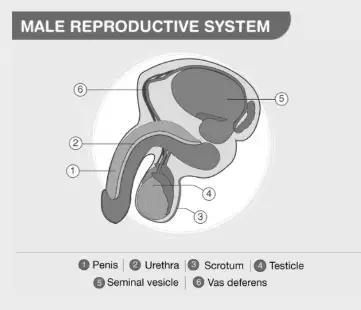
Illustration of the male reproductive system
Female Reproductive System and Its Functions
Components and Roles of the Female Reproductive Organs
The female reproductive system is designed to produce female gametes called ova (eggs), facilitate fertilization, and support embryo development. It includes a pair of ovaries that generate eggs and secrete estrogen, fallopian tubes where fertilization occurs, the uterus which nurtures the developing embryo, and the vagina that serves as the passage for intercourse and childbirth.
During puberty, eggs mature cyclically, with one ovum released approximately every 28 to 30 days in a process known as ovulation.
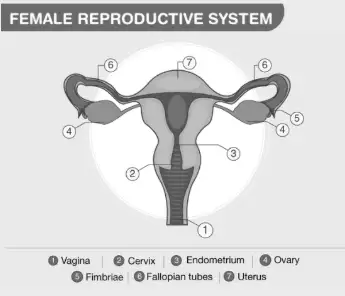
Diagram of the female reproductive system
Example Question: Ovulation Timing
Problem: If a woman’s menstrual cycle is 30 days long, on which day is ovulation most likely to occur? Explain the significance of this timing.
Solution:
Ovulation typically occurs about 14 days before the start of the next menstrual period. For a 30-day cycle:
\[ \text{Ovulation day} = 30 - 14 = 16 \]
Thus, ovulation is expected around day 16. This is the period when the mature ovum is released and is available for fertilization by sperm.
Stages and Mechanisms of Human Reproduction
Process from Fertilization to Embryo Development
Human reproduction involves the union of male and female gametes during fertilization, resulting in a zygote. This zygote undergoes multiple cell divisions, forming an embryo that travels to the uterus and implants into its lining, a process called implantation. The embryo then develops into a fetus within the uterus until birth.
This sequence includes three main phases: pre-fertilization (gamete formation and release), fertilization (fusion of sperm and egg), and post-fertilization (embryo development and implantation).
Example Calculation: Cell Division in Early Embryo
Problem: If a zygote divides every 12 hours, how many cells will be present after 3 days?
Solution:
Number of divisions in 3 days (72 hours):
\[ \frac{72 \text{ hours}}{12 \text{ hours/division}} = 6 \text{ divisions} \]
Number of cells after 6 divisions:
\[ 2^6 = 64 \text{ cells} \]
Therefore, the embryo will consist of 64 cells after 3 days.
Quick Reference: Key Points on Human Reproduction
Aspect | Description |
|---|---|
Reproduction Type | Sexual reproduction involving two parents |
Male Gamete | Sperm produced in testes |
Female Gamete | Ovum produced in ovaries |
Fertilization Site | Fallopian tubes |
Embryo Development Site | Uterus |
Ovulation Cycle | Approximately every 28–30 days |
Temperature Regulation | Scrotum maintains optimal temperature for sperm |
Semen Composition | Mixture of sperm and secretions from accessory glands |
Implantation | Attachment of embryo to uterine wall |
Embryo to Fetus | Development occurs inside uterus until birth |
Glossary of Important Terms
Term | Definition |
|---|---|
Fertilization | Fusion of male and female gametes to form a zygote |
Zygote | Single cell formed after fertilization |
Gamete | Sex cell (sperm or ovum) involved in reproduction |
Ovum | Female reproductive cell or egg |
Sperm | Male reproductive cell |
Testes | Male organs producing sperm and testosterone |
Ovaries | Female organs producing eggs and estrogen |
Implantation | Attachment of embryo to the uterine lining |
Scrotum | External pouch housing testes, regulating temperature |
Ovulation | Release of a mature egg from the ovary |
Frequently Asked Questions
What is the biological significance of reproduction?
Reproduction ensures the survival and continuation of species by producing new individuals, maintaining population numbers across generations.
How does fertilization occur in humans?
Fertilization happens when a sperm cell from the male merges with an ovum from the female, typically within the fallopian tube, forming a zygote.
What is the role of the scrotum in male reproduction?
The scrotum maintains the testes at a temperature slightly lower than body temperature, which is essential for healthy sperm production.
Why is ovulation important in the reproductive cycle?
Ovulation releases a mature egg, making it available for fertilization, which is critical for conception to occur.
What happens after fertilization in the female reproductive system?
The fertilized egg divides to form an embryo, which travels to the uterus and implants into its lining to develop into a fetus.