Understanding the Human Nervous System and Its Functions
Fundamentals of Stimulus and Response in Living Organisms
How Organisms Detect and React to Environmental Changes
Living beings continuously adjust their actions and positions in reaction to changes in their environment to ensure survival or gain an advantage. The external or internal change that triggers a reaction is called a stimulus, while the action or behavior that follows is known as the response. Common stimuli include factors such as sound, light, temperature, smell, taste, water, and gravity.
For example, if you accidentally touch a hot surface, the sensation of pain prompts you to withdraw your hand immediately. This protective mechanism is vital; lacking such pain perception could lead to severe injuries without awareness, which would be detrimental to survival.
Example Problem
A person accidentally touches a hot object and immediately pulls their hand away. Explain the role of stimulus and response in this scenario.
Solution:
The heat from the object acts as the stimulus.
The sensory receptors in the skin detect this stimulus and send signals to the brain via neurons.
The brain processes the information and sends a command to the muscles to contract and pull the hand away.
This muscle contraction is the response to the stimulus.
This reflex action helps prevent further injury.
Overview of the Human Nervous System
Structure and Function of the Nervous System
The nervous system is an intricate network of specialized cells called neurons that transmit messages throughout the body. Its complexity increases in higher animals, with humans possessing one of the most advanced nervous systems. It integrates sensory input, processes information, and coordinates responses to maintain homeostasis and enable complex behaviors.
Neurons communicate via electrical impulses, allowing rapid transmission of signals between the brain, spinal cord, and various body parts. This system enables control over voluntary movements, reflexes, and involuntary functions.
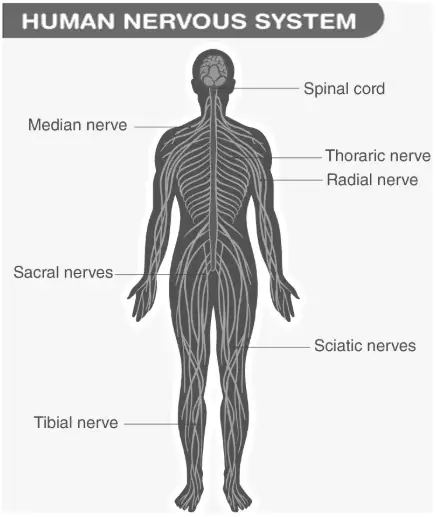
Describe how neurons transmit messages in the human nervous system.
Solution:
Neurons receive stimuli through their dendrites.
Electrical impulses are generated and travel along the axon.
At the synapse, neurotransmitters carry the signal to the next neuron.
This process continues until the message reaches the brain or target organ.
The brain processes the information and sends appropriate responses.
Central Nervous System: The Body’s Command Center
Components and Roles of the Brain and Spinal Cord
The Central Nervous System (CNS) acts as the primary control hub, consisting of the brain and spinal cord. The brain is the largest and most complex organ, responsible for cognition, memory, decision-making, and coordination. It is protected by the skull and divided into three main parts:
Forebrain: Includes the cerebrum, hypothalamus, and thalamus, involved in sensory processing, voluntary movement, and regulation of vital functions.
Midbrain: Contains structures like the tectum and tegmentum, which coordinate visual and auditory reflexes.
Hindbrain: Comprises the cerebellum, medulla, and pons, which regulate balance, respiration, and heart rate.
The spinal cord is a cylindrical structure enclosed within the vertebral column, connecting the brain to the rest of the body. It facilitates reflex actions and transmits nerve impulses between the brain and peripheral nerves.
Example Problem
Explain the role of the spinal cord in reflex actions.
Solution:
The spinal cord receives sensory input from receptors.
It processes the information locally without involving the brain.
It sends immediate motor commands to muscles to produce a quick response.
This rapid action helps protect the body from harm.
Peripheral Nervous System: Connecting the Body to the CNS
Structure and Function of Peripheral Nerves
The Peripheral Nervous System (PNS) links the CNS to limbs and organs. It consists of nerves that carry signals to and from the CNS, enabling both voluntary and involuntary actions. The PNS is divided into two main parts:
Somatic Nervous System (SNS): Controls voluntary movements by transmitting impulses from the CNS to skeletal muscles.
Autonomic Nervous System (ANS): Regulates involuntary functions such as digestion, heart rate, and salivation. It is further subdivided into the sympathetic and parasympathetic systems.
The PNS contains two types of nerve fibers:
Afferent fibers: Carry sensory information from organs to the CNS.
Efferent fibers: Transmit commands from the CNS to muscles and glands.
Example Problem
Differentiate between afferent and efferent nerve fibers with examples.
Solution:
Afferent fibers: Carry sensory signals, e.g., pain receptors sending signals to the brain.
Efferent fibers: Carry motor commands, e.g., brain sending signals to arm muscles to move.
Neurons and Nerves: The Communication Units of the Nervous System
Structure and Function of Neurons and Types of Nerves
Neurons are the fundamental units of the nervous system, specialized to transmit electrochemical signals. Unlike typical cells, neurons have unique shapes and structures:
Dendrites: Short extensions that receive signals from other neurons.
Cell Body: Contains the nucleus and cytoplasm, integrating incoming signals.
Axon: A long fiber that carries impulses away from the cell body, often insulated by a myelin sheath for faster transmission.
Synapse: The tiny gap between neurons where neurotransmitters pass signals.
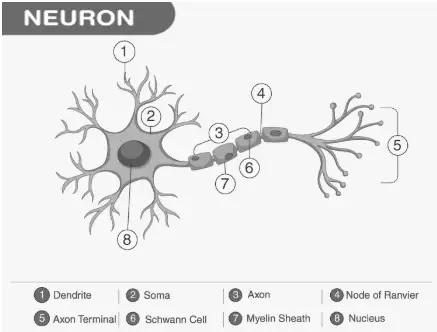
Illustration of a Neuron
Nerves are bundles of neurons that transmit messages between the brain, spinal cord, and body. They are classified as:
Sensory nerves: Carry information from sensory organs to the brain.
Motor nerves: Transmit commands from the brain to muscles.
Mixed nerves: Contain both sensory and motor fibers.
Example Problem
Explain the difference between sensory and motor nerves with examples.
Solution:
Sensory nerves transmit signals like touch or pain from skin to brain.
Motor nerves send instructions from brain to muscles to contract.
Mixed nerves perform both functions, e.g., spinal nerves.
Quick Reference: Summary of the Nervous System
Component | Description | Function |
|---|---|---|
Stimulus | Change in environment | Triggers response |
Response | Reaction to stimulus | Protects organism |
Central Nervous System (CNS) | Brain and spinal cord | Processes information and controls body |
Peripheral Nervous System (PNS) | Nerves outside CNS | Connects CNS to body parts |
Neuron | Basic nerve cell | Transmits electrical impulses |
Synapse | Gap between neurons | Allows signal transmission |
Somatic Nervous System | Voluntary control | Controls skeletal muscles |
Autonomic Nervous System | Involuntary control | Regulates internal organs |
Sensory Nerves | Carry sensory info | Transmit signals to CNS |
Motor Nerves | Carry motor commands | Transmit signals from CNS to muscles |
Glossary of Key Terms
Term | Definition |
|---|---|
Stimulus | Any change in the environment that causes a response. |
Response | The reaction of an organism to a stimulus. |
Neuron | Basic cell of the nervous system that transmits signals. |
Synapse | Microscopic gap between two neurons for signal transmission. |
Central Nervous System (CNS) | Comprises the brain and spinal cord. |
Peripheral Nervous System (PNS) | Nerves outside the CNS connecting it to the body. |
Somatic Nervous System | Controls voluntary muscle movements. |
Autonomic Nervous System | Regulates involuntary body functions. |
Axon | Long fiber of a neuron that carries impulses away from the cell body. |
Dendrite | Short extensions of a neuron that receive signals. |
Frequently Asked Questions
What are the main divisions of the human nervous system?
The nervous system is divided into the Central Nervous System (brain and spinal cord) and the Peripheral Nervous System (all other nerves connecting the CNS to the body).
How do neurons differ from nerves?
Neurons are individual nerve cells that transmit electrical signals, while nerves are bundles of many neurons grouped together to carry messages throughout the body.
What is the function of the spinal cord?
The spinal cord transmits signals between the brain and the body and controls reflex actions independently of the brain.
What roles do sensory and motor nerves play?
Sensory nerves carry information from sensory organs to the CNS, while motor nerves transmit commands from the CNS to muscles and glands.
What is the difference between the somatic and autonomic nervous systems?
The somatic nervous system controls voluntary movements of skeletal muscles, whereas the autonomic nervous system regulates involuntary functions like heartbeat and digestion.