Comprehensive Overview of the Human Heart
Fundamentals of the Human Heart
Location and Basic Role of the Heart
The heart is a vital muscular organ positioned centrally in the chest cavity, slightly offset to the left side behind the sternum. It functions as the primary pump that propels blood throughout the body, facilitating the transport of oxygen, nutrients, and hormones to various tissues. This organ originates from the mesodermal layer during embryonic development and works continuously to sustain life.
Alongside the heart, the blood vessels and blood collectively form the cardiovascular system, which is essential for maintaining homeostasis and supporting cellular functions.
Illustration of Circulatory Pathways
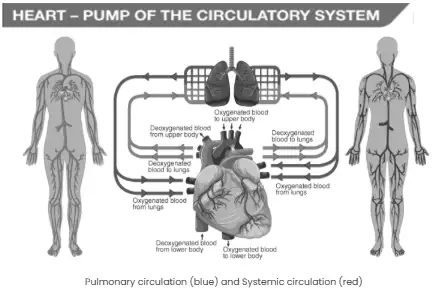
Visual representation of pulmonary (blue) and systemic (red) circulation
Example: Calculating Blood Flow Distribution
Problem: If the heart pumps 5,000 liters of blood daily, and 40% of this volume circulates through the pulmonary circuit, how many liters of blood flow through the systemic circuit each day?
Solution:
The pulmonary circulation volume is \( 0.40 \times 5000 = 2000 \text{ liters} \).
Therefore, the systemic circulation volume is:
\[ 5000 - 2000 = 3000 \text{ liters} \]
Hence, 3,000 liters of blood flow through the systemic circuit daily.
Circulatory Systems and Their Functions
Understanding Pulmonary and Systemic Circulation
Pulmonary circulation is responsible for transporting deoxygenated blood from the heart to the lungs, where it receives oxygen, and then returning oxygen-rich blood back to the heart. This process ensures that blood is replenished with oxygen before being distributed to the body.
Systemic circulation carries oxygenated blood from the heart to all body tissues and returns deoxygenated blood back to the heart. This circulation supports cellular respiration and nutrient delivery throughout the body.
Role of Coronary Circulation
The heart muscle itself requires a continuous supply of oxygenated blood to function effectively. Coronary circulation fulfills this need by delivering oxygen-rich blood to the heart tissue via coronary arteries and removing deoxygenated blood through cardiac veins. This specialized circulation is crucial for maintaining the heart's pumping efficiency.
Example: Significance of Coronary Blood Flow
Problem: A blockage reduces coronary blood flow by 30%. If the normal coronary blood flow is 250 mL/min, what is the reduced flow rate?
Solution:
Calculate the reduction:
\[ 0.30 \times 250 = 75 \text{ mL/min} \]
Reduced flow rate is:
\[ 250 - 75 = 175 \text{ mL/min} \]
This decrease can impair heart function and may lead to conditions such as angina or myocardial infarction.
Anatomical Features of the Human Heart
Structural Composition and Chamber Functions
The human heart is roughly the size of a clenched fist and is divided into four chambers: two atria and two ventricles. The atria are smaller, thin-walled chambers that receive blood, while the ventricles are larger, muscular chambers responsible for pumping blood out of the heart.
The right atrium and ventricle form the right heart, which manages pulmonary circulation, whereas the left atrium and ventricle constitute the left heart, which handles systemic circulation. A muscular wall called the septum separates the right and left sides, preventing the mixing of oxygenated and deoxygenated blood.
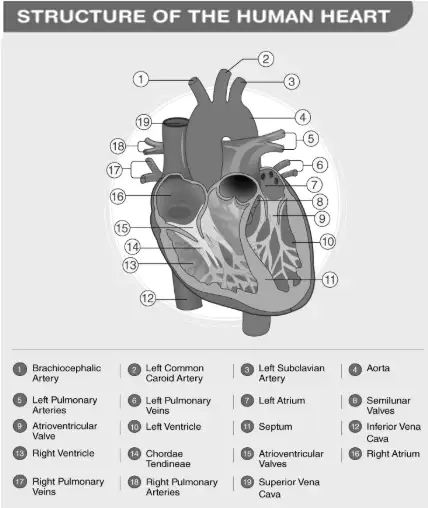
Diagram illustrating the four chambers and major vessels of the heart
Protective Layers: The Pericardium
The heart is enclosed within the pericardium, a fibrous sac filled with lubricating serous fluid. This membrane reduces friction between the heart and surrounding organs during contractions and helps maintain the heart's position within the thoracic cavity. The pericardium consists of two layers:
Visceral layer: Directly covers the heart's surface.
Parietal layer: Forms the outer sac enclosing the pericardial cavity.
Heart Wall Layers and Their Roles
The heart wall is composed of three distinct layers:
Epicardium: The outermost layer that provides protection and lubrication.
Myocardium: The thick muscular middle layer responsible for the heart's pumping action.
Endocardium: The innermost lining that covers the chambers and valves, preventing blood clot formation by reducing friction.
Example: Calculating Heart Wall Thickness Ratio
Problem: If the myocardium thickness is 12 mm and the epicardium thickness is 2 mm, what is the ratio of myocardium to epicardium thickness?
Solution:
Calculate the ratio:
\[ \frac{12 \text{ mm}}{2 \text{ mm}} = 6 \]
This indicates the myocardium is six times thicker than the epicardium, reflecting its critical role in pumping blood.
Blood Vessels and Valves Ensuring Efficient Circulation
The heart connects to various blood vessels that regulate blood flow:
Veins: Carry deoxygenated blood to the heart, primarily through the superior and inferior vena cava into the right atrium.
Arteries: Transport oxygenated blood away from the heart, with the aorta being the largest artery distributing blood systemically.
Capillaries: Microscopic vessels that facilitate exchange between arteries and veins.
Valves within the heart maintain unidirectional blood flow and prevent backflow. These include:
Atrioventricular valves: Tricuspid valve (right side) and mitral valve (left side) between atria and ventricles.
Semilunar valves: Located at the exits of the ventricles, including the pulmonary valve and aortic valve.
Example: Valve Function in Preventing Backflow
Problem: Describe how the mitral valve prevents blood from flowing backward during ventricular contraction.
Solution:
During ventricular contraction, the mitral valve closes tightly to block blood from returning to the left atrium.
This closure ensures blood is forced into the aorta for systemic circulation.
Valve flaps are supported by chordae tendineae, preventing inversion under pressure.
Key Facts and Insights About the Heart
Important statistics and facts about the human heart
The human heart is an incredibly efficient organ with remarkable features:
It pumps approximately 6,500 liters of blood daily, circulating it through the entire body.
Located centrally in the chest, it tilts slightly to the left side.
On average, the heart beats around 100,000 times per day, totaling nearly 3 billion beats over a lifetime.
The average weight of a male heart ranges from 280 to 340 grams, while a female heart weighs between 230 and 280 grams.
Resting heart rates vary: adults typically have 60–100 beats per minute, whereas newborns have faster rates, approximately 90–190 beats per minute.
Example: Estimating Heartbeats Over a Year
Problem: Calculate the approximate number of heartbeats in one year for an adult with a resting heart rate of 75 beats per minute.
Solution:
Number of minutes in a year:
\[ 365 \times 24 \times 60 = 525,600 \text{ minutes} \]
Total heartbeats:
\[ 75 \times 525,600 = 39,420,000 \text{ beats} \]
Thus, the heart beats approximately 39.4 million times annually at this rate.
Quick Reference: Human Heart Overview
Aspect | Details |
|---|---|
Location | Thoracic cavity, left of sternum |
Chambers | 4 (2 atria, 2 ventricles) |
Major Circulations | Pulmonary, Systemic, Coronary |
Heart Wall Layers | Epicardium, Myocardium, Endocardium |
Valves | Tricuspid, Mitral, Pulmonary, Aortic |
Average Heart Rate | 60–100 beats per minute (adult) |
Daily Blood Pumped | Approximately 6,500 liters |
Weight | 230–340 grams (varies by sex) |
Function | Circulates blood, supplies oxygen and nutrients |
Protective Membrane | Pericardium |
Glossary of Key Terms
Term | Definition |
|---|---|
Atria | Upper chambers of the heart that receive blood |
Ventricles | Lower chambers that pump blood out of the heart |
Pericardium | Fibrous sac enclosing the heart, providing protection and lubrication |
Myocardium | Muscular middle layer of the heart wall responsible for contraction |
Endocardium | Inner lining of the heart chambers and valves |
Septum | Muscular wall separating the right and left sides of the heart |
Pulmonary Circulation | Pathway of blood between heart and lungs for oxygenation |
Systemic Circulation | Circulation of oxygenated blood from heart to body tissues |
Coronary Circulation | Blood supply to the heart muscle itself |
Valves | Structures that prevent backflow of blood within the heart |
Frequently Asked Questions
What is the purpose of pulmonary circulation?
Pulmonary circulation transports deoxygenated blood from the heart to the lungs for oxygenation and returns oxygen-rich blood back to the heart for systemic distribution.
How does systemic circulation function?
Systemic circulation carries oxygenated blood from the heart to all body tissues and returns deoxygenated blood back to the heart, supporting cellular metabolism.
Why is coronary circulation vital for the heart?
Coronary circulation supplies oxygenated blood to the heart muscle, ensuring it receives the nutrients and oxygen necessary to maintain its pumping activity.
Can you describe the four chambers of the heart?
The heart has two atria (right and left) that receive blood and two ventricles (right and left) that pump blood out to the lungs and body, respectively.
What role do heart valves play?
Heart valves ensure blood flows in one direction by preventing backflow, maintaining efficient circulation through the heart chambers and vessels.