Comprehensive Overview of the Buccal Cavity and Its Components
Introduction to the Buccal Cavity and Its Role in Digestion
Understanding the Oral Cavity as the Gateway to Digestion
The buccal cavity, commonly known as the mouth or oral cavity, serves as the initial segment of the human digestive tract. It connects to the pharynx and subsequently the oesophagus, facilitating the passage of food. Anatomically, the oral cavity is separated from the nasal cavity by the palate, ensuring distinct respiratory and digestive pathways.
This cavity encompasses essential structures such as the teeth, tongue, and salivary glands, which collectively initiate the digestion process. The mouth is bounded externally by the lips and internally by the cheeks, tongue, upper and lower jaws. The upper jaw is fixed and forms the roof of the mouth, while the lower jaw is movable, constituting the floor.
Besides digestion, the mouth plays a vital role in speech production and breathing, especially when nasal breathing is compromised. It also enables sensory enjoyment of food and facilitates communication.
Example: Describe the anatomical boundaries of the buccal cavity and their significance in the digestive system.
Solution:
The buccal cavity is bounded by the lips externally and cheeks laterally, providing an entry point for food.
The roof is formed by the hard and soft palate, separating it from the nasal cavity, which prevents food from entering the respiratory tract.
The floor consists of the movable lower jaw and tongue, aiding in mastication and swallowing.
This arrangement ensures efficient food intake, initial digestion, and safe passage to the oesophagus.
Detailed Anatomy of the Buccal Cavity Components
Key Structures Within the Oral Cavity
The buccal cavity comprises several integral parts, each contributing uniquely to digestion and oral functions. These include the lips, buccal mucosa, tongue, teeth, gums, and salivary glands.
The lips are soft, muscular, and highly mobile, formed primarily by the orbicularis oris muscle. Their characteristic reddish hue results from the dense network of blood vessels beneath a thin epithelial layer.
The buccal mucosa lines the inner cheeks and the posterior aspect of the lips, providing the cheeks with their rounded contour and protecting the inner oral environment.
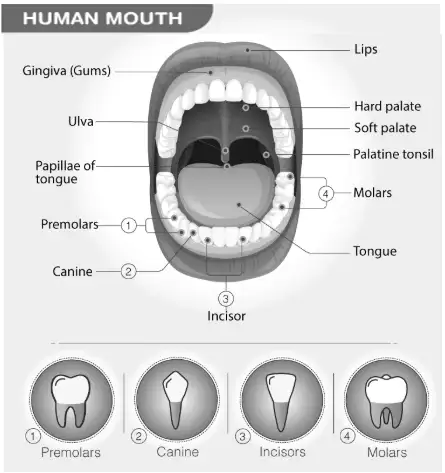
Illustration of the main parts of the mouth
Example: Explain the role of the buccal mucosa in oral health.
Solution:
The buccal mucosa acts as a protective lining for the inner cheeks and lips.
It maintains moisture and provides a barrier against mechanical injury during chewing.
Its elasticity allows for the movement of cheeks during speech and mastication.
It also plays a role in immune defense by housing immune cells that detect pathogens.
Functions and Features of the Tongue and Teeth
The Tongue: A Multifunctional Muscular Organ
The tongue is a prominent muscular organ occupying most of the oral cavity. It is highly flexible, capable of adopting various shapes and positions to assist in multiple functions. Taste buds embedded in the tongue’s lining contain 50 to 100 taste receptor cells each, enabling the perception of different tastes.
Beyond taste, the tongue is essential for clear speech articulation, oral hygiene by cleansing the mouth, and facilitating the movement of food towards the oropharynx during swallowing.
Example: How does the tongue contribute to speech and digestion?
Solution:
It shapes sounds by altering its position and tension, enabling distinct speech sounds.
It senses taste, which influences appetite and digestion.
It helps in mixing food with saliva and pushing it towards the throat for swallowing.
It assists in cleaning the oral cavity by removing food particles.
Teeth: Structure and Classification
Teeth are the hardest structures in the human body, designed for mechanical digestion by cutting and grinding food. An adult typically has 32 teeth, categorized into incisors, canines, premolars, and molars. The third molars, known as wisdom teeth, usually emerge during late adolescence or early adulthood.
Each tooth consists of a crown, neck, and root. The central pulp cavity contains blood vessels, nerves, and connective tissue, surrounded by enamel, which protects against physical damage and bacterial invasion.
Example: Identify the main parts of a tooth and their functions.
Solution:
Crown: The visible part above the gum line, covered by enamel for protection.
Neck: The constricted region connecting crown and root.
Root: Anchors the tooth into the jawbone.
Pulp cavity: Contains nerves and blood vessels, providing nourishment and sensation.
Summary Table for Quick Revision
Component | Description | Primary Function |
|---|---|---|
Lips | Soft, muscular structures with rich blood supply | Food intake, speech articulation, facial expression |
Buccal Mucosa | Inner lining of cheeks and lips | Protection and flexibility during chewing |
Tongue | Muscular organ with taste buds | Taste sensation, speech, food manipulation |
Teeth | Hard structures with enamel covering | Mechanical digestion by cutting and grinding |
Salivary Glands | Glands producing saliva | Moistening food, initiating digestion of starch |
Glossary of Key Terms
Term | Definition |
|---|---|
Buccal Cavity | The mouth cavity serving as the entry point of the digestive system. |
Palate | The roof of the mouth separating oral and nasal cavities. |
Buccal Mucosa | The mucous membrane lining the inner cheeks and lips. |
Enamel | The hard, protective outer layer of a tooth. |
Pulp Cavity | The central part of a tooth containing nerves and blood vessels. |
Incisors | Front teeth adapted for cutting food. |
Canines | Pointed teeth used for tearing food. |
Molars | Teeth with broad surfaces for grinding food. |
Tongue | Muscular organ involved in taste, speech, and swallowing. |
Salivary Glands | Glands that secrete saliva to aid digestion and oral hygiene. |
Frequently Asked Questions
What are the primary components of the mouth?
The mouth includes the teeth, tongue, salivary glands, tonsils, the back of the throat, and the epiglottis, all of which contribute to digestion, speech, and breathing.
What is the main function of the buccal cavity?
The buccal cavity acts as the initial segment of the digestive tract, facilitating food intake and beginning the digestion process. It is separated from the nasal cavity by the palate and contains teeth, tongue, and salivary glands.
How many types of teeth are there and what are they?
There are four types of teeth: incisors for cutting, canines for tearing, premolars and molars for grinding food.
Why is the tongue important in digestion?
The tongue helps in tasting food, mixing it with saliva, pushing it towards the throat for swallowing, and plays a crucial role in speech.
What protects the teeth from damage and infection?
The enamel, a hard outer layer, shields the teeth from physical damage and bacterial invasion.