Comprehensive Overview of the Human Brain Structure and Functions
Fundamentals of the Human Brain
Basic Composition and Role of the Brain
The human brain, weighing approximately between 1.0 kg and 1.5 kg in adults, is primarily made up of neurons, which are the essential cells responsible for transmitting signals throughout the nervous system. Current research estimates the brain contains roughly 86 to 100 billion neurons. Together with the spinal cord, the brain forms the central nervous system (CNS), which governs thought processes, sensory interpretation, and voluntary body movements.
Example: If a brain contains 90 billion neurons and each neuron connects to an average of 7,000 other neurons, estimate the total number of connections in the brain.
Total connections = Number of neurons × Connections per neuron = \( 90 \times 10^9 \times 7,000 = 6.3 \times 10^{14} \) connections.
Protection and Location of the Brain
Enclosure and Cushioning Mechanisms
The brain is securely housed within the skull, which consists of 22 bones—8 cranial bones forming the protective cranium and 14 facial bones. Surrounding the brain is the cerebrospinal fluid (CSF), a clear fluid produced daily at about 500 mL by specialized ependymal cells. This fluid cushions the brain against mechanical shocks, provides immunological defense, and suspends the brain to reduce its effective weight, preventing damage to delicate neural tissues.
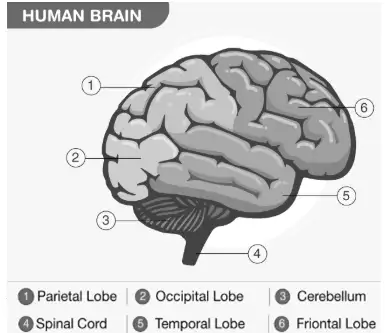
Illustration of the human brain structure
Example: Calculate the effective weight of a 1.3 kg brain suspended in CSF if the buoyant force reduces its weight by 97%.
Effective weight = Original weight × (1 - 0.97) = \( 1.3 \text{ kg} \times 0.03 = 0.039 \text{ kg} \).
Major Divisions of the Brain and Their Functions
Overview of Forebrain, Midbrain, and Hindbrain
The brain is anatomically divided into three primary regions: the forebrain, midbrain, and hindbrain. The forebrain, the largest section, includes the cerebrum, hypothalamus, and thalamus, and regulates vital functions such as reproduction, temperature control, emotions, hunger, and sleep. The midbrain, the smallest and central part, contains the tectum and tegmentum, which manage sensory relay and motor functions. The hindbrain comprises the cerebellum, medulla oblongata, and pons, coordinating essential survival processes like breathing, heartbeat, and motor learning.
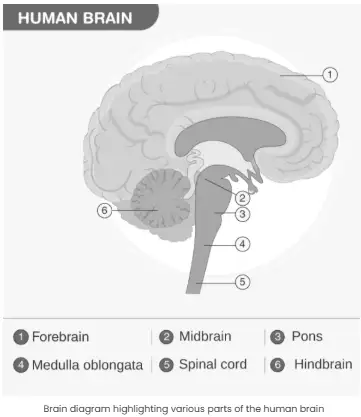
Diagram highlighting the main brain regions
Example: Identify which brain region controls sleep and breathing and explain its components.
The hindbrain controls sleep and breathing. It includes the cerebellum (balance and coordination), medulla oblongata (autonomic functions like heartbeat and breathing), and pons (relay center and sleep regulation).
Detailed Anatomy of the Cerebrum
Structure and Functional Areas of the Largest Brain Part
The cerebrum, the brain's largest component, consists of two hemispheres connected by the corpus callosum, a dense fiber bundle. It is divided into four lobes: frontal (speech, planning, reasoning, movement), parietal (movement, sensory perception, orientation), occipital (visual processing), and temporal (memory, auditory perception, speech recognition). The cerebrum contains grey matter, composed mainly of neuronal cell bodies, and white matter, consisting of axons connecting different brain regions. The cerebral cortex, the convoluted outer layer, includes sensory areas (receiving stimuli), association areas (integrating sensory input), and motor areas (controlling voluntary muscles).
Example: Explain the role of the parietal lobe in sensory processing.
The parietal lobe interprets sensory information such as touch, temperature, and pain, and helps in spatial orientation and movement coordination.
Functions of the Thalamus and Hypothalamus
Relay and Regulatory Centers in the Brain
The thalamus, located above the brainstem, acts as a relay station for sensory signals traveling to the cerebrum and also transmits motor information for coordination. It is part of the limbic system, which is crucial for memory formation and emotional processing. The hypothalamus, situated below the thalamus, is vital for maintaining homeostasis. It regulates body temperature, mood, hunger, sleep, and hormone synthesis, and connects the nervous system with the endocrine system through its interaction with the pituitary gland.
Example: Describe how the hypothalamus influences body temperature regulation.
The hypothalamus receives temperature signals from the body and initiates responses such as sweating or shivering to maintain a stable internal temperature.
Midbrain Components: Tectum and Tegmentum
Central Brainstem Structures and Their Roles
The tectum, forming the dorsal part of the midbrain, serves as a sensory relay center, particularly for auditory information, and controls reflexive movements of the head, eyes, and neck. The tegmentum, a complex area within the brainstem, is involved in regulating body movements, sleep, arousal, attention, and reflexes. It connects the midbrain with the thalamus, cerebral cortex, and spinal cord, facilitating communication across these regions.
Example: What reflexes are controlled by the tectum?
The tectum manages reflexive responses such as turning the head and eyes toward sudden sounds or visual stimuli.
Role and Structure of the Cerebellum
Coordination and Balance Center
The cerebellum, the second largest brain part, is located behind the medulla and pons. It is separated from the cerebrum by the cerebellar tentorium and transverse fissure. The cerebellum has an outer grey cortex with parallel ridges called folia and an inner white medulla. It contains two hemispheres and several lobes responsible for skeletal muscle coordination. The cerebellum ensures balance, posture, and precise voluntary movements such as walking, running, and swimming by predicting body position and adjusting motor actions accordingly.
Example: How does the cerebellum contribute to maintaining balance during movement?
The cerebellum processes sensory input about body position and sends corrective signals to muscles to maintain equilibrium and posture during activities.
Medulla Oblongata and Pons: Vital Brainstem Structures
Autonomic Control and Signal Relay
The medulla oblongata, located at the brain's base, regulates autonomic functions such as heartbeat, breathing, and digestion. It also connects the spinal cord with higher brain regions and assists in posture and reflex control. The pons, situated between the midbrain and medulla, acts as a communication hub between the cerebellum, spinal cord, and cerebrum. It regulates sleep cycles, breathing rhythm, and transmits sensory information related to taste, hearing, and balance.
Example: Identify the brainstem part responsible for regulating breathing frequency.
The pons controls the rate and depth of breathing by sending signals to respiratory muscles.
Quick Reference: Summary of Brain Parts and Their Functions
Brain Part | Primary Function | Key Components |
|---|---|---|
Forebrain | Regulates emotions, body temperature, hunger, sleep, and reproductive functions | Cerebrum, Hypothalamus, Thalamus |
Midbrain | Processes sensory information and controls reflexes and motor functions | Tectum, Tegmentum |
Hindbrain | Coordinates vital survival functions and motor learning | Cerebellum, Medulla Oblongata, Pons |
Cerebrum | Responsible for intelligence, memory, sensory interpretation, and voluntary movement | Frontal, Parietal, Occipital, Temporal Lobes |
Thalamus | Relays sensory and motor signals to the cerebral cortex | Part of Limbic System |
Hypothalamus | Maintains homeostasis and links nervous and endocrine systems | Controls hormones, temperature, appetite |
Cerebellum | Maintains balance, posture, and coordinates precise movements | Grey cortex, White medulla, Lobes |
Medulla Oblongata | Controls autonomic functions like heartbeat and breathing | Connects spinal cord and brain |
Pons | Regulates sleep, respiration, and relays signals between brain regions | Bridge between cerebellum and cerebrum |
Glossary of Key Terms
Term | Definition |
|---|---|
Neuron | Basic nerve cell that transmits electrical signals in the brain and nervous system. |
Central Nervous System (CNS) | Comprises the brain and spinal cord, responsible for processing and sending information. |
Cerebrospinal Fluid (CSF) | Fluid surrounding the brain and spinal cord that cushions and protects them. |
Corpus Callosum | Thick band of nerve fibers connecting the two cerebral hemispheres. |
Grey Matter | Brain tissue consisting mainly of neuronal cell bodies. |
White Matter | Brain tissue composed primarily of axons connecting different brain regions. |
Thalamus | Brain structure that relays sensory and motor signals to the cerebral cortex. |
Hypothalamus | Region controlling homeostasis, hormone production, and autonomic functions. |
Cerebellum | Part of the brain responsible for balance, coordination, and fine motor control. |
Medulla Oblongata | Brainstem region regulating vital autonomic functions like heartbeat and breathing. |
Frequently Asked Questions
1. How is the human nervous system categorized?
The nervous system is divided into the central nervous system (brain and spinal cord) and the peripheral nervous system (nerves outside the CNS connecting to limbs and organs).
2. What are the main components of the central nervous system?
The central nervous system consists of the brain and spinal cord, which coordinate bodily functions and cognitive processes.
3. What role does the peripheral nervous system play?
The peripheral nervous system links the central nervous system to the rest of the body, enabling sensory input and motor output.
4. In what ways is the brain protected within the body?
The brain is encased in the skull and cushioned by cerebrospinal fluid, which absorbs shocks and provides immunological protection.
5. Can you summarize the main parts of the brain?
The brain is divided into the forebrain (cerebrum, hypothalamus, thalamus), midbrain (tectum, tegmentum), and hindbrain (cerebellum, medulla, pons), each with distinct functions.