Comprehensive Overview of ATP Formation and Energy Metabolism
Fundamentals of Cellular Energy Currency
Role and Importance of ATP in Cellular Functions
Adenosine triphosphate (ATP) serves as the primary energy carrier in all living cells. It fuels numerous vital processes including active ion transport, muscle fiber contraction, intracellular signaling, and the biosynthesis of essential molecules. The energy stored in ATP is harnessed to drive these cellular activities efficiently.
ATP is predominantly generated through cellular respiration, where organic molecules such as carbohydrates, fats, and proteins undergo oxidation. This oxidation releases energy, which is then conserved in the high-energy phosphate bonds of ATP molecules.
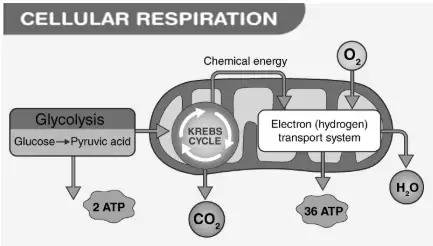
Illustration of Cellular Respiration
Example Problem
Explain why ATP is often referred to as the "energy currency" of the cell.
Solution:
ATP stores energy in its phosphate bonds, which can be quickly released when hydrolyzed.
It acts as an immediate source of energy for cellular reactions, similar to how currency is used for transactions.
ATP is continuously recycled, making it a reusable energy carrier within the cell.
This universality and efficiency make ATP the preferred molecule for energy transfer in biological systems.
Pathways of ATP Generation in Cells
Glycolysis: The Initial Energy Harvesting Step
Glycolysis is the universal first stage of glucose breakdown, occurring in the cytoplasm of all cells. It does not require oxygen and involves a series of enzyme-driven reactions that convert one glucose molecule into two molecules of pyruvate. This process consists of two phases: an energy investment phase consuming ATP, and an energy payoff phase producing ATP and NADH.
Overall, glycolysis yields a net gain of 2 ATP molecules and 2 NADH molecules per glucose molecule. In aerobic conditions, pyruvate proceeds to mitochondria for further oxidation, while under anaerobic conditions, such as intense muscle activity, pyruvate is converted into lactate to regenerate NAD+ and sustain glycolysis.
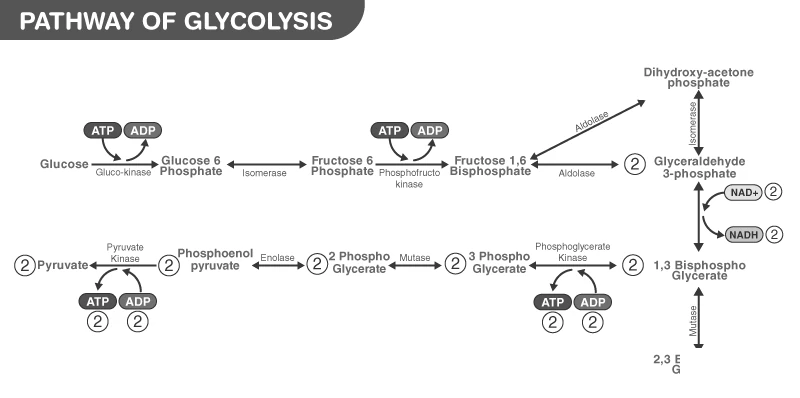
Overview of Glycolysis Pathway
Example Problem
Calculate the net ATP produced from glycolysis when 1 mole of glucose is metabolized anaerobically.
Solution:
During glycolysis, 4 ATP molecules are produced but 2 ATP molecules are consumed in the preparatory phase.
Net ATP gain = 4 - 2 = 2 ATP molecules per glucose.
Since anaerobic glycolysis ends with lactate formation, no additional ATP is produced beyond glycolysis.
Therefore, total net ATP yield per glucose anaerobically is 2 ATP molecules.
Mitochondrial ATP Production: The TCA Cycle and Electron Transport
Following glycolysis, pyruvate enters the mitochondria where it undergoes oxidative decarboxylation to form acetyl CoA, releasing NADH. Acetyl CoA then enters the Tricarboxylic Acid (TCA) cycle, a sequence of enzymatic reactions that oxidize acetyl groups to carbon dioxide while reducing coenzymes NAD+ and FAD to NADH and FADH2 respectively.
The TCA cycle produces one ATP (or GTP), three NADH, and one FADH2 per acetyl CoA molecule. These reduced coenzymes carry electrons to the electron transport chain (ETC) embedded in the inner mitochondrial membrane, where oxidative phosphorylation occurs.
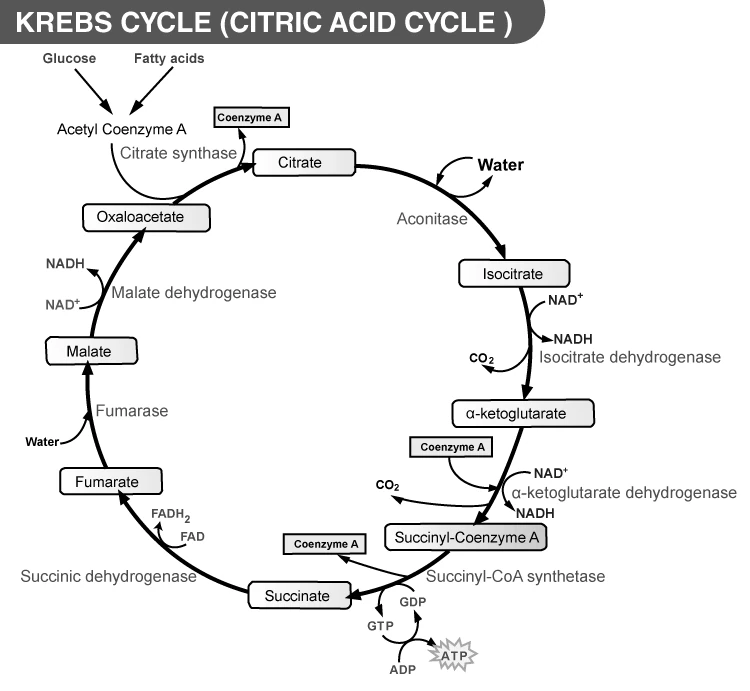
Representation of the Krebs (TCA) Cycle
Example Problem
Determine the total NADH molecules generated from the complete oxidation of one glucose molecule through glycolysis and the TCA cycle.
Solution:
Glycolysis produces 2 NADH per glucose.
Each glucose yields 2 pyruvate molecules, each converted to 1 acetyl CoA producing 1 NADH each, totaling 2 NADH.
Each acetyl CoA entering the TCA cycle generates 3 NADH, so 2 acetyl CoA produce 6 NADH.
Total NADH = 2 (glycolysis) + 2 (pyruvate oxidation) + 6 (TCA cycle) = 10 NADH molecules.
Electron Transport Chain and ATP Synthase: Final Energy Conversion
The electron transport chain (ETC) consists of four major protein complexes located in the inner mitochondrial membrane. Electrons from NADH and FADH2 are transferred through these complexes, driving proton pumping from the mitochondrial matrix to the intermembrane space, creating an electrochemical gradient.
This proton motive force powers ATP synthase (Complex V), an enzyme that synthesizes ATP from ADP and inorganic phosphate by allowing protons to flow back into the matrix through its channel. Oxygen acts as the final electron acceptor, combining with electrons and protons to form water.
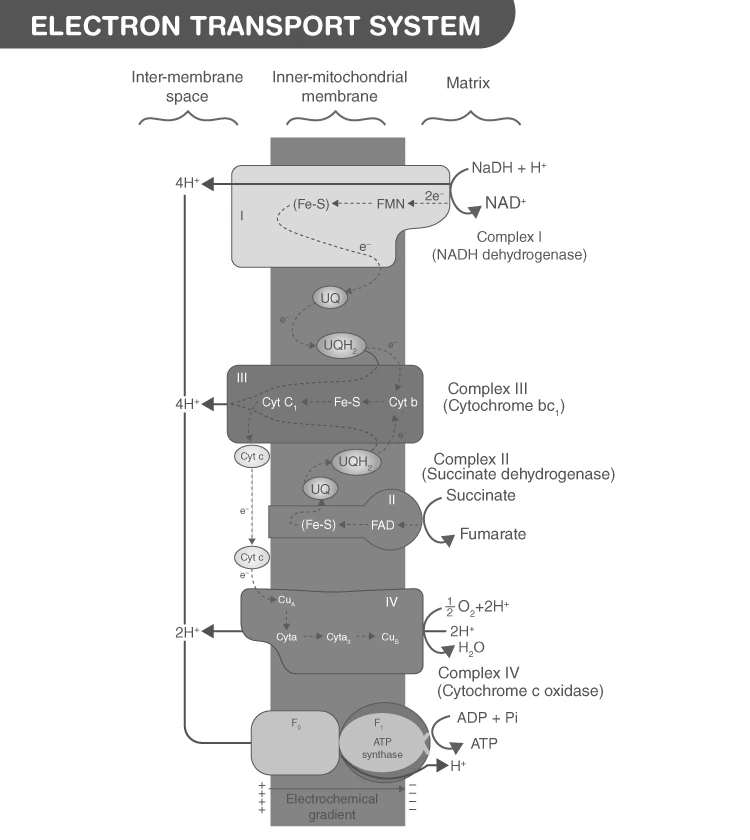
Structure of the Electron Transport System
Example Problem
Calculate the theoretical ATP yield from the oxidation of 1 NADH and 1 FADH2 molecule in the electron transport chain.
Solution:
Oxidation of 1 NADH results in the production of approximately 3 ATP molecules.
Oxidation of 1 FADH2 yields about 2 ATP molecules.
This difference arises because NADH donates electrons to Complex I, pumping more protons, whereas FADH2 donates electrons at Complex II, which pumps fewer protons.
ATP Generation in Photosynthetic Organisms
ATP Synthesis via Chemiosmosis in Chloroplasts
In plants, ATP is also produced during photosynthesis within chloroplasts. Light-driven reactions create a proton gradient across the thylakoid membrane by splitting water molecules and transferring electrons through photosystems. Protons accumulate inside the thylakoid lumen, establishing an electrochemical gradient.
Protons flow back into the stroma through the ATP synthase complex (CF0-CF1), driving ATP synthesis. This ATP is then utilized in the Calvin cycle (dark reactions) for carbohydrate production.
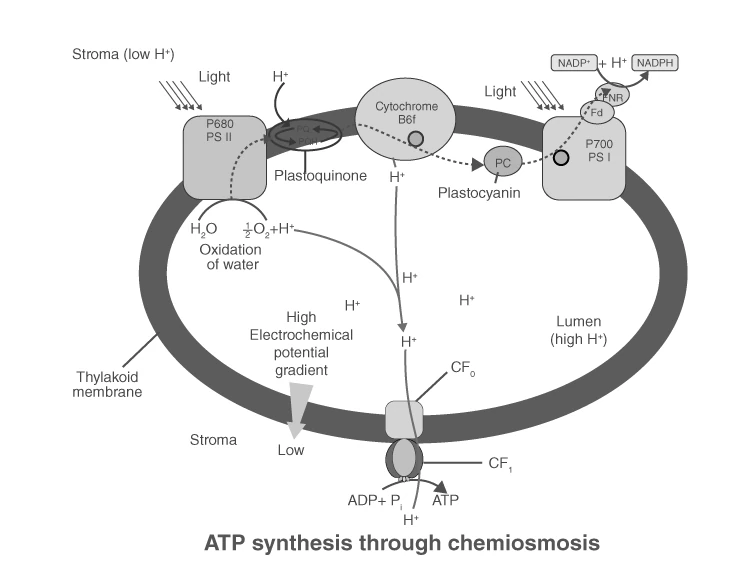
ATP Formation through Chemiosmosis in Chloroplasts
Example Problem
Describe the role of the proton gradient in ATP synthesis during photosynthesis.
Solution:
Light energy splits water, releasing protons into the thylakoid lumen.
Electron transport pumps additional protons into the lumen, increasing proton concentration.
The resulting proton gradient drives protons back into the stroma via ATP synthase.
This proton flow provides the energy needed for ATP synthase to convert ADP and Pi into ATP.
Summary of ATP Production Mechanisms
Process | Location | ATP Yield per Glucose | Key Features |
|---|---|---|---|
Glycolysis | Cytoplasm | 2 ATP (net) | Oxygen not required; produces pyruvate and NADH |
Pyruvate Oxidation | Mitochondrial Matrix | 0 ATP directly; 2 NADH per glucose | Converts pyruvate to acetyl CoA |
TCA Cycle | Mitochondrial Matrix | 2 ATP (GTP) per glucose | Produces NADH and FADH2 for ETC |
Electron Transport Chain | Inner Mitochondrial Membrane | ~34 ATP | Uses NADH and FADH2; oxygen is final electron acceptor |
Photosynthetic ATP Synthesis | Thylakoid Membrane (Chloroplast) | Variable, used in Calvin cycle | Driven by light-induced proton gradient |
Key Terminology in Cellular Energy Metabolism
Term | Definition |
|---|---|
ATP (Adenosine Triphosphate) | Primary energy carrier molecule in cells. |
Glycolysis | Metabolic pathway converting glucose to pyruvate in cytoplasm. |
Pyruvate | End product of glycolysis, precursor for TCA cycle. |
Acetyl CoA | Molecule formed from pyruvate, enters TCA cycle. |
TCA Cycle (Krebs Cycle) | Series of reactions oxidizing acetyl CoA to CO2. |
Electron Transport Chain (ETC) | Protein complexes transferring electrons to oxygen, generating proton gradient. |
Oxidative Phosphorylation | ATP synthesis driven by electron transport and proton gradient. |
ATP Synthase | Enzyme complex synthesizing ATP using proton flow. |
Chemiosmosis | Movement of protons across membrane driving ATP synthesis. |
Photosynthesis | Process by which plants convert light energy into chemical energy. |
Frequently Asked Questions on ATP and Energy Metabolism
What is the total ATP yield from one glucose molecule during aerobic respiration?
Theoretically, aerobic respiration produces about 38 ATP molecules per glucose, including glycolysis, TCA cycle, and oxidative phosphorylation, though actual yield may vary.
Why is oxygen essential in the electron transport chain?
Oxygen acts as the final electron acceptor, combining with electrons and protons to form water, allowing continuous electron flow and ATP production.
How does anaerobic respiration differ from aerobic respiration in ATP production?
Anaerobic respiration yields less ATP (2 ATP per glucose) as it relies solely on glycolysis and converts pyruvate to lactate or other products without using oxygen.
What role does ATP synthase play in energy metabolism?
ATP synthase harnesses the proton gradient to catalyze the formation of ATP from ADP and inorganic phosphate during oxidative phosphorylation or photosynthesis.
Can ATP be stored for long periods in cells?
No, ATP is unstable and used immediately; cells continuously regenerate ATP to meet energy demands.