Eukaryotic Cells: Structure, Functions, and Life Cycle
Fundamentals of Eukaryotic Cells
Defining Features and Biological Significance
Eukaryotic cells are distinguished by the presence of a nucleus enclosed within a double membrane, which houses the cell's genetic material. These cells form the basis of complex organisms such as plants, animals, fungi, and protozoa, classified under the domain Eukaryota. Their compartmentalized internal structure allows for specialized metabolic processes to occur simultaneously, enabling them to grow larger and perform more complex functions than prokaryotic cells.
This compartmentalization is essential for maintaining distinct microenvironments within the cell, facilitating efficient biochemical reactions and cellular regulation.
Example Problem
Question: Explain why eukaryotic cells can grow larger than prokaryotic cells and how compartmentalization contributes to this ability.
Answer:
Eukaryotic cells have membrane-bound organelles that separate different biochemical processes.
This separation allows simultaneous metabolic reactions without interference.
Compartmentalization optimizes efficiency and regulation of cellular activities.
As a result, eukaryotic cells can maintain larger sizes and complex functions compared to prokaryotes.
Structural Components and Characteristics of Eukaryotic Cells
Key Organelles and Their Roles
Eukaryotic cells possess several defining structures that contribute to their function and integrity:
Nucleus: Enclosed by a nuclear membrane, it contains linear DNA and controls cellular activities.
Mitochondria: Known as the powerhouse, they generate energy through cellular respiration.
Locomotory Structures: Flagella and cilia enable movement in certain eukaryotic cells.
Cell Wall: Present in plants and fungi, it provides rigidity and protection; absent in animal cells.
Cytoskeleton: A network of microfilaments and microtubules that maintain cell shape and facilitate movement.
Cell Division: Eukaryotic cells reproduce via mitosis, ensuring genetic consistency.
These features collectively enable eukaryotic cells to perform complex biological functions and adapt to diverse environments.
Example Problem
Question: Identify three organelles unique to eukaryotic cells and describe their functions.
Answer:
Nucleus: Stores genetic information and regulates gene expression.
Mitochondria: Produces ATP through aerobic respiration.
Endoplasmic Reticulum: Synthesizes proteins (rough ER) and lipids (smooth ER).
Detailed Architecture of Eukaryotic Cells
Membranes, Organelles, and Cytoskeleton
The eukaryotic cell is composed of various specialized structures:
Plasma Membrane: A selectively permeable barrier embedded with proteins that regulate substance exchange.
Cell Wall: A rigid outer layer in plants made of cellulose, providing shape and protection; absent in animal cells.
Cytoskeleton: Composed of microfilaments and microtubules, it maintains cell shape, anchors organelles, and enables intracellular transport.
Endoplasmic Reticulum (ER): A network of tubules; rough ER has ribosomes for protein synthesis, while smooth ER synthesizes lipids.
Nucleus: Contains nucleoplasm with DNA and proteins; surrounded by a double membrane with pores for molecular transport.
Golgi Apparatus: Stacks of flattened cisternae involved in modifying, sorting, and packaging proteins and lipids.
Ribosomes: Sites of protein synthesis, composed of RNA and proteins.
Mitochondria: Double-membraned organelles with inner folds called cristae, crucial for energy production.
Lysosomes: Contain hydrolytic enzymes to digest macromolecules and cellular debris.
Plastids: Present only in plant cells; include chloroplasts for photosynthesis, chromoplasts for pigment storage, and leucoplasts for storage of starch, oils, or proteins.
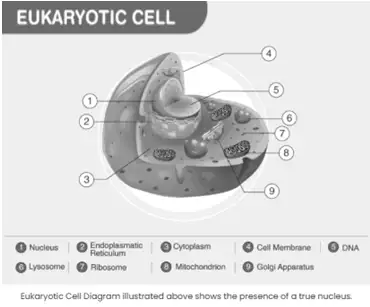
Illustration of a Eukaryotic Cell with Organelles
Example Problem
Question: Describe the differences between rough and smooth endoplasmic reticulum and their functions.
Answer:
Rough ER: Studded with ribosomes; synthesizes and processes proteins.
Smooth ER: Lacks ribosomes; involved in lipid synthesis and detoxification.
Both contribute to intracellular transport and membrane production.
Cell Division and Life Cycle of Eukaryotic Cells
Phases and Regulation of the Cell Cycle
Eukaryotic cells undergo a regulated cycle of growth and division, consisting of distinct phases:
G0 Phase (Quiescence): A resting state where cells do not divide; common in neurons and liver cells.
Interphase: Preparation for division, subdivided into:
G1 Phase: Cell growth and protein synthesis.
S Phase: DNA replication occurs.
G2 Phase: Further growth and preparation for mitosis.
Mitosis: Division of the nucleus through stages:
Prophase
Prometaphase
Metaphase
Anaphase
Telophase
Cytokinesis: Division of the cytoplasm, resulting in two identical daughter cells.
Each daughter cell inherits an exact copy of the parent cell's DNA, ensuring genetic continuity.
Example Problem
Question: Outline the sequence of events during mitosis and explain the significance of metaphase.
Answer:
Prophase: Chromosomes condense, spindle fibers form.
Prometaphase: Nuclear envelope breaks down, spindle fibers attach to chromosomes.
Metaphase: Chromosomes align at the cell equator, ensuring equal segregation.
Anaphase: Sister chromatids separate to opposite poles.
Telophase: Nuclear membranes reform around separated chromatids.
Significance of Metaphase: Proper alignment prevents unequal chromosome distribution, critical for genetic stability.
Examples and Diversity of Eukaryotic Cells
Varied Cell Types Across Organisms
Eukaryotic cells exhibit diversity depending on the organism and function:
Plant Cells: Characterized by a cellulose cell wall, large central vacuole for turgor pressure, and chloroplasts for photosynthesis.
Fungal Cells: Have a chitin-based cell wall; some possess septa with pores allowing cytoplasmic flow.
Animal Cells: Lack a cell wall, have flexible membranes, and can perform endocytosis processes like phagocytosis and pinocytosis.
Protozoa: Mostly unicellular, some with cilia or flagella for movement; pellicle provides structural support.
Example Problem
Question: Compare the cell wall composition of plant and fungal cells and explain its functional importance.
Answer:
Plant cell walls are primarily made of cellulose, providing rigidity and support.
Fungal cell walls contain chitin, which offers strength and protection.
Both types protect cells from mechanical damage and pathogens.
Quick Reference: Summary of Eukaryotic Cell Features
Component | Description | Presence |
|---|---|---|
Nucleus | Membrane-bound, contains linear DNA | All eukaryotic cells |
Mitochondria | Energy production via ATP synthesis | All eukaryotic cells |
Cell Wall | Rigid outer layer; cellulose in plants, chitin in fungi | Plants and fungi only |
Endoplasmic Reticulum | Protein and lipid synthesis | All eukaryotic cells |
Golgi Apparatus | Protein modification and packaging | All eukaryotic cells except some specialized cells |
Ribosomes | Protein synthesis | All eukaryotic cells |
Lysosomes | Digestive enzymes for macromolecule breakdown | Most animal cells |
Plastids | Photosynthesis and storage (chloroplasts, chromoplasts, leucoplasts) | Plant cells only |
Cytoskeleton | Maintains shape and facilitates movement | All eukaryotic cells |
Locomotory Organelles | Cilia and flagella for movement | Some eukaryotic cells |
Glossary of Key Terms
Term | Definition |
|---|---|
Chromoplast | Plastid containing pigments that give plants red, yellow, or orange colors. |
Cilia | Short, hair-like structures that aid in cell movement or fluid movement across the cell surface. |
Endoplasmic Reticulum | Network of membranes involved in protein and lipid synthesis. |
Golgi Apparatus | Organelle that modifies, sorts, and packages proteins and lipids. |
Leucoplast | Colorless plastid involved in storage of starch, oils, or proteins. |
Mitochondria | Organelles responsible for energy production through cellular respiration. |
Nucleus | Membrane-bound organelle containing the cell’s genetic material. |
Plasma Membrane | Selective barrier that controls the movement of substances in and out of the cell. |
Ribosome | Cellular structure where protein synthesis occurs. |
Septum | Partition in fungal hyphae allowing cytoplasmic flow between cells. |
Frequently Asked Questions
Are eukaryotic cells always multicellular?
Eukaryotic cells can be unicellular, like protozoa, or multicellular, such as plants and animals.
What feature primarily distinguishes eukaryotic cells from prokaryotic cells?
The presence of a membrane-bound nucleus is the key distinguishing feature of eukaryotic cells.
Do viruses belong to eukaryotes?
No, viruses are not classified as eukaryotes or prokaryotes since they lack cellular structure and depend on host cells for replication.
How do eukaryotic cells reproduce?
Eukaryotic cells divide through mitosis, a process ensuring two genetically identical daughter cells.
What evidence supports the endosymbiotic origin of mitochondria and chloroplasts?
Both organelles contain their own DNA similar to bacterial DNA, supporting the theory that they originated from symbiotic bacteria.