Understanding the Electron Transport Chain and ATP Synthesis
Fundamentals of Electron Transport and Energy Conversion
Overview of Electron Transport Chain Functionality
The electron transport chain (ETC) is a sequence of protein complexes and molecules embedded in the mitochondrial membrane that facilitate the transfer of electrons from electron carriers to oxygen. This transfer generates a proton gradient across the membrane, which is then harnessed to produce ATP through oxidative phosphorylation. The ETC is essential for cellular energy production, as it yields the majority of ATP during aerobic respiration.
Within the chain, electrons are passed along a series of redox reactions, similar to a relay race, where each component accepts electrons and passes them to the next. The final electron acceptor is molecular oxygen, which combines with electrons and protons to form water, highlighting the critical role of oxygen in this process.
Example Problem
In a mitochondrion, if 3 electrons are transferred through the electron transport chain, and each electron transfer pumps 4 protons across the inner membrane, calculate the total number of protons pumped.
Solution:
Number of electrons transferred = 3
Protons pumped per electron = 4
Total protons pumped = \(3 \times 4 = 12\) protons
Thus, 12 protons are translocated across the membrane, contributing to the proton gradient used for ATP synthesis.
Detailed Components of the Mitochondrial Electron Transport Chain
Structure and Role of Protein Complexes
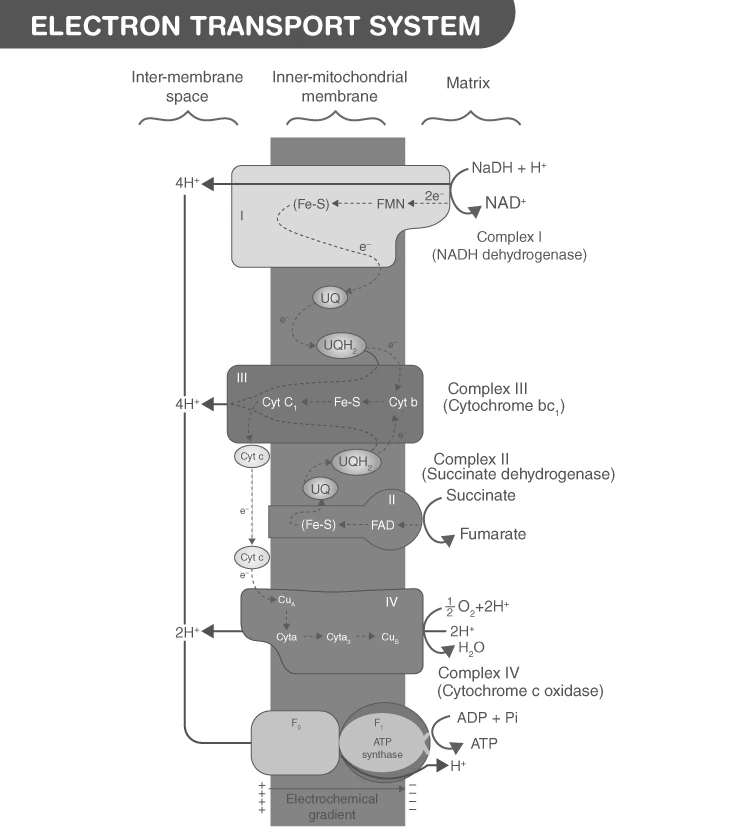
The electron transport chain consists of four main protein complexes, each with specific functions and cofactors. These complexes are embedded in the inner mitochondrial membrane and work sequentially to transfer electrons and pump protons.
Complex I, known as NADH-Q oxidoreductase, contains iron-sulfur clusters and flavin mononucleotide (FMN), which accepts electrons from NADH. FMN is a derivative of vitamin B2 and plays a crucial role in electron acceptance.
Complex II, or Succinate-Q reductase, receives electrons from FADH2, bypassing Complex I. Both Complex I and II transfer electrons to ubiquinone (Q), a lipid-soluble molecule that shuttles electrons to Complex III.
Example Problem
During electron transport, if Complex II transfers 2 electrons to ubiquinone, and each electron transfer results in pumping 3 protons, how many protons are pumped by Complex II?
Solution:
Electrons transferred = 2
Protons pumped per electron = 3
Total protons pumped = \(2 \times 3 = 6\) protons
Therefore, Complex II contributes to pumping 6 protons across the membrane.
Mechanisms of Electron Transfer and Proton Pumping in Complexes III and IV
Functionality of Cytochrome Complexes and Oxygen Reduction
Complex III, called Cytochrome c reductase, contains cytochromes b and c and iron-sulfur proteins. It facilitates electron transfer from ubiquinone to cytochrome c while pumping protons into the intermembrane space, enhancing the proton gradient.
Complex IV, or Cytochrome c oxidase, includes cytochromes a and a3, which hold oxygen molecules between copper and iron centers. This complex completes the electron transport by reducing oxygen to water, a process that consumes protons from the mitochondrial matrix.
The reduction of oxygen is vital as it maintains the flow of electrons through the chain and prevents electron backup, ensuring continuous ATP production.
Example Problem
In Complex IV, if 4 electrons reduce one oxygen molecule, and 4 protons are consumed from the matrix to form water, write the balanced chemical equation for this reaction.
Solution:
The reaction is:
\[ \mathrm{O_2} + 4e^- + 4H^+ \rightarrow 2H_2O \]
This shows that molecular oxygen accepts electrons and protons to form water, completing the electron transport process.
Summary of Key Concepts
| Component | Primary Function | Electron Donor | Proton Pumping |
|---|---|---|---|
| Complex I (NADH-Q oxidoreductase) | Accepts electrons from NADH; pumps protons | NADH | Yes |
| Complex II (Succinate-Q reductase) | Transfers electrons from FADH2; no proton pumping | FADH2 | No |
| Complex III (Cytochrome c reductase) | Transfers electrons to cytochrome c; pumps protons | Ubiquinone (Q) | Yes |
| Complex IV (Cytochrome c oxidase) | Reduces oxygen to water; pumps protons | Cytochrome c | Yes |
| Ubiquinone (Q) | Electron carrier between Complex I/II and III | Complex I/II | Not applicable |
| Cytochrome c | Electron carrier between Complex III and IV | Complex III | Not applicable |
Glossary of Essential Terms
| Term | Definition |
|---|---|
| Electron Transport Chain (ETC) | A series of protein complexes that transfer electrons and pump protons to generate ATP. |
| Oxidative Phosphorylation | Process of ATP synthesis powered by the proton gradient created by the ETC. |
| Proton Gradient | Difference in proton concentration across the mitochondrial membrane used to drive ATP synthesis. |
| Complex I | NADH-Q oxidoreductase; first protein complex in ETC accepting electrons from NADH. |
| Complex II | Succinate-Q reductase; accepts electrons from FADH2 and passes them to ubiquinone. |
| Complex III | Cytochrome c reductase; transfers electrons to cytochrome c and pumps protons. |
| Complex IV | Cytochrome c oxidase; reduces oxygen to water and pumps protons. |
| Ubiquinone (Q) | Mobile electron carrier that shuttles electrons between complexes I/II and III. |
| Cytochrome c | Small protein that transfers electrons from Complex III to Complex IV. |
| ATP (Adenosine Triphosphate) | Primary energy currency of the cell produced during oxidative phosphorylation. |
Frequently Asked Questions
What is the main purpose of the electron transport chain?
The ETC transfers electrons through protein complexes to create a proton gradient that drives ATP synthesis, providing energy for cellular activities.
Why is oxygen essential in the electron transport chain?
Oxygen acts as the final electron acceptor, combining with electrons and protons to form water, which allows the ETC to continue functioning.
How does the proton gradient lead to ATP production?
The proton gradient generates potential energy across the membrane, which ATP synthase uses to convert ADP and inorganic phosphate into ATP.
What roles do ubiquinone and cytochrome c play?
They are mobile electron carriers that shuttle electrons between the protein complexes within the ETC.
How many ATP molecules are produced from one NADH molecule?
Typically, the oxidation of one NADH molecule through the ETC results in the production of approximately 2.5 to 3 ATP molecules.