Comprehensive Overview of Echinodermata
Distinctive Features and Habitat of Echinoderms
Marine Exclusivity and Body Organization
Echinoderms are exclusively marine animals, inhabiting various oceanic zones from shallow intertidal areas to deep sea floors. No species from this phylum have adapted to freshwater or terrestrial environments. These organisms are multicellular with well-developed organ systems, including circulatory and digestive systems, reflecting an advanced level of biological organization.
They possess a triploblastic body plan with a true coelomic cavity and a skeleton composed primarily of calcium carbonate. Their bodies are unsegmented and lack a distinct head, with the mouth located on the underside (ventral side) and the anus on the upper side (dorsal side). The skin is characteristically spiny, providing protection and structural support.
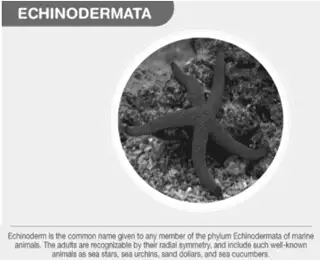
Illustration of a typical Echinoderm with spiny skin and radial symmetry
The water vascular system is a unique feature of echinoderms, facilitating gas exchange, nutrient transport, and waste removal. This system also powers their tube feet, which aid in locomotion and feeding. Respiration occurs through gills or specialized structures like the cloacal respiratory tree.
Example Problem
Question: Explain how the water vascular system supports both movement and respiration in echinoderms.
Answer:
The water vascular system consists of a network of fluid-filled canals connected to tube feet.
Hydraulic pressure generated within these canals extends and retracts the tube feet, enabling movement.
Additionally, the system facilitates gas exchange by circulating water through respiratory structures such as gills or cloacal trees.
This dual function supports both locomotion and respiration efficiently in the marine environment.
Core Characteristics and Biological Traits of Echinoderms
Structural and Functional Attributes
Echinoderms exhibit radial symmetry, often resembling star-shaped or spherical forms. Their bodies are covered with spiny skin, which serves as a defense mechanism. The skeleton is internal and made of calcareous plates, providing rigidity and protection.
They have an open circulatory system and a simple radial nervous system without a centralized brain. Excretory organs are absent, and waste elimination occurs through diffusion. Their sensory organs are rudimentary, including chemoreceptors and tactile structures, which help them respond to environmental stimuli.
Reproduction is primarily sexual with external fertilization, although many species can regenerate lost body parts, enabling asexual reproduction. Development typically involves indirect metamorphosis, with larval stages distinct from adults.
Example Problem
Question: Describe the reproductive strategies and regenerative abilities of echinoderms.
Answer:
Echinoderms reproduce sexually through the release of gametes into the water, where fertilization occurs externally.
Many species can regenerate lost limbs or body parts, allowing asexual reproduction and survival after injury.
Their development includes larval stages that differ morphologically from adults, indicating indirect development.
Diverse Classes within Echinodermata and Their Distinctive Features
Classification and Unique Traits of Major Groups
The phylum Echinodermata is divided into several classes, each with distinct morphological and physiological characteristics:
Asteroidea: Star-shaped with five arms, possessing tube feet with suckers and respiratory papulae. Their bodies have calcareous plates and movable spines, along with pedicellariae for cleaning. Examples include Asterias and Zoroaster.
Ophiuroidea: Characterized by a flat body with a central disc and long, slender arms without suckers on tube feet. Respiration occurs through bursae. Examples are Ophiderma and Amphuria.
Echinoidea: Hemispherical body lacking arms, with tube feet that have suckers. They have a compact skeleton and movable spines. Examples include Echinus and Cidaris.
Holothuroidea: Elongated, cylindrical body without arms, spines, or pedicellariae. Respiration is through the cloacal respiratory tree, and tube feet have suckers. Examples are Cucumaria and Holothuria.
Crinoidea: Star-shaped body with bifurcated arms, tube feet without suckers, and absence of spines and pedicellariae. Examples include Neometra and Antedon.
Example Problem
Question: Compare the respiratory structures of Asteroidea and Holothuroidea.
Answer:
Asteroidea respire through papulae, which are small projections on the body surface facilitating gas exchange.
Holothuroidea use a cloacal respiratory tree, an internal branching structure connected to the anus, for respiration.
This difference reflects adaptations to their respective body forms and lifestyles.
Quick Reference: Summary of Echinodermata Features
Feature | Description |
|---|---|
Habitat | Exclusively marine environments |
Symmetry | Radial symmetry, often pentamerous |
Skeleton | Internal calcareous plates |
Circulatory System | Open type |
Respiration | Gills, papulae, bursae, or cloacal respiratory tree |
Nervous System | Simple radial without brain |
Reproduction | Sexual (external fertilization) and asexual (regeneration) |
Development | Indirect with larval stages |
Locomotion | Tube feet powered by water vascular system |
Excretory System | Absent; waste eliminated by diffusion |
Glossary of Key Terms Related to Echinodermata
Term | Definition |
|---|---|
Water Vascular System | A network of fluid-filled canals unique to echinoderms used for locomotion, feeding, and respiration. |
Tube Feet | Small, flexible appendages operated hydraulically for movement and attachment. |
Pedicellaria | Small pincer-like structures on the surface used for cleaning and defense. |
Papulae | Skin gills that facilitate respiration in some echinoderms. |
Bursae | Sac-like structures used for respiration and excretion in brittle stars. |
Cloacal Respiratory Tree | Internal respiratory organ connected to the anus in sea cucumbers. |
Calcareous Plates | Hard skeletal elements forming the endoskeleton of echinoderms. |
Triploblastic | Having three primary germ layers: ectoderm, mesoderm, and endoderm. |
Coelom | A fluid-filled body cavity lined by mesodermal tissue. |
Regeneration | The ability to regrow lost or damaged body parts. |
Frequently Asked Questions on Echinodermata
What environments do echinoderms inhabit?
Echinoderms are found exclusively in marine habitats, ranging from shallow coastal waters to deep ocean floors. They do not live in freshwater or on land.
How does the water vascular system function in echinoderms?
This system uses hydraulic pressure to operate tube feet for movement and also assists in respiration and nutrient transport.
Can echinoderms regenerate lost body parts?
Yes, many echinoderms can regenerate limbs or other body parts, which helps in asexual reproduction and survival after injury.
What type of symmetry do echinoderms exhibit?
Adult echinoderms typically show radial symmetry, often pentamerous (five-part), although larvae are bilaterally symmetrical.
How do echinoderms reproduce?
They reproduce sexually through external fertilization, releasing eggs and sperm into the water, and some can also reproduce asexually through regeneration.