Understanding Double Fertilization in Flowering Plants
Fundamentals of Double Fertilization in Angiosperms
Concept and Mechanism of Double Fertilization
Double fertilization is a distinctive reproductive feature found exclusively in flowering plants, or angiosperms. This intricate process involves the fusion of two male gametes with components of the female gametophyte. Specifically, one male gamete merges with the egg cell to form a diploid zygote, while the other male gamete fuses with two polar nuclei to create a triploid primary endosperm nucleus. This dual fusion event ensures both the formation of the future embryo and the nutritive tissue that supports its development.
This process not only restores the diploid chromosome number but also triggers the transformation of the ovary into fruit and the ovules into seeds, facilitating successful reproduction and dispersal.
Example: Calculating Chromosome Number After Double Fertilization
In a flowering plant species where the haploid number of chromosomes is 12, determine the chromosome number in the zygote and the primary endosperm nucleus formed after double fertilization.
Solution:
The haploid number \( n = 12 \).
The zygote is diploid, so its chromosome number is:
\[ 2n = 2 \times 12 = 24 \text{ chromosomes} \]
The primary endosperm nucleus is triploid, formed by fusion of two polar nuclei and one male gamete:
\[ 3n = 3 \times 12 = 36 \text{ chromosomes} \]
Thus, the zygote has 24 chromosomes, and the primary endosperm nucleus has 36 chromosomes.
Detailed Sequence of Double Fertilization in Flowering Plants
Stepwise Progression from Pollination to Fertilization
In angiosperms, flowers contain distinct male and female reproductive structures. Pollination transfers pollen grains to the stigma, from where pollen tubes grow through the style to reach the ovule. Each pollen grain contains two sperm cells that travel down the tube.
Upon reaching the ovule, one sperm cell fertilizes the egg cell, forming the zygote, while the other sperm cell fuses with the two polar nuclei located in the central cell of the embryo sac. This fusion results in the primary endosperm nucleus, which later develops into the endosperm, a tissue that nourishes the developing embryo.
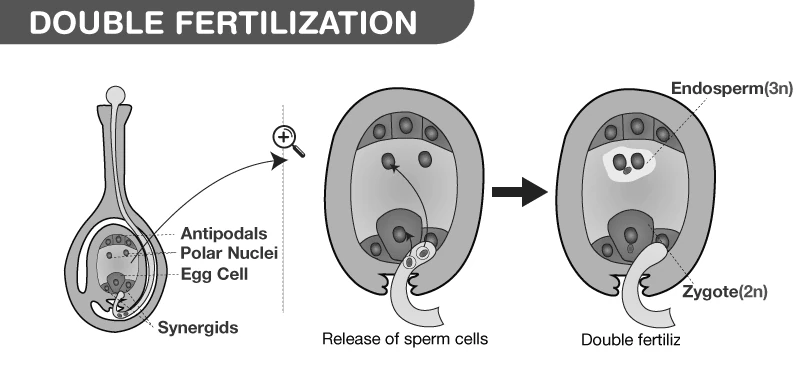
Illustration of Double Fertilization Process in Angiosperms
Example: Identifying Fertilization Products
During fertilization in a flowering plant, one sperm cell fuses with the egg cell, and the other fuses with two polar nuclei. What are the ploidy levels of the resulting zygote and endosperm?
Answer:
The zygote formed by fusion of haploid sperm and egg is diploid (2n).
The endosperm formed by fusion of one sperm and two polar nuclei is triploid (3n).
Embryo Formation and Development Post Fertilization
Stages of Embryogenesis in Flowering Plants
Following fertilization, the zygote undergoes a series of cell divisions initiating embryonic development. The first division produces an upper terminal cell and a lower basal cell. The basal cell forms the suspensor, which anchors the embryo and facilitates nutrient transfer, while the terminal cell develops into the pro-embryo.
The embryo progresses through several stages: it first becomes globular, then heart-shaped as cotyledons form, followed by a bent stage, and finally fills the seed completely as it matures.
Sequential Development of Embryo in Flowering Plants
Example: Role of Suspensor in Embryo Development
Explain the function of the suspensor during early embryonic development in angiosperms.
Answer:
The suspensor anchors the embryo to the ovule.
It facilitates the transfer of nutrients and growth regulators from maternal tissues to the developing embryo.
It helps in pushing the embryo into the nutritive tissue for better nourishment.
Importance and Outcomes of Double Fertilization
Biological Significance and Advantages
Double fertilization ensures efficient use of male gametes by producing two essential structures: the zygote and the endosperm. The endosperm acts as a nutritive tissue, supporting the embryo's growth within the seed. This process enhances seed viability and increases the chances of successful plant reproduction.
Additionally, double fertilization can lead to polyembryony, where multiple embryos develop from a single fertilization event, improving the plant's survival prospects.
Significance of Double Fertilization in Angiosperms
Example: Benefits of Double Fertilization
List three key advantages of double fertilization in flowering plants.
Answer:
Formation of endosperm provides nourishment to the developing embryo.
Stimulates the ovary to develop into fruit, aiding seed dispersal.
Utilizes both male gametes efficiently, enhancing reproductive success.
Quick Reference: Summary of Double Fertilization
Aspect | Details |
|---|---|
Definition | Fusion of one female gamete with two male gametes in angiosperms. |
Products | Diploid zygote and triploid primary endosperm nucleus. |
Significance | Formation of embryo and nutritive endosperm; fruit development. |
Location | Occurs inside the ovule of flowering plants. |
Unique Feature | Exclusive to angiosperms; absent in gymnosperms. |
Discovery | Identified by Nawaschin in 1898. |
Embryo Development | Begins with zygote division into terminal and basal cells. |
Endosperm | Triploid tissue providing nourishment to embryo. |
Polyembryony | Possible occurrence due to double fertilization. |
Pollination Role | Transfers pollen grains to stigma initiating fertilization. |
Glossary of Key Terms
Term | Meaning |
|---|---|
Angiosperms | Flowering plants that produce seeds enclosed within fruits. |
Double Fertilization | Fusion of one egg with one sperm and two polar nuclei with another sperm. |
Zygote | Diploid cell formed by fusion of egg and sperm, develops into embryo. |
Endosperm | Triploid nutritive tissue supporting embryo development. |
Polar Nuclei | Two nuclei in the central cell of embryo sac that fuse with sperm. |
Synergid | Cells adjacent to egg cell that help guide pollen tube. |
Suspensor | Structure derived from basal cell that supports embryo growth. |
Pro-embryo | Early stage embryo formed from terminal cell division. |
Pollination | Transfer of pollen grains from anther to stigma. |
Polyembryony | Formation of multiple embryos from a single fertilization event. |
Frequently Asked Questions
What is double fertilization in flowering plants?
It is the process where one sperm fertilizes the egg to form a zygote, and the other sperm fuses with two polar nuclei to form the primary endosperm nucleus.
Why is double fertilization important?
It ensures formation of both the embryo and nutritive endosperm, which supports seed development and fruit formation.
What are the products of double fertilization?
The two main products are the diploid zygote and the triploid primary endosperm nucleus.
Why do gymnosperms not exhibit double fertilization?
Gymnosperms lack ovaries and have different reproductive structures, so their fertilization process does not involve fusion with polar nuclei.
Who discovered double fertilization and when?
Double fertilization was discovered by Nawaschin in 1898 while studying certain liliaceous plants.