Understanding Pollination: Mechanisms and Types
Fundamentals of Pollination in Flowering Plants
Defining Pollination and Its Role in Plant Reproduction
Pollination is the biological process where pollen grains are transferred from the male reproductive organ, the anther, to the female receptive part, the stigma, of a flower. This transfer must occur between flowers of the same species to ensure successful fertilization and seed formation. Pollination is essential for the continuation of plant species as it enables sexual reproduction by combining genetic material from parent plants.
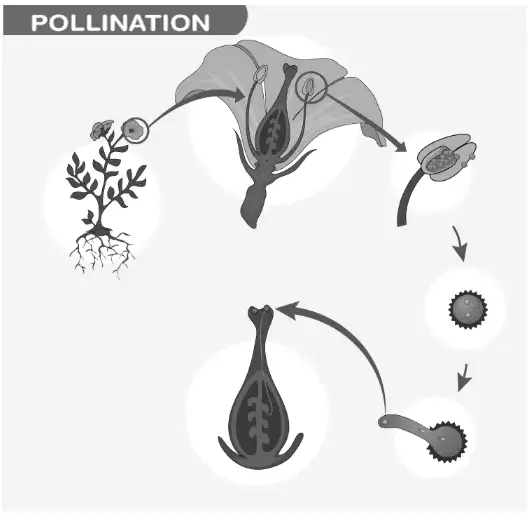
Diagram illustrating the pollination process
Stepwise Mechanism of Pollination and Fertilization
The pollination process initiates when pollen grains land on the stigma of a compatible flower. Subsequently, a pollen tube develops, growing through the style to reach the ovary. This tube acts as a conduit for sperm cells to travel from the pollen grain to the ovule. Upon arrival, fertilization occurs as sperm cells unite with egg cells, leading to seed formation. The seed then detaches from the parent plant, capable of germinating into a new individual, thus perpetuating the species.
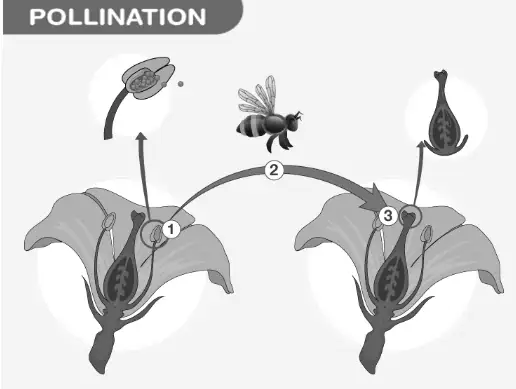
Visual representation of pollen tube growth and fertilization
Example Problem
A pollen grain takes 48 hours to grow a pollen tube of length 12 mm to reach the ovary. Calculate the average growth rate of the pollen tube in micrometers per hour.
Solution:
Given length of pollen tube, \( L = 12 \text{ mm} = 12,000 \text{ μm} \)
Time taken, \( t = 48 \text{ hours} \)
Average growth rate, \( r = \frac{L}{t} = \frac{12,000 \text{ μm}}{48 \text{ hours}} = 250 \text{ μm/hour} \)
Therefore, the pollen tube grows at an average rate of \( 250 \text{ μm/hour} \).
Exploring the Varieties of Pollination
Self-Pollination: Characteristics and Implications
Self-pollination occurs when pollen grains from the anther of a flower are directly deposited onto the stigma of the same flower or another flower on the same plant. This method is straightforward and rapid but limits genetic variation since the genetic material comes from a single parent. It ensures the preservation of specific traits but may reduce the overall vigor of the progeny due to limited gene mixing.
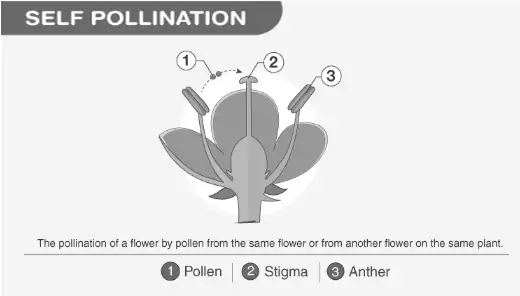
Illustration of self-pollination within a flower
Pros and Cons of Self-Pollination
Maintains genetic purity by preventing gene mixing.
Minimizes pollen wastage as transfer occurs within the same flower.
Does not depend on external agents like wind or animals.
Ensures reproductive success even with limited pollen production.
However, self-pollination has drawbacks:
Reduces genetic diversity, potentially lowering adaptability.
May decrease the vigor and disease resistance of offspring.
Example Problem
A flower produces 150 pollen grains, and 90% of them successfully pollinate the same flower's stigma. Calculate the number of pollen grains that do not contribute to pollination.
Solution:
Total pollen grains = 150
Successful pollination = \( 90\% \) of 150 = \( 0.9 \times 150 = 135 \)
Unsuccessful pollen grains = \( 150 - 135 = 15 \)
Hence, 15 pollen grains fail to participate in pollination.
Cross-Pollination and Its Diverse Mechanisms
Understanding Cross-Pollination and Its Genetic Benefits
Cross-pollination involves the transfer of pollen grains from the anther of one flower to the stigma of a different flower, often on another plant of the same species. This process enhances genetic diversity by combining different genetic materials, resulting in offspring with varied traits and improved adaptability.
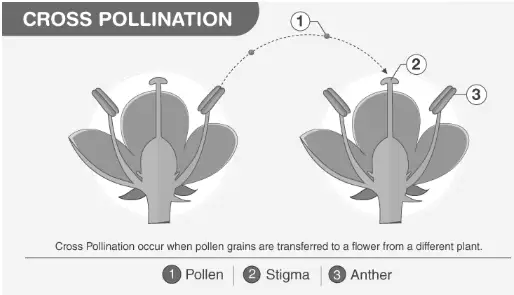
Depiction of pollen transfer between different flowers
Categories of Cross-Pollination Based on Pollinating Agents
Cross-pollination relies on various biotic and abiotic vectors to facilitate pollen transfer:
Anemophily (Wind Pollination): Plants like maize, coconut, and grasses produce large amounts of lightweight pollen. Their flowers are typically small, greenish, and lack scent or nectar, as they do not attract animals. The stigmas are often feathery and exposed to catch airborne pollen.
Zoophily (Animal Pollination): Animals such as insects, birds, and bats assist in pollination by carrying pollen while feeding on nectar or fruits, aiding in seed dispersal and genetic exchange.
Anthropophily (Artificial Pollination): Humans manually transfer pollen to facilitate fertilization, especially when natural pollination is insufficient. This method is used in hybridization and crop improvement.
Advantages and Limitations of Cross-Pollination
Generates offspring with enhanced vigor and disease resistance.
Enables reproduction in unisexual plants.
Eliminates harmful recessive traits through genetic recombination.
Introduces new genetic combinations, promoting species evolution.
Despite these benefits, cross-pollination has some disadvantages:
Significant pollen wastage due to dependence on external agents.
Possibility of undesirable traits appearing due to genetic recombination.
Example Problem
A wind-pollinated plant produces 1,000,000 pollen grains, but only 0.1% successfully fertilize ovules. Calculate the number of pollen grains that achieve fertilization and those wasted.
Solution:
Total pollen grains = 1,000,000
Successful fertilization = \( 0.1\% \) of 1,000,000 = \( \frac{0.1}{100} \times 1,000,000 = 1,000 \)
Pollen grains wasted = \( 1,000,000 - 1,000 = 999,000 \)
Thus, 1,000 pollen grains fertilize ovules, while 999,000 are wasted.
Wind Pollination (Anemophily) in Detail
Wind-pollinated plants typically have inconspicuous flowers without bright colors or scent. They produce copious amounts of light pollen grains that are easily carried by air currents. The stigmas are large and feathery to maximize pollen capture. Examples include maize, coconut, and many gymnosperms.
Animal-Mediated Pollination (Zoophily)
Animals contribute significantly to pollination by transferring pollen while feeding on nectar or fruits. This interaction not only aids reproduction but also helps in seed dispersal, allowing plants to colonize new areas.
Human-Assisted Pollination (Anthropophily)
When natural pollination is inadequate, humans intervene by manually transferring pollen to female flowers. This artificial pollination supports hybridization and enhances crop yields.
Summary Table: Key Points on Pollination
Aspect | Self-Pollination | Cross-Pollination |
|---|---|---|
Definition | Pollen transfer within the same flower or plant | Pollen transfer between different flowers or plants |
Genetic Variation | Low; offspring are genetically similar | High; offspring have diverse traits |
Dependence on Agents | No external agents required | Requires biotic or abiotic pollinators |
Pollen Wastage | Minimal | Significant |
Advantages | Maintains purity; efficient | Increases vigor; promotes diversity |
Disadvantages | Reduced vigor and adaptability | Pollen wastage; possible unwanted traits |
Glossary of Important Terms
Term | Meaning |
|---|---|
Anther | The male part of a flower that produces pollen grains |
Stigma | The female part of a flower that receives pollen |
Pollen Grain | Microscopic structure containing male gametes |
Pollen Tube | A tube that grows from pollen grain to ovule for fertilization |
Fertilization | Fusion of male and female gametes to form a zygote |
Self-Pollination | Transfer of pollen within the same flower or plant |
Cross-Pollination | Transfer of pollen between different flowers or plants |
Anemophily | Pollination carried out by wind |
Zoophily | Pollination facilitated by animals |
Anthropophily | Pollination performed artificially by humans |
Frequently Asked Questions on Pollination
What is the main difference between self-pollination and cross-pollination?
Self-pollination involves pollen transfer within the same flower or plant, while cross-pollination occurs between different flowers or plants, promoting genetic diversity.
Why do wind-pollinated flowers lack bright colors and scent?
Because they rely on wind to transfer pollen, these flowers do not need to attract animals, so they are usually small, greenish, and odorless.
How does artificial pollination benefit agriculture?
Artificial pollination helps overcome natural pollination barriers, enabling hybridization and improving crop yields.
What are the advantages of cross-pollination over self-pollination?
Cross-pollination increases genetic variation, enhances vigor, and improves disease resistance in offspring.
Can self-pollination occur in unisexual plants?
No, unisexual plants require cross-pollination because they have either male or female flowers, not both.