Comprehensive Overview of Assisted Reproductive Technologies
Understanding Assisted Reproductive Technologies and Their Role in Overcoming Infertility
Defining Assisted Reproductive Technologies and Their Applications
Assisted Reproductive Technologies (ART) encompass a range of medical procedures designed to help individuals or couples achieve pregnancy when natural conception is challenging. These techniques include methods such as in vitro fertilization (IVF), artificial insemination, and surrogacy arrangements. According to the World Health Organization, infertility is characterized by the inability to conceive after one year of regular, unprotected intercourse. ART addresses this issue by utilizing both male sperm and female eggs through various interventions.
The process typically involves retrieving eggs from the female partner, fertilizing them with sperm outside the body to form embryos, and then implanting these embryos back into the uterus. IVF remains the most widely used and effective ART method. Additionally, ART may involve the use of donor eggs, donor sperm, or previously frozen embryos. In some cases, a surrogate mother carries the pregnancy, especially when the intended mother cannot conceive or carry a pregnancy to term. One notable challenge with ART is the increased likelihood of multiple pregnancies, which can be mitigated by limiting the number of embryos transferred.
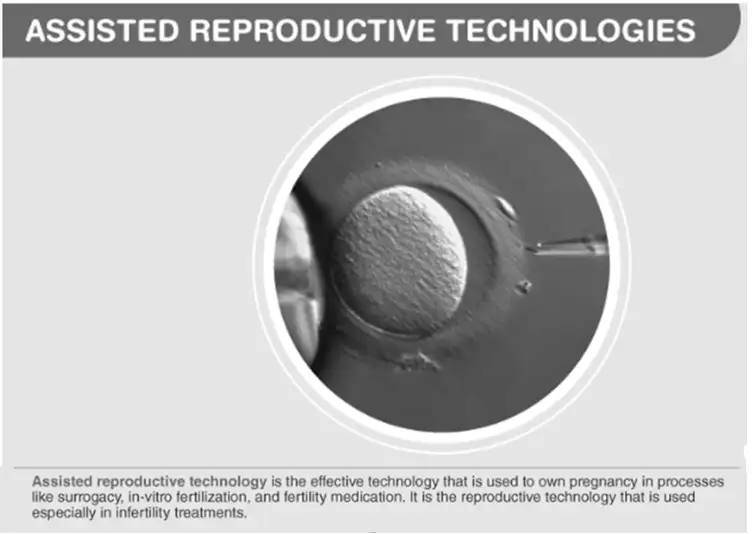
Illustration depicting various Assisted Reproductive Technology methods
Example Problem: ART Procedure Steps
Explain the sequence of steps involved in the IVF process for a couple facing infertility.
Solution:
Ovarian stimulation to produce multiple eggs using fertility medications.
Egg retrieval from the ovaries through a minor surgical procedure.
Collection of sperm sample from the male partner.
Fertilization of eggs with sperm in a laboratory setting to form embryos.
Culture of embryos for several days to monitor development.
Transfer of one or more healthy embryos into the woman’s uterus.
Monitoring for pregnancy confirmation after implantation.
Common Causes of Infertility in Men and Women
Infertility can affect both males and females due to various physiological and structural factors. In men, issues such as erectile dysfunction, low sperm count (oligospermia), absence of sperm (azoospermia), or abnormal sperm shape and motility can hinder fertilization. Age also plays a significant role, as sperm quality and quantity tend to decline with advancing years.
For women, infertility may arise from ovulation disorders like polycystic ovary syndrome (PCOS), poor uterine lining quality due to conditions such as endometriosis, or blockages in the fallopian tubes that prevent sperm and egg meeting. Advanced maternal age reduces egg quality and quantity, further complicating conception.
Example Problem: Identifying Infertility Factors
A 38-year-old woman has irregular menstrual cycles and difficulty conceiving. What could be the possible reasons for her infertility?
Solution:
Irregular cycles suggest ovulation problems, possibly PCOS.
Age-related decline in egg quality may reduce fertility.
Potential uterine or fallopian tube abnormalities should be evaluated.
Varieties of Assisted Reproductive Techniques and Their Specific Uses
Several ART methods are tailored to different infertility causes. IVF involves fertilization outside the body, followed by embryo transfer to the uterus. Gamete Intrafallopian Transfer (GIFT) places both eggs and sperm directly into the fallopian tube, allowing fertilization to occur naturally within the body. Zygote Intrafallopian Transfer (ZIFT) is similar to IVF but transfers the fertilized egg (zygote) into the fallopian tube instead of the uterus.
Intracytoplasmic Sperm Injection (ICSI) is a specialized technique where a single sperm is injected directly into a mature egg, often used when male infertility is severe or previous IVF attempts have failed. Artificial insemination involves placing sperm into the female reproductive tract without sexual intercourse and includes intrauterine, intracervical, and intratubal insemination methods.
Example Problem: Choosing an ART Method
A couple where the male partner has a very low sperm count is seeking fertility treatment. Which ART technique would be most appropriate and why?
Solution:
ICSI is ideal because it involves injecting a single sperm directly into the egg, overcoming low sperm count issues.
Conventional IVF may not be effective due to insufficient sperm to fertilize eggs naturally.
Quick Reference: Summary of Assisted Reproductive Technologies
Technique | Key Feature | Typical Use Case |
|---|---|---|
In Vitro Fertilization (IVF) | Fertilization outside the body; embryo transferred to uterus | General infertility, tubal blockage |
Gamete Intrafallopian Transfer (GIFT) | Eggs and sperm placed in fallopian tube for natural fertilization | Unexplained infertility, ethical/religious preferences |
Zygote Intrafallopian Transfer (ZIFT) | Fertilization outside body; zygote transferred to fallopian tube | Tubal infertility, previous IVF failures |
Intracytoplasmic Sperm Injection (ICSI) | Single sperm injected into egg | Severe male infertility, failed IVF attempts |
Artificial Insemination | Sperm introduced into female reproductive tract | Low sperm motility, cervical issues |
Glossary of Key Terms in Assisted Reproductive Technologies
Term | Definition |
|---|---|
Assisted Reproductive Technology (ART) | Medical procedures used to aid conception and pregnancy. |
In Vitro Fertilization (IVF) | Fertilization of egg by sperm outside the body. |
Intracytoplasmic Sperm Injection (ICSI) | Injection of a single sperm directly into an egg. |
Gamete Intrafallopian Transfer (GIFT) | Transfer of eggs and sperm into fallopian tube for fertilization. |
Zygote Intrafallopian Transfer (ZIFT) | Transfer of fertilized egg (zygote) into fallopian tube. |
Artificial Insemination | Introduction of sperm into female reproductive tract without intercourse. |
Surrogacy | Arrangement where a woman carries a pregnancy for another person or couple. |
Oligospermia | Condition of low sperm count in semen. |
Azoospermia | Absence of sperm in semen. |
Endometriosis | Condition where uterine tissue grows outside the uterus, affecting fertility. |
Frequently Asked Questions on Assisted Reproductive Technologies
What exactly is assisted reproductive technology?
Assisted reproductive technology refers to medical procedures that help individuals or couples conceive by manipulating eggs, sperm, or embryos outside the body or through specialized techniques.
What does ICSI stand for and when is it used?
ICSI stands for Intracytoplasmic Sperm Injection. It is used primarily when male infertility is severe, involving the direct injection of a single sperm into an egg to facilitate fertilization.
Can ART increase the chances of multiple pregnancies?
Yes, ART can lead to multiple pregnancies if multiple embryos are transferred. This risk is managed by limiting the number of embryos implanted during treatment.
Is surrogacy considered a part of ART?
Surrogacy is often associated with ART as it involves a woman carrying a pregnancy for another individual or couple, sometimes using embryos created through ART methods.
What are common causes of infertility in women?
Common causes include ovulation disorders like PCOS, fallopian tube blockages, poor uterine lining quality, endometriosis, and age-related decline in egg quality.