Comprehensive Overview of Angiosperms: Structure, Traits, and Classification
Fundamental Features and Adaptations of Angiosperms
Distinctive Traits of Flowering Plants
Angiosperms, commonly known as flowering plants, are vascular plants characterized by the presence of true stems, roots, and leaves. Their seeds develop enclosed within specialized reproductive structures called flowers, which later mature into fruits. This group represents the most evolved and ecologically significant category of plants, thriving in diverse environments as trees, shrubs, herbs, and climbers.
One of the defining features of angiosperms is their heterosporous nature, producing two types of spores: microspores (which develop into pollen grains) and megaspores (which give rise to the female gametophyte). The sporophyte generation is diploid and distinctly differentiated into roots, stems, and leaves, supported by a complex vascular system containing true vessels in the xylem and companion cells in the phloem.
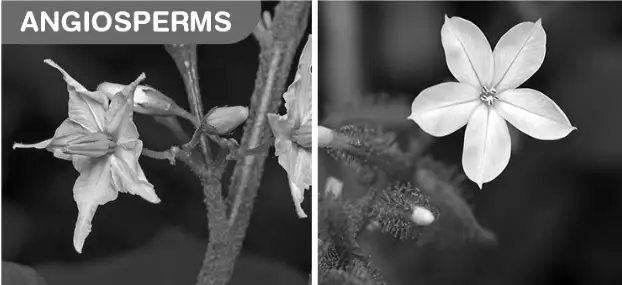
Diagram depicting an angiosperm plant with flowers and fruit formation
The reproductive organs, stamens (male) and carpels (female), are organized within the flower. Each stamen contains microsporangia producing pollen, while the ovules are enclosed within the ovary at the base of the carpel. Pollination involves the transfer of pollen grains from the anther to the stigma, facilitating fertilization. This process is notably rapid in angiosperms, leading to swift seed and fruit development.
Additionally, angiosperms undergo double fertilization, resulting in the formation of a diploid zygote and a triploid endosperm, which nourishes the developing embryo. Their root systems are complex, comprising cortex, xylem, phloem, and epidermis layers, enabling efficient nutrient and water transport.
Example Problem
A certain angiosperm species produces flowers with stamens containing 5 microsporophylls, each microsporophyll having 4 microsporangia. Calculate the total number of microsporangia in one flower.
Solution:
Given:
Number of microsporophylls per stamen = 5
Microsporangia per microsporophyll = 4
Total microsporangia = Number of microsporophylls × Microsporangia per microsporophyll
\[ = 5 \times 4 = 20 \]
Therefore, one flower contains 20 microsporangia in its stamens.
Classification and Structural Differences Among Angiosperms
Monocotyledons: Characteristics and Examples
Monocots are a major group of angiosperms distinguished by seeds containing a single cotyledon. Their leaves typically exhibit parallel venation, and the root system is adventitious rather than taprooted. Floral parts in monocots are usually arranged in multiples of three, and their vascular bundles are numerous and closed, scattered throughout the stem.
Common examples include banana, sugarcane, and lilies, which thrive in various habitats. The structural adaptations of monocots allow them to efficiently absorb nutrients and water, supporting their growth in diverse environments.
Example Problem
A monocot plant has flowers with 6 petals and a root system consisting of adventitious roots. Identify the type of venation expected in its leaves and explain why.
Solution:
Since the plant is a monocot, its leaves will have parallel venation.
Parallel venation means veins run side by side along the length of the leaf.
This venation pattern supports the elongated leaf shape typical of monocots.
Hence, the leaves of this monocot plant exhibit parallel venation.
Dicotyledons: Features and Representative Plants
Dicots are angiosperms with seeds containing two cotyledons. They generally possess a taproot system and leaves with reticulate (net-like) venation. Their flowers often have parts in multiples of four or five, and vascular bundles are arranged in a ring within the stem, allowing secondary growth.
Examples include grapes, sunflowers, and tomatoes. These plants are adapted to a wide range of environments and often show more complex structural development compared to monocots.
Example Problem
A dicot plant has flowers with five petals and a taproot system. Describe the expected arrangement of vascular bundles in its stem and the type of leaf venation.
Solution:
Dicots have vascular bundles arranged in a ring within the stem.
The leaves exhibit reticulate venation, where veins form a network.
This arrangement supports secondary growth and efficient nutrient transport.
Therefore, the stem shows ring-arranged vascular bundles and the leaves have reticulate venation.
Ecological Significance and Evolutionary Advantages of Angiosperms
Adaptability and Reproductive Efficiency
Angiosperms are the most widespread and ecologically dominant group of plants, constituting approximately 80% of the Earth's flora. Their evolutionary success is attributed to rapid fertilization processes, efficient seed production, and the development of fruits that aid in seed dispersal.
The formation of endosperm through triple fusion provides a nutritive tissue that supports seedling growth, enhancing survival rates. Their ability to inhabit diverse ecosystems, including marine environments, highlights their remarkable adaptability.
Example Problem
Explain the significance of double fertilization in angiosperms and how it benefits the developing embryo.
Solution:
Double fertilization involves one sperm fertilizing the egg to form a diploid zygote, and the other sperm fusing with two polar nuclei to form a triploid endosperm.
The endosperm acts as a food reserve, supplying nutrients to the developing embryo.
This process ensures efficient use of resources and supports rapid seedling development.
Thus, double fertilization enhances reproductive success and seed viability in angiosperms.
Historical Origin and Importance to Humans
Angiosperms originated around 250 million years ago and have since become the primary source of food for humans and animals. Their fruits, seeds, and other plant parts are integral to agriculture and ecosystems worldwide.
Their diverse forms and rapid life cycles make them essential for ecological balance and economic activities.
Quick Reference: Key Features of Angiosperms
Aspect | Monocotyledons | Dicotyledons |
|---|---|---|
Seed Cotyledons | One | Two |
Leaf Venation | Parallel | Reticulate |
Root System | Adventitious | Taproot |
Floral Parts | Multiples of 3 | Multiples of 4 or 5 |
Vascular Bundles | Scattered, closed | Arranged in ring |
Examples | Banana, Sugarcane, Lilies | Grapes, Sunflower, Tomato |
Glossary of Essential Terms
Term | Definition |
|---|---|
Angiosperms | Plants that produce flowers and seeds enclosed within fruits. |
Heterosporous | Producing two types of spores: microspores and megaspores. |
Microsporangia | Structures in stamens where pollen grains develop. |
Megasporangia | Structures in carpels where ovules develop. |
Double Fertilization | Process where one sperm fertilizes egg and another forms endosperm. |
Endosperm | Nutrient-rich tissue supporting embryo development. |
Monocotyledons | Angiosperms with one seed leaf or cotyledon. |
Dicotyledons | Angiosperms with two seed leaves or cotyledons. |
Vascular Bundles | Groups of xylem and phloem tissues for transport. |
Pollination | Transfer of pollen from anther to stigma for fertilization. |
Frequently Asked Questions
What distinguishes angiosperms from other plant groups?
Angiosperms produce flowers and seeds enclosed within fruits, unlike gymnosperms which have naked seeds. They also undergo double fertilization, forming endosperm to nourish the embryo.
How do monocots and dicots differ in leaf venation?
Monocots have parallel venation where veins run side by side, while dicots exhibit reticulate venation with a network of interconnected veins.
Why is double fertilization important in angiosperms?
It ensures formation of both the embryo and nutritive endosperm, enhancing seed development and seedling survival.
What role do flowers play in angiosperm reproduction?
Flowers house reproductive organs, facilitating pollination and fertilization, which leads to seed and fruit formation.
Can angiosperms grow in aquatic environments?
Yes, many angiosperms have adapted to marine and freshwater habitats, demonstrating their ecological versatility.