Understanding Cellular Respiration: Aerobic and Anaerobic Processes
Overview of Cellular Respiration and Its Types
Energy powers every function within living cells, and this energy primarily comes from the food we consume. Cellular respiration is the biochemical process by which cells convert nutrients into usable energy in the form of adenosine triphosphate (ATP). Both eukaryotic and prokaryotic organisms perform cellular respiration. Based on oxygen availability, this process is categorized into two main types: aerobic respiration, which requires oxygen, and anaerobic respiration, which occurs without oxygen.
Mechanism of Oxygen-Dependent Energy Production
Stepwise Breakdown of Aerobic Respiration
Aerobic respiration involves the complete oxidation of glucose molecules in the presence of oxygen, resulting in the release of energy stored as ATP. This multi-stage process occurs partly in the cytoplasm and mainly within mitochondria, encompassing three key phases: glycolysis, the Krebs cycle, and the electron transport chain.
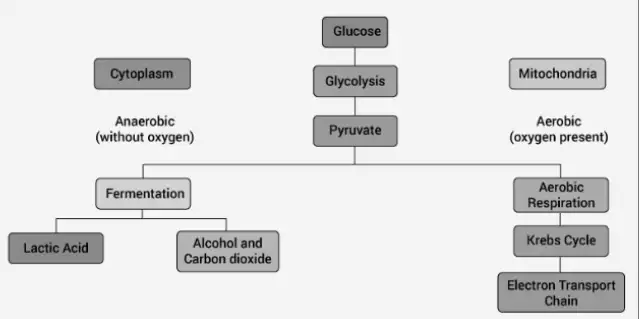
Illustration of Aerobic Respiration Process
Glycolysis: This initial phase splits one glucose molecule (6 carbons) into two molecules of pyruvate (3 carbons each). It takes place in the cytoplasm and does not require oxygen. The net products are two ATP molecules and two NADH molecules, which carry electrons forward.
Krebs Cycle: Also called the citric acid or tricarboxylic acid (TCA) cycle, this stage occurs in the mitochondrial matrix. Pyruvate is converted into acetyl CoA, which enters the cycle. Through a series of reactions, two ATP molecules are generated along with electron carriers NADH and FADH2 that transport high-energy electrons to the next phase.
Electron Transport Chain and Oxidative Phosphorylation: This oxygen-dependent stage involves a sequence of electron carriers that transfer electrons from NADH and FADH2. The energy released pumps protons across the mitochondrial membrane, creating a gradient. ATP synthase then uses this gradient to convert ADP into ATP through oxidative phosphorylation.
Overall, aerobic respiration yields approximately 36 ATP molecules per glucose in eukaryotic cells and about 38 ATP in prokaryotes.
Example Problem: Calculating ATP Yield in Aerobic Respiration
Suppose a eukaryotic cell metabolizes one glucose molecule completely through aerobic respiration. Calculate the total ATP produced if glycolysis yields 2 ATP, the Krebs cycle produces 2 ATP, and the electron transport chain generates 32 ATP.
Solution:
Total ATP = ATP from glycolysis + ATP from Krebs cycle + ATP from electron transport chain
\[ = 2 + 2 + 32 = 36 \text{ ATP molecules} \]
Thus, the cell produces 36 ATP molecules from one glucose molecule during aerobic respiration.
Energy Generation Without Oxygen
Understanding Anaerobic Respiration and Fermentation
Anaerobic respiration occurs when oxygen is absent, and cells rely on alternative pathways to generate energy. This process, often called fermentation, bypasses the Krebs cycle and electron transport chain. Instead, pyruvate produced from glycolysis undergoes further chemical changes to regenerate NAD+ and produce small amounts of ATP.
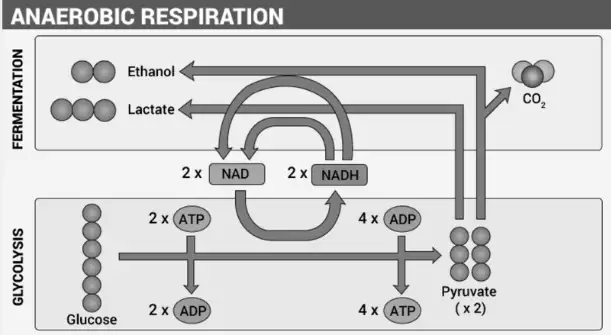
Visual Depiction of Anaerobic Respiration
There are two common types of fermentation:
Alcoholic Fermentation: Pyruvate is converted into ethanol and carbon dioxide, producing ATP. This is typical in yeast and some bacteria.
Lactic Acid Fermentation: In animal muscle cells under oxygen shortage, pyruvate is reduced to lactic acid, generating ATP. This process helps muscles function during intense activity.
Compared to aerobic respiration, anaerobic pathways yield significantly less ATP, making them less efficient for energy production.
Example Problem: ATP Production in Anaerobic Conditions
A muscle cell performs lactic acid fermentation during vigorous exercise. If glycolysis produces 2 ATP molecules per glucose, and no further ATP is generated, calculate the total ATP yield per glucose molecule under anaerobic conditions.
Solution:
Since fermentation does not produce additional ATP beyond glycolysis:
\[ \text{Total ATP} = 2 \text{ ATP molecules} \]
Therefore, only 2 ATP molecules are produced per glucose molecule during anaerobic respiration.
Quick Reference: Key Differences Between Aerobic and Anaerobic Respiration
Feature | Aerobic Respiration | Anaerobic Respiration |
|---|---|---|
Oxygen Requirement | Requires oxygen | Occurs without oxygen |
Location in Cell | Cytoplasm and mitochondria | Cytoplasm only |
End Products | Carbon dioxide and water | Alcohol and CO2 or lactic acid |
ATP Yield per Glucose | Approximately 36-38 ATP | 2 ATP |
Pathways Involved | Glycolysis, Krebs cycle, Electron Transport Chain | Glycolysis and fermentation |
Glossary of Important Terms
Term | Definition |
|---|---|
Adenosine Triphosphate (ATP) | Primary energy carrier molecule in cells. |
Glycolysis | Process of splitting glucose into pyruvate molecules. |
Pyruvate | Three-carbon compound formed at the end of glycolysis. |
Krebs Cycle | Cyclic series of reactions producing energy carriers and ATP. |
Electron Transport Chain (ETC) | Sequence of proteins that transfer electrons to generate ATP. |
Oxidative Phosphorylation | ATP production using energy from electron transport and oxygen. |
Fermentation | Energy-producing process in absence of oxygen, producing byproducts like alcohol or lactic acid. |
NADH | Electron carrier molecule generated during respiration. |
FADH2 | Another electron carrier involved in the Krebs cycle. |
Acetyl CoA | Molecule formed from pyruvate that enters the Krebs cycle. |
Frequently Asked Questions
What defines aerobic respiration?
Aerobic respiration is the process where glucose is fully oxidized in the presence of oxygen to produce ATP, carbon dioxide, and water.
How does anaerobic respiration differ from aerobic respiration?
Anaerobic respiration occurs without oxygen, producing less ATP and different end products such as lactic acid or ethanol.
What role does the Krebs cycle play in respiration?
The Krebs cycle processes acetyl CoA to generate electron carriers and ATP, which are essential for the electron transport chain.
Can you explain the electron transport chain?
It is a series of protein complexes that transfer electrons from NADH and FADH2 to oxygen, creating a proton gradient used to synthesize ATP.
What is glycolysis and where does it occur?
Glycolysis is the breakdown of glucose into pyruvate, occurring in the cytoplasm, and it is the first step in both aerobic and anaerobic respiration.