Understanding the Central Nervous System and Its Cellular Components
Overview of the Central Nervous System
The Central Nervous System (CNS) serves as the primary control center of the body, orchestrating communication, coordination, and regulation of bodily functions. It acts as the core processing unit, integrating sensory inputs and issuing commands to maintain homeostasis and respond to stimuli. The CNS is composed of two main structures: the brain and the spinal cord.
The brain interprets signals from sensory organs and internal systems, while the spinal cord functions as a conduit, transmitting messages between the brain and the rest of the body. Damage to the spinal cord can disrupt this vital communication, leading to impaired bodily functions.
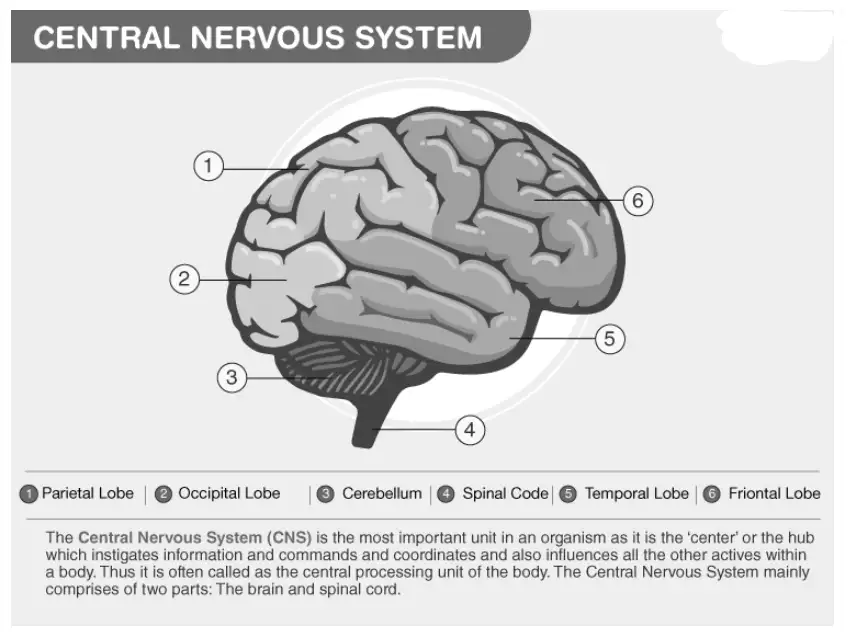
Illustration of the Central Nervous System
Example Problem
Question: Explain why injury to the spinal cord can have more widespread effects on the body compared to injury to a peripheral nerve.
Answer:
The spinal cord acts as the main communication highway between the brain and the entire body.
Damage to the spinal cord interrupts multiple nerve pathways simultaneously, affecting motor and sensory functions below the injury site.
Peripheral nerves serve localized areas; injury to one affects only a specific region.
Therefore, spinal cord injury results in broader loss of function compared to peripheral nerve damage.
Structural Divisions and Functions of the Brain
The brain is a complex organ divided into three primary regions, each responsible for distinct functions:
Forebrain: Handles higher cognitive functions, sensory processing, and voluntary motor activities.
Midbrain: Acts as a relay center for auditory and visual information and controls eye movement.
Hindbrain: Regulates vital functions such as balance, coordination, and autonomic activities.
Approximately 30% of the body's oxygen supply is utilized by the brain, highlighting its high metabolic demand. Besides processing inputs from the five senses, the brain also receives signals from internal organs like the stomach, integrating internal and external information.
Some components such as the retina, optic nerves, olfactory epithelium, and olfactory nerves are sometimes considered part of the CNS because they connect directly to brain tissues without intermediate nerve fibers.
Example Problem
Question: Describe the role of the midbrain in sensory processing and motor control.
Answer:
The midbrain serves as a hub for transmitting auditory and visual signals to higher brain centers.
It coordinates reflexive responses to sensory stimuli, such as eye movement and pupil dilation.
It also contributes to voluntary motor control by connecting motor pathways.
Cellular Components of the Central Nervous System
The CNS relies on specialized cells to perform its functions efficiently. The primary cellular types include neurons, dendrites, and glial cells, each playing a unique role in information processing and support.
Neurons: The Information Messengers
Neurons are the essential units responsible for receiving, processing, and transmitting information throughout the nervous system. The human brain contains roughly 100 billion neurons. Each neuron consists of a cell body (soma), dendrites that receive signals, and an axon that sends impulses to other neurons, muscles, or glands.
Dendrites extend from the neuron’s cell body and specialize in collecting incoming signals from other cells, channeling this information back to the soma for processing.
Example Problem
Question: A neuron receives signals from 5 different neurons, each firing at a rate of 20 impulses per second. Calculate the total number of impulses the neuron receives per second.
Solution:
The total impulses received per second is the sum of impulses from all neurons:
\[ 5 \times 20 = 100 \text{ impulses/second} \]
Therefore, the neuron receives 100 impulses every second from its inputs.
Glial Cells: The Support Network
Glial cells provide crucial metabolic and structural support to neurons. There are three main types of glial cells in the CNS:
Astrocytes: Star-shaped cells that maintain the blood-brain barrier, supply nutrients, and assist in repair processes after injury.
Microglia: Comprising 10–15% of brain cells, these act as immune defenders by removing dead cells and releasing cytokines to modulate immune responses.
Oligodendrocytes: Responsible for producing the myelin sheath, a fatty layer that insulates axons and accelerates nerve signal transmission.
Example Problem
Question: Explain how oligodendrocytes enhance the speed of nerve impulse conduction.
Answer:
Oligodendrocytes wrap axons with a myelin sheath composed of fatty substances.
This myelin sheath acts as an electrical insulator, preventing signal loss.
It enables saltatory conduction, where impulses jump between nodes of Ranvier, increasing transmission speed.
Quick Reference: Central Nervous System Essentials
Component | Function | Key Features |
|---|---|---|
Brain | Processes sensory information and controls body functions | Divided into forebrain, midbrain, hindbrain; uses 30% of body's oxygen |
Spinal Cord | Transmits signals between brain and body | Acts as communication bridge; injury disrupts information flow |
Neurons | Transmit electrical impulses | Consist of cell body, dendrites, axon; approx. 100 billion in brain |
Dendrites | Receive signals from other cells | Extensions of neuron cell body; carry information inward |
Astrocytes | Support and repair CNS tissue | Star-shaped; maintain blood-brain barrier |
Microglia | Immune defense in CNS | Remove dead cells; produce cytokines |
Oligodendrocytes | Form myelin sheath around axons | Enhance nerve signal speed via insulation |
Glossary of Key Terms
Term | Definition |
|---|---|
Central Nervous System (CNS) | The main control system of the body, consisting of the brain and spinal cord. |
Neuron | A nerve cell that transmits electrical signals. |
Dendrite | Branch-like extensions of neurons that receive signals. |
Axon | The long projection of a neuron that sends impulses away from the cell body. |
Astrocyte | Star-shaped glial cell that supports neurons and maintains the blood-brain barrier. |
Microglia | Immune cells of the CNS that remove debris and dead cells. |
Oligodendrocyte | Glial cell that produces myelin sheath around CNS axons. |
Myelin Sheath | Fatty insulating layer around axons that speeds up nerve impulses. |
Forebrain | Brain region responsible for complex cognitive functions. |
Spinal Cord | Bundle of nerve fibers connecting brain to the body. |
Frequently Asked Questions
What are the main functions of the Central Nervous System?
The CNS controls and coordinates body activities by processing sensory information and sending motor commands.
How do neurons communicate with each other?
Neurons transmit electrical impulses through axons and receive signals via dendrites, enabling communication across the nervous system.
Why is the myelin sheath important?
It insulates axons, allowing faster transmission of nerve impulses through saltatory conduction.
What role do astrocytes play in brain health?
Astrocytes support neurons metabolically, maintain the blood-brain barrier, and assist in repairing brain injuries.
Can damage to the spinal cord be repaired?
Spinal cord injuries are often severe and difficult to repair due to limited regeneration capacity, but research is ongoing for treatments.