Comprehensive Overview of Cell Division and Its Mechanisms
Fundamentals of Cellular Reproduction
Understanding the Process of Cell Multiplication
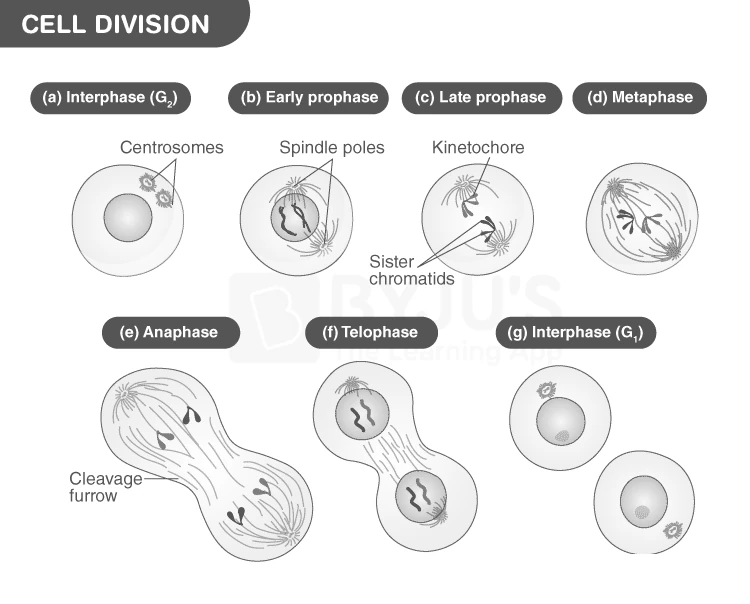
Cell division is the biological mechanism through which a single parent cell splits to form two or more daughter cells. This process is integral to the cell cycle, enabling organisms to grow, repair tissues, and reproduce. Each division results in daughter cells that inherit genetic material from the parent, ensuring continuity of life.
As daughter cells continue to divide and grow, they generate a vast population originating from one ancestral cell. This cyclical pattern of growth and division is responsible for the formation of complex multicellular structures composed of millions of cells.
Example Problem
A single cell undergoes division every 24 hours. How many cells will be present after 5 days if all daughter cells continue dividing at the same rate?
Solution:
Each division doubles the number of cells. Starting with 1 cell:
\[ \text{Number of cells after } n \text{ days} = 2^n \]
For \( n = 5 \):
\[ 2^5 = 32 \text{ cells} \]
Therefore, after 5 days, there will be 32 cells.
Classification of Cell Division Types
Exploring the Varieties of Cellular Division
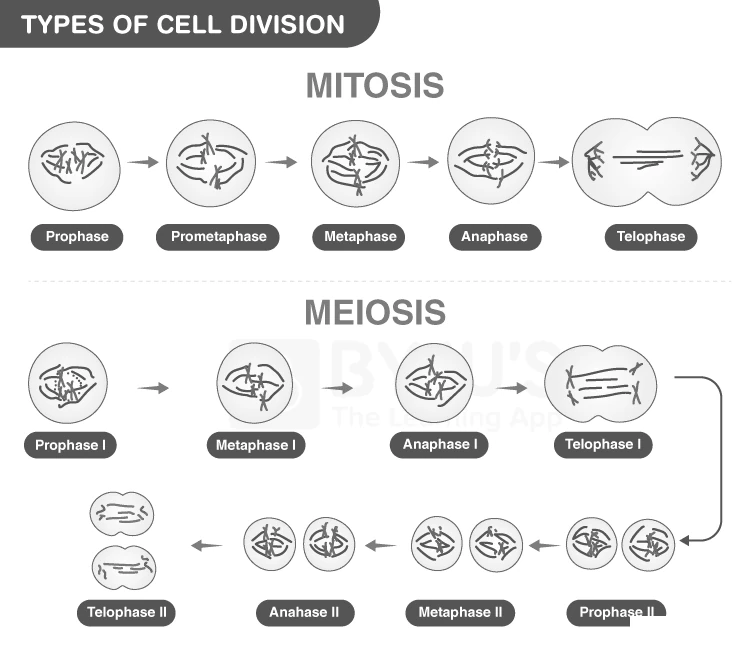
Cell division can be broadly categorized into two main types based on the outcome and purpose: mitosis and meiosis. Mitosis results in two genetically identical daughter cells, supporting growth and tissue repair. Meiosis, on the other hand, produces four genetically diverse haploid cells, essential for sexual reproduction.
Additionally, unicellular organisms such as bacteria reproduce through binary fission, a simpler form of division that allows rapid population increase.
Example Problem
Identify which type of cell division is responsible for producing skin cells and which produces gametes in humans.
Solution:
- Skin cells are generated through mitosis, which creates identical cells for growth and repair.
- Gametes (sperm and egg cells) are formed via meiosis, resulting in haploid cells with half the chromosome number.
Detailed Phases of the Cell Cycle
Breaking Down the Stages Leading to Cell Division
The cell cycle consists of two major phases: interphase and the mitotic (M) phase. Interphase was once considered a resting period but is now understood as a highly active phase where the cell prepares for division.
Interphase itself is subdivided into several stages:
- G0 Phase: A quiescent state where cells are metabolically active but do not divide.
- G1 Phase: The cell grows and carries out normal metabolic functions.
- S Phase: DNA replication occurs, doubling the genetic content.
- G2 Phase: The cell synthesizes proteins and prepares for mitosis.
The M phase encompasses the actual division process, including two critical steps: karyokinesis (nuclear division) and cytokinesis (cytoplasmic division). The M phase is further divided into four sequential stages:
- Prophase
- Metaphase
- Anaphase
- Telophase
Example Problem
A cell spends 10 hours in interphase and 2 hours in the M phase. If the total cell cycle duration is 24 hours, calculate the time spent in the G1 phase assuming S phase lasts 4 hours and G2 phase lasts 2 hours.
Solution:
Total interphase time = 10 hours
Given:
- S phase = 4 hours
- G2 phase = 2 hours
Let G1 phase duration be \( t \) hours.
Sum of interphase phases:
\[ t + 4 + 2 = 10 \]
Solving for \( t \):
\[ t = 10 - 6 = 4 \text{ hours} \]
Therefore, the G1 phase lasts 4 hours.
Quick Reference: Summary of Cell Division Concepts
| Aspect | Description | Outcome |
|---|---|---|
| Mitosis | Division producing two identical daughter cells | Growth, repair, asexual reproduction |
| Meiosis | Division producing four haploid cells | Formation of gametes for sexual reproduction |
| Binary Fission | Simple division in unicellular organisms | Rapid reproduction in bacteria |
| Interphase | Preparation phase with G0, G1, S, G2 stages | Cell growth and DNA replication |
| M Phase | Includes prophase, metaphase, anaphase, telophase | Actual cell division |
Glossary of Key Terms in Cell Division
| Term | Definition |
|---|---|
| Cell Cycle | The series of events a cell undergoes leading to division |
| Daughter Cells | Cells produced from the division of a parent cell |
| Mitosis | Type of cell division producing identical cells |
| Meiosis | Cell division producing haploid gametes |
| Interphase | Phase of cell cycle involving growth and DNA replication |
| G0 Phase | Resting phase where cells do not divide |
| Prophase | First stage of mitosis where chromosomes condense |
| Metaphase | Chromosomes align at the cell's equator |
| Anaphase | Sister chromatids separate to opposite poles |
| Telophase | Final stage of mitosis where nuclei reform |
Frequently Asked Questions on Cell Division
What is the main difference between mitosis and meiosis?
Mitosis produces two identical diploid cells for growth and repair, while meiosis generates four genetically diverse haploid cells for reproduction.
Why is the S phase important in the cell cycle?
The S phase is crucial because it duplicates the cell’s DNA, ensuring each daughter cell receives a complete set of chromosomes.
Can cells in the G0 phase divide again?
Cells in the G0 phase are typically inactive and do not divide, but some can re-enter the cell cycle under specific conditions.
What happens during cytokinesis?
Cytokinesis is the process where the cytoplasm divides, resulting in two separate daughter cells after mitosis.
How does binary fission differ from mitosis?
Binary fission is a simpler division method used by prokaryotes like bacteria, involving DNA replication and cell splitting without the complex stages of mitosis.