Understanding the Cell Cycle and Its Phases
Overview of the Cell Cycle and Its Significance
Fundamentals of the Cell Cycle
The cell cycle is a sequence of carefully regulated events that a cell undergoes to duplicate its DNA and divide into two daughter cells. This process ensures the continuity of life by enabling growth, tissue repair, and reproduction in living organisms. Each cell contains various organelles such as the cytoplasm, cytoskeleton, endoplasmic reticulum, Golgi apparatus, lysosomes, mitochondria, nucleus, plasma membrane, and ribosomes, all of which play roles during the cycle.
Originally identified by Prevost and Dumas in 1824 during their studies on frog zygote cleavage, the cell cycle is fundamental to cellular reproduction and organismal development. It encompasses phases of growth, DNA replication, and division, culminating in two genetically identical cells.
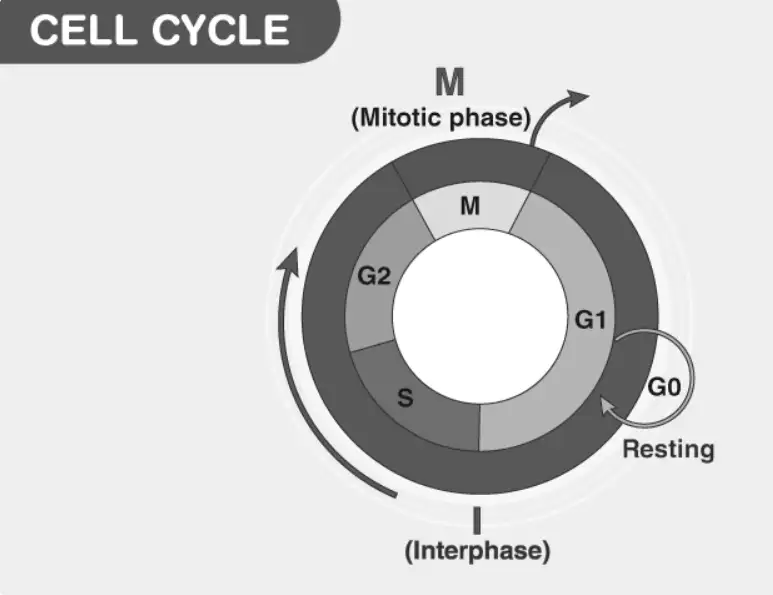
Illustration of the cell cycle stages
Example Problem
A cell starts with a DNA content of 3 picograms (pg) during the G1 phase. After DNA replication in the S phase, what will be the DNA content before mitosis begins?
Solution:
During the S phase, DNA content doubles. Therefore, if the initial DNA content is 3 pg, after replication it becomes:
\[ 3 \text{ pg} \times 2 = 6 \text{ pg} \]
Hence, the DNA content before mitosis is 6 pg.
Detailed Phases of the Cell Cycle
Interphase: Preparation for Division
Interphase is the longest phase of the cell cycle, occupying about 95% of the total duration. During this period, the cell grows, performs its normal functions, and prepares for division by replicating its DNA and organelles. Interphase is subdivided into three distinct stages:
G1 Phase (Gap 1): The cell grows in size and synthesizes proteins but does not replicate DNA. It remains metabolically active and prepares for DNA synthesis.
S Phase (Synthesis): DNA replication occurs, doubling the genetic material. If the DNA content at G1 is \(2N\), it becomes \(4N\) after this phase, although the chromosome number remains constant at \(2n\). Centrioles also duplicate in cells that possess them.
G2 Phase (Gap 2): The cell produces RNA, proteins, and other molecules necessary for mitosis and continues to grow, ensuring all components are ready for division.
Some cells, such as mature cardiac muscle cells, exit the cycle and enter a resting state called the G0 phase, where they remain metabolically active but do not divide unless stimulated.
Example Problem
A cell in the G1 phase has 5 picograms of DNA. Calculate the DNA content at the end of the S phase and explain the chromosome number.
Solution:
DNA content doubles during the S phase:
\[ 5 \text{ pg} \times 2 = 10 \text{ pg} \]
The chromosome number remains unchanged; only the amount of DNA has doubled due to replication.
Mitotic Phase and Cytoplasmic Division
Stages of Mitosis and Cytokinesis
The mitotic phase (M phase) is when the cell undergoes nuclear division followed by cytoplasmic division, resulting in two genetically identical daughter cells. Mitosis is subdivided into four overlapping stages:
Prophase: Chromosomes condense and become visible, the nuclear envelope breaks down, and the mitotic spindle begins to form.
Metaphase: Chromosomes align at the cell's equatorial plate, attached to spindle fibers.
Anaphase: Sister chromatids separate and move toward opposite poles of the cell.
Telophase: Chromatids arrive at poles, nuclear envelopes re-form, and chromosomes begin to decondense.
Following mitosis, cytokinesis divides the cytoplasm. In animal cells, a cleavage furrow forms to split the cell, while in plant cells, a cell plate develops due to the rigid cell wall.
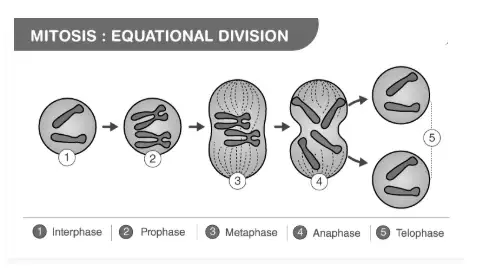
Visual representation of mitotic stages
Example Problem
During anaphase, a cell has 12 chromosomes. How many chromatids are pulled apart, and what is the chromosome number in each daughter cell after mitosis?
Solution:
Each chromosome consists of two sister chromatids during anaphase, so:
\[ 12 \text{ chromosomes} \times 2 = 24 \text{ chromatids} \]
These chromatids separate and move to opposite poles. After mitosis, each daughter cell has 12 chromosomes, maintaining the original chromosome number.
Summary of Key Concepts
Phase | Main Events | Duration |
|---|---|---|
G1 Phase | Cell growth and metabolic activity; no DNA replication | Variable, depends on cell type |
S Phase | DNA replication; centriole duplication | Several hours |
G2 Phase | Preparation for mitosis; synthesis of proteins and organelles | Several hours |
M Phase (Mitosis) | Nuclear division into two nuclei | About 1 hour |
Cytokinesis | Division of cytoplasm to form two daughter cells | Immediately after mitosis |
Glossary of Important Terms
Term | Definition |
|---|---|
Cell Cycle | The sequence of events in a cell leading to its division and duplication. |
Interphase | The phase where the cell grows and DNA replicates before mitosis. |
G1 Phase | First gap phase involving cell growth without DNA replication. |
S Phase | Phase during which DNA synthesis and replication occur. |
G2 Phase | Second gap phase preparing the cell for mitosis. |
Mitosis | Process of nuclear division resulting in two identical nuclei. |
Cytokinesis | Division of the cytoplasm to form two separate daughter cells. |
Chromosome | Thread-like structure of DNA and proteins carrying genetic information. |
Centrioles | Cell structures involved in spindle formation during mitosis. |
G0 Phase | A resting state where cells do not divide but remain metabolically active. |
Frequently Asked Questions
What is the cell cycle?
The cell cycle is a series of stages a cell undergoes to duplicate its DNA and divide into two daughter cells.
Which phases make up the interphase?
Interphase consists of G1 (growth), S (DNA synthesis), and G2 (preparation for mitosis) phases.
Who first discovered the cell cycle?
Walther Flemming, a 19th-century anatomist, is credited with discovering the cell cycle.
Why is cell division important?
Cell division is essential for growth, repair, maintaining chromosome number, and replacing damaged cells.
What happens during cytokinesis?
Cytokinesis divides the cytoplasm, resulting in two separate daughter cells after mitosis.