Understanding the Calvin Cycle: The Pathway of Carbon Fixation in Plants
Overview of Photosynthesis and the Calvin Cycle
Fundamentals of Photosynthesis and Its Two Phases
Photosynthesis is a vital biochemical process in green plants and autotrophs, where carbon dioxide (\( \text{CO}_2 \)) is converted into organic compounds rich in carbon-hydrogen bonds. This transformation stores energy in chemical bonds, enabling plants to sustain themselves and other organisms.
The process is divided into two main stages:
Light-dependent reactions: These require sunlight and occur mainly during the day, producing energy carriers.
Light-independent reactions: Also known as the Calvin cycle or dark reactions, these can proceed with or without light, utilizing energy carriers to fix carbon.
The Calvin cycle is the central pathway for carbon fixation, converting inorganic carbon into sugars.
Visualizing the Calvin Cycle
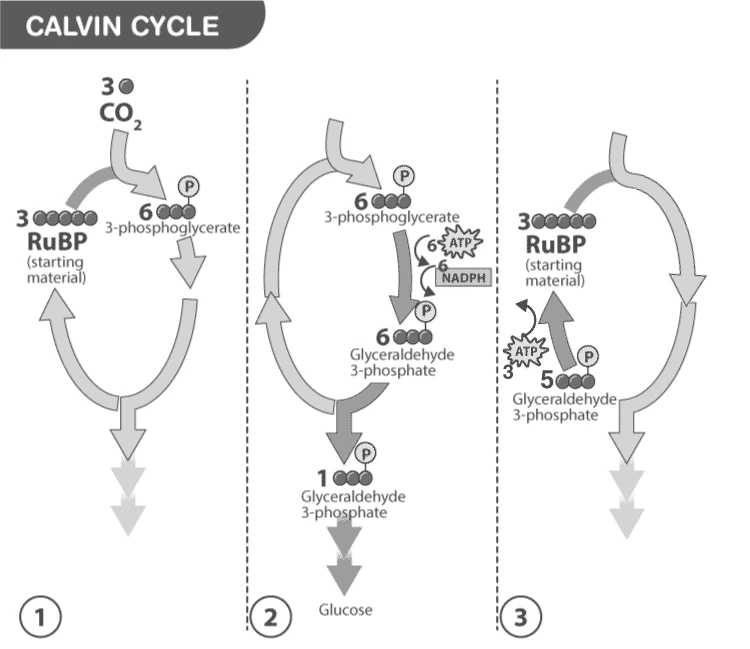
Illustration of the Calvin Cycle stages
Detailed Mechanisms of the Calvin Cycle
Step 1: Carbon Incorporation into Organic Molecules
The initial phase of the Calvin cycle involves the fixation of atmospheric carbon dioxide. The enzyme ribulose-1,5-bisphosphate carboxylase/oxygenase (RuBisCO) catalyzes the attachment of \( \text{CO}_2 \) to ribulose bisphosphate (RuBP), a five-carbon sugar. This reaction produces two molecules of 3-phosphoglycerate (3-PGA), each containing three carbons.
RuBisCO is a large, slow-acting enzyme but is extremely abundant in chloroplasts, making up over half of the leaf's protein content. Its abundance compensates for its low catalytic speed.
Step 2: Conversion of 3-PGA into Energy-Rich Sugars
In this phase, the 3-PGA molecules formed during carbon fixation are transformed into glyceraldehyde-3-phosphate (G3P), a three-carbon sugar phosphate. This conversion requires energy supplied by ATP and reducing power from NADPH, both generated in the light-dependent reactions.
This step is termed reduction because electrons from NADPH reduce 3-PGA to G3P, storing energy in the sugar molecules.
Example Problem: Energy Requirement for Sugar Formation
If 3 molecules of 3-PGA require 6 ATP and 4 NADPH molecules to be converted into G3P, how many ATP and NADPH molecules are needed to produce 2 molecules of G3P?
Solution:
Since 3-PGA to G3P conversion requires 6 ATP and 4 NADPH for 3 molecules, for 2 molecules of G3P (which corresponds to 3 molecules of 3-PGA), the energy requirement remains the same:
\[ \text{ATP} = 6, \quad \text{NADPH} = 4 \]
Therefore, 6 ATP and 4 NADPH molecules are consumed to form 2 G3P molecules.
Step 3: Regeneration of the Carbon Dioxide Acceptor
The final stage involves regenerating RuBP, the molecule that accepts \( \text{CO}_2 \) at the start of the cycle. Some G3P molecules are diverted to synthesize glucose and other carbohydrates, while others are recycled to restore RuBP using ATP.
This regeneration is essential to maintain the cycle's continuity and ensure ongoing carbon fixation.
Regeneration of RuBP from G3P molecules
Example Problem: ATP Consumption in RuBP Regeneration
During the regeneration phase, 5 molecules of G3P are used to regenerate 3 molecules of RuBP. If regenerating each RuBP molecule requires 3 ATP molecules, calculate the total ATP molecules consumed to regenerate 3 RuBP molecules.
Solution:
ATP required:
\[ 3 \text{ RuBP} \times 3 \text{ ATP per RuBP} = 9 \text{ ATP} \]
Hence, 9 ATP molecules are used in the regeneration step.
Summary of Calvin Cycle Outputs and Significance
End Products and Energy Consumption
Each turn of the Calvin cycle fixes one carbon atom, and it takes three turns to produce one molecule of glyceraldehyde-3-phosphate (G3P). Two G3P molecules combine to form one glucose molecule.
The energy cost for synthesizing one glucose molecule is substantial, requiring 18 ATP and 12 NADPH molecules, which are supplied by the light-dependent reactions.
Key Insights into the Calvin Cycle
The Calvin cycle is often called the dark reaction but depends indirectly on light through ATP and NADPH.
Carbon fixation is the crucial first step, catalyzed by RuBisCO.
Reduction converts 3-PGA into energy-rich G3P using ATP and NADPH.
Regeneration restores RuBP, enabling the cycle to continue.
The cycle is fundamental for producing carbohydrates that fuel plant growth and energy storage.
Quick Reference: Calvin Cycle at a Glance
Stage | Main Process | Key Molecules Involved | Energy Requirement |
|---|---|---|---|
Carbon Fixation | Attachment of \( \text{CO}_2 \) to RuBP forming 3-PGA | RuBisCO, \( \text{CO}_2 \), RuBP | None directly |
Reduction | Conversion of 3-PGA to G3P | ATP, NADPH, 3-PGA | ATP and NADPH consumed |
Regeneration | Recycling of G3P to regenerate RuBP | ATP, G3P, RuBP | ATP consumed |
Overall Output | Glucose synthesis from G3P molecules | G3P, Glucose | 18 ATP, 12 NADPH per glucose |
Glossary of Key Terms
Term | Definition |
|---|---|
ATP | Adenosine triphosphate, the energy currency of the cell. |
Calvin Cycle | Series of biochemical reactions that fix carbon dioxide into sugars. |
Carbon Fixation | Process of converting inorganic \( \text{CO}_2 \) into organic molecules. |
G3P (Glyceraldehyde-3-phosphate) | A three-carbon sugar phosphate produced in the Calvin cycle. |
Light-dependent Reactions | Photosynthetic reactions that require light to produce ATP and NADPH. |
NADPH | Nicotinamide adenine dinucleotide phosphate, a reducing agent in photosynthesis. |
Photosynthesis | Process by which plants convert light energy into chemical energy. |
RuBisCO | Enzyme that catalyzes the first step of carbon fixation in the Calvin cycle. |
RuBP (Ribulose bisphosphate) | A five-carbon sugar that accepts \( \text{CO}_2 \) in the Calvin cycle. |
3-PGA (3-Phosphoglycerate) | Three-carbon molecule formed immediately after carbon fixation. |
Frequently Asked Questions
What is the Calvin cycle and where does it occur?
The Calvin cycle is a set of chemical reactions in the chloroplast stroma that fix carbon dioxide into sugars, forming the light-independent phase of photosynthesis.
Which enzyme is responsible for carbon fixation in the Calvin cycle?
RuBisCO catalyzes the fixation of \( \text{CO}_2 \) to RuBP, initiating the Calvin cycle.
Why is the Calvin cycle called a light-independent reaction?
Because it does not require light directly but depends on ATP and NADPH produced by light-dependent reactions.
How many ATP and NADPH molecules are used to produce one glucose molecule?
Producing one glucose molecule consumes 18 ATP and 12 NADPH molecules during the Calvin cycle.
What happens during the regeneration phase of the Calvin cycle?
During regeneration, some G3P molecules are used to restore RuBP, allowing the cycle to continue fixing carbon dioxide.