Understanding Photosynthesis and Carbon Fixation Pathways
Fundamentals of Photosynthesis
Overview of the Photosynthetic Process
Photosynthesis is a vital biological mechanism through which green plants, certain bacteria, and other autotrophic organisms transform light energy into chemical energy. This process synthesizes glucose by combining carbon dioxide and water, utilizing sunlight as the energy source. Oxygen is simultaneously released as a by-product, enriching the atmosphere.
Sunlight acts as the primary energy input, driving the conversion of inorganic molecules into organic compounds. Photosynthesis occurs in two main stages: the light-dependent (photochemical) phase and the light-independent (biosynthetic) phase.
Phases of Photosynthesis
The initial photochemical phase captures light energy to generate ATP and NADPH, which are essential for the subsequent biosynthetic phase. During the biosynthetic phase, glucose is produced through carbon fixation, where carbon dioxide molecules are incorporated into organic compounds.
Carbon fixation pathways vary among plants, leading to different mechanisms for synthesizing carbohydrates.
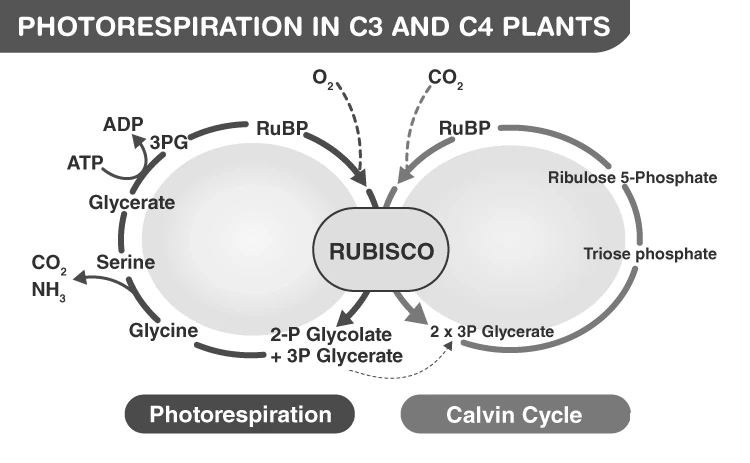
Photorespiration in C3 and C4 Plants
Example Problem
Calculate the number of oxygen molecules released when 3 molecules of glucose are synthesized during photosynthesis.
Solution:
From the balanced equation, 1 molecule of glucose produces 6 molecules of oxygen.
Therefore, for 3 glucose molecules:
\[ 3 \times 6 = 18 \text{ molecules of } \text{O}_2 \]
Hence, 18 oxygen molecules are released.
Carbon Fixation Routes in Photosynthesis
Introduction to Carbon Fixation Pathways
During the biosynthetic phase, carbon dioxide is incorporated into organic molecules, a process known as carbon fixation. Plants utilize distinct pathways for this fixation, primarily categorized based on the first stable product formed.
These pathways are classified as the C3 and C4 routes, each with unique biochemical steps and adaptations.
Example Question
Explain why different plants have evolved distinct carbon fixation pathways.
Plants adapt to their environments to optimize photosynthesis efficiency.
C3 plants thrive in moderate climates, while C4 plants are suited for hot, dry conditions.
C4 pathway reduces photorespiration, enhancing carbon fixation under stress.
The C3 Carbon Fixation Mechanism
Details of the Calvin Cycle
Most plants fix carbon dioxide by producing a three-carbon compound called 3-phosphoglyceric acid (3-PGA) as the first stable product. This process is known as the C3 pathway or Calvin cycle.
The Calvin cycle proceeds through three main stages:
Carboxylation: Carbon dioxide combines with ribulose bisphosphate (RuBP) catalyzed by the enzyme RuBP carboxylase, forming two molecules of 3-PGA.
Reduction: ATP and NADPH convert 3-PGA into glyceraldehyde-3-phosphate (G3P), a sugar precursor.
Regeneration: RuBP is regenerated from G3P to continue the cycle.
Examples of plants following this pathway include wheat, rice, beans, and potatoes.
Numerical Example
In a C3 plant, if 12 molecules of 3-PGA are produced during carboxylation, how many molecules of RuBP were involved?
Solution:
Each RuBP molecule reacts with one CO₂ molecule to produce 2 molecules of 3-PGA.
Let the number of RuBP molecules be \(x\).
\[ 2x = 12 \implies x = \frac{12}{2} = 6 \]
Therefore, 6 RuBP molecules participated in the reaction.
Exploring the C4 Carbon Fixation Pathway
Adaptations and Biochemical Steps in C4 Plants
While all photosynthetic plants perform the Calvin cycle, some have an additional preliminary step called the C4 pathway, especially those in hot, arid environments. This pathway begins with the fixation of carbon dioxide into a four-carbon compound, oxaloacetic acid (OAA).
The process starts with phosphoenolpyruvate (PEP), a three-carbon molecule that acts as the primary CO₂ acceptor. The enzyme PEP carboxylase catalyzes the carboxylation, producing OAA, which is then converted into malic acid.
Malic acid is transported from mesophyll cells to bundle sheath cells, where it breaks down to release CO₂ and a three-carbon molecule. The released CO₂ enters the Calvin cycle, while the three-carbon molecule returns to mesophyll cells to regenerate PEP.
Plants such as corn, sugarcane, and certain shrubs utilize this pathway, which helps minimize photorespiration and enhances photosynthetic efficiency under stress.
Problem Solving
In a C4 plant, if 8 molecules of malic acid are transported to bundle sheath cells, how many molecules of CO₂ are released for the Calvin cycle?
Solution:
Each malic acid molecule releases 1 molecule of CO₂.
\[ 8 \times 1 = 8 \text{ molecules of } \text{CO}_2 \]
Thus, 8 CO₂ molecules are supplied to the Calvin cycle.
Summary of Photosynthesis Pathways
Aspect | C3 Pathway (Calvin Cycle) | C4 Pathway (Hatch-Slack Pathway) |
|---|---|---|
First Stable Product | 3-Phosphoglyceric acid (3-PGA) | Oxaloacetic acid (OAA) |
Primary CO₂ Acceptor | Ribulose bisphosphate (RuBP) | Phosphoenolpyruvate (PEP) |
Key Enzyme | RuBP carboxylase | PEP carboxylase |
Typical Plants | Wheat, Rice, Beans, Potatoes | Corn, Sugarcane, Some Shrubs |
Adaptation | Temperate climates | Hot, dry environments |
Photorespiration | Higher | Reduced |
Glossary of Key Terms
Term | Definition |
|---|---|
Photosynthesis | Process by which plants convert light energy into chemical energy. |
Carbon Fixation | Incorporation of CO₂ into organic molecules during photosynthesis. |
Calvin Cycle | Series of biochemical reactions in C3 plants producing glucose. |
3-Phosphoglyceric Acid (3-PGA) | First stable product in the C3 pathway. |
Oxaloacetic Acid (OAA) | Four-carbon compound formed first in the C4 pathway. |
Phosphoenolpyruvate (PEP) | Three-carbon molecule acting as CO₂ acceptor in C4 plants. |
RuBP Carboxylase | Enzyme catalyzing CO₂ fixation in the Calvin cycle. |
PEP Carboxylase | Enzyme responsible for initial CO₂ fixation in C4 plants. |
Photorespiration | Process where oxygen interferes with photosynthesis, reducing efficiency. |
ATP and NADPH | Energy carriers produced in the light-dependent phase of photosynthesis. |
Frequently Asked Questions
What is the main difference between C3 and C4 plants?
C3 plants produce a 3-carbon compound as the first product of carbon fixation, while C4 plants initially form a 4-carbon compound, allowing them to minimize photorespiration and thrive in hot climates.
Why is photorespiration less in C4 plants?
C4 plants spatially separate CO₂ fixation and the Calvin cycle, concentrating CO₂ around RuBP carboxylase, which reduces oxygen's interference and lowers photorespiration.
What role does sunlight play in photosynthesis?
Sunlight provides the energy required to produce ATP and NADPH in the light-dependent phase, which are essential for synthesizing glucose in the biosynthetic phase.
Can all plants perform the Calvin cycle?
Yes, all photosynthetic plants carry out the Calvin cycle, but C4 plants have an additional preliminary step to enhance efficiency.
How does carbon fixation contribute to plant growth?
Carbon fixation converts inorganic CO₂ into organic sugars, which serve as energy sources and building blocks for plant development.