Comprehensive Overview of Human Joint Types and Their Functions
Fundamentals of Human Joints and Their Role in Movement
Understanding the Nature and Purpose of Joints
Joints, also called articulations, are the crucial connections where two or more bones meet within the human skeleton. These junctions enable various types of movement, providing flexibility and support to the body. The specific structure of a joint determines how much and in what manner movement can occur. Ligaments connect bones at these points, while muscles attach to bones via tendons, facilitating motion.
Movement is essential for survival, allowing organisms to seek food, protect themselves, and reproduce. In humans, the skeletal framework combined with joints and muscles forms the basis for locomotion and diverse physical activities.
Example Problem
Question: Explain why ligaments are vital for joint stability and how they differ from tendons in their function.
Solution:
Ligaments connect bone to bone, providing stability and limiting excessive movement at joints.
Tendons connect muscle to bone, transmitting the force generated by muscles to move bones.
Without ligaments, joints would be unstable and prone to dislocation.
Thus, ligaments maintain joint integrity while tendons enable movement.
Structural and Functional Classification of Joints
Joints are categorized based on their anatomical structure and the extent of movement they allow. Structurally, joints are divided into three main types:
Fibrous Joints: Immovable joints where bones are tightly fused.
Cartilaginous Joints: Slightly movable joints connected by cartilage.
Synovial Joints: Freely movable joints with a fluid-filled cavity.
Functionally, joints are classified by their mobility, ranging from immovable to freely movable, with several subtypes within the synovial category.
Example Problem
Question: Identify the type of joint found in the human skull and justify its classification.
Solution:
The joints in the skull are fibrous joints, specifically sutures.
These joints are immovable, as the bones are fused tightly to protect the brain.
This fusion provides a rigid structure, preventing movement to safeguard vital organs.
Detailed Examination of Joint Types and Their Movements
Characteristics and Examples of Fibrous and Cartilaginous Joints
Fibrous joints are fixed connections where bones are joined by dense connective tissue, allowing no movement. Examples include the sutures of the skull and the connection between teeth and jawbones.
Cartilaginous joints permit limited movement and are united by cartilage. They include temporary joints like synchondroses, which exist in children and disappear after growth, and permanent joints like symphyses found in the pubic region and vertebral discs.
Example Problem
Question: Describe the role of the epiphyseal plate in bone development and classify the joint it represents.
Solution:
The epiphyseal plate is a temporary cartilaginous joint (synchondrosis) in growing children.
It allows for longitudinal bone growth during development.
After puberty, this cartilage ossifies, and the joint becomes immovable.
Synovial Joints: Structure and Functional Diversity
Synovial joints are the most prevalent and versatile joints in the human body. They feature a synovial cavity filled with lubricating fluid, enabling smooth and extensive movement. These joints are found in areas requiring flexibility such as shoulders, knees, wrists, and neck.
Based on their shape and movement capabilities, synovial joints are further divided into six types:
Ball and Socket
Pivot
Hinge
Saddle
Condyloid
Gliding
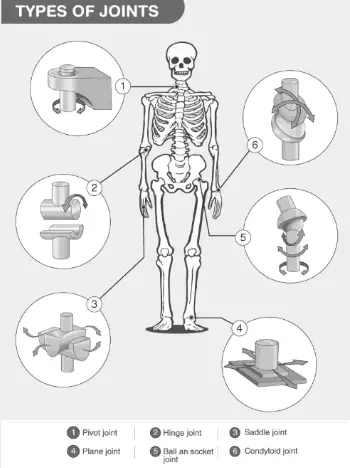
Illustration of Different Joint Types and Their Movements
Example Problem
Question: Explain why the shoulder joint is classified as a ball and socket joint and describe its movement range.
Solution:
The shoulder joint consists of a spherical head of the humerus fitting into the cup-like glenoid cavity of the scapula.
This structure allows rotational movement in multiple directions.
Movements include flexion, extension, abduction, adduction, and rotation, making it highly flexible.
Exploring Specific Synovial Joint Types and Their Functional Roles
Ball and Socket, Pivot, and Hinge Joints
Ball and socket joints allow rotational movement in almost all directions, exemplified by the hip and shoulder joints. Pivot joints enable rotational movement around a single axis, such as the joint between the first and second cervical vertebrae, allowing head rotation.
Hinge joints function like door hinges, permitting movement primarily in one plane, such as bending and straightening. Examples include the elbow, knee, and ankle joints.
Example Problem
Question: Calculate the angle of flexion if a person bends their elbow from a straight position to a 45° angle. Identify the joint type involved.
Solution:
The elbow joint is a hinge joint allowing movement in one plane.
Flexion angle is given as \( 45^\circ \), indicating the arm is bent halfway from full extension.
This movement reduces the angle between the forearm and upper arm by \( 45^\circ \).
Thus, the hinge joint facilitates controlled bending at the elbow.
Saddle, Condyloid, and Gliding Joints
Saddle joints are biaxial, allowing movement in two planes such as flexion-extension and abduction-adduction. The thumb's carpometacarpal joint is a prime example, enabling grasping and manipulation.
Condyloid joints permit movement along two axes, allowing up-down and side-to-side motions, found in the wrist and base of the fingers.
Gliding joints involve flat or slightly curved surfaces that slide over each other, providing limited movement. These are present in the joints between the small bones of the wrist and ankle.
Example Problem
Question: Describe the type of movement allowed by the saddle joint in the thumb and its significance in hand function.
Solution:
The saddle joint allows movement in two planes: flexion-extension and abduction-adduction.
This biaxial movement enables the thumb to oppose other fingers, crucial for gripping.
Such mobility enhances dexterity and precision in hand tasks.
Summary Table of Joint Types and Their Characteristics
Joint Type | Structural Category | Movement Allowed | Examples |
|---|---|---|---|
Fibrous | Immovable | No movement | Skull sutures, teeth-jaw connection |
Cartilaginous | Slightly movable | Limited movement | Pubic symphysis, vertebral discs |
Synovial | Freely movable | Wide range of movements | Shoulder, knee, wrist |
Ball and Socket | Synovial | Rotational, multi-directional | Shoulder, hip |
Pivot | Synovial | Rotational around one axis | Neck (atlas-axis joint) |
Hinge | Synovial | Back and forth | Elbow, knee, ankle |
Saddle | Synovial | Biaxial movement | Thumb carpometacarpal joint |
Condyloid | Synovial | Up-down, side-side | Wrist, base of fingers |
Gliding | Synovial | Sliding movements | Wrist, ankle bones |
Glossary of Key Terms Related to Joints
Term | Definition |
|---|---|
Articulation | Point where two or more bones meet. |
Ligament | Connective tissue linking bones at joints. |
Tendon | Connective tissue attaching muscles to bones. |
Fibrous Joint | Immovable joint where bones are fused. |
Cartilaginous Joint | Joint connected by cartilage allowing slight movement. |
Synovial Joint | Freely movable joint with a fluid-filled cavity. |
Ball and Socket Joint | Joint allowing rotational movement in multiple directions. |
Pivot Joint | Joint permitting rotation around a single axis. |
Hinge Joint | Joint allowing movement in one plane like a door hinge. |
Saddle Joint | Biaxial joint allowing movement in two planes. |
Frequently Asked Questions on Joint Types
What defines a joint in the human body?
A joint is the location where two or more bones connect, enabling movement and providing structural support.
How are joints classified based on mobility?
Joints are classified as immovable (fibrous), slightly movable (cartilaginous), and freely movable (synovial) based on their movement range.
What are the main functions of joints?
Joints connect bones, facilitate movement, allow rotation, and help bear the body's weight.
Can you list the types of synovial joints?
Synovial joints include planar (gliding), hinge, pivot, condyloid, saddle, and ball and socket joints.
Give examples of fibrous joints.
Examples include sutures in the skull, gomphosis (tooth to jaw), and syndesmosis (between long bones).