Comprehensive Overview of Asexual Reproduction
Fundamentals and Defining Traits of Asexual Reproduction
Understanding the Mechanism of Asexual Reproduction
Asexual reproduction is a biological process where a single organism produces offspring without the involvement of another parent. The progeny generated are exact genetic replicas of the parent, often referred to as clones. This form of reproduction is prevalent in both unicellular and multicellular life forms.
Unlike sexual reproduction, this process does not require the fusion of gametes, and the chromosome number remains constant across generations. Genetic variation is minimal, except in rare instances where spontaneous mutations may occur.
Example:
Consider a unicellular organism that reproduces asexually by splitting into two. If the parent cell has 12 chromosomes, each daughter cell will also contain 12 chromosomes, maintaining genetic consistency.
Key Features Characterizing Asexual Reproduction
The following attributes are typical of asexual reproduction:
Only one parent organism is involved in producing offspring.
There is no formation or fusion of gametes during the process.
The reproduction cycle is generally rapid, allowing quick population growth.
Offspring are genetically identical to the parent, ensuring uniformity.
Example:
A bacterium divides every 20 minutes through asexual reproduction, leading to exponential growth in a short period.
Various Modes of Asexual Reproduction and Their Mechanisms
Binary Fission: Simple Cell Division
Binary fission is a straightforward method where a single parent cell splits into two equal daughter cells. Each new cell inherits a nucleus identical to the original, along with an equal share of cytoplasm. This process is directional in some organisms and non-directional in others.
Organisms such as amoeba and euglena commonly reproduce through binary fission, enabling rapid multiplication.
Fragmentation: Breaking into New Individuals
Fragmentation involves the parent organism breaking into multiple parts, each capable of developing into a complete new organism. This method is common in species like spirogyra and planaria.
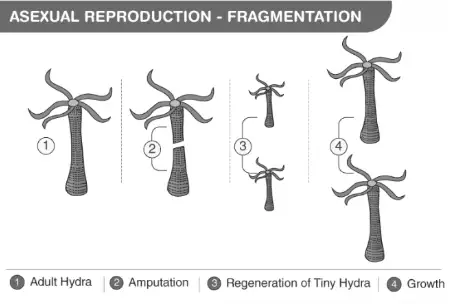
Illustration of fragmentation in asexual reproduction
Example:
A planaria breaks into 4 fragments. Each fragment regenerates into a new planaria, resulting in 4 new organisms from one parent.
Regeneration: Growth from Lost Parts
Regeneration is the ability of an organism to regrow lost or damaged body parts, sometimes leading to the formation of a new individual. This is possible due to specialized cells that can differentiate and multiply.
Hydra and planaria are notable examples exhibiting this capability.
Example:
When a lizard loses its tail, the tail regenerates over time, restoring the lost part without sexual reproduction.
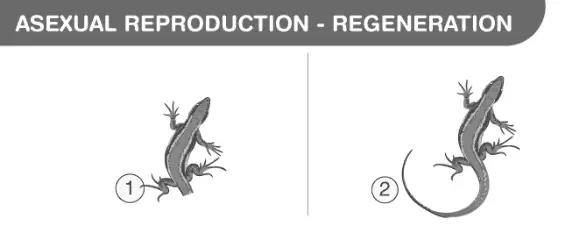
Illustration shows a lizard regenerating its tail as an example of asexual reproduction through regeneration.
Budding: New Organisms from Parent Outgrowths
Budding is a process where a new individual develops as an outgrowth or bud from the parent organism. The bud remains attached initially, receiving nourishment until it matures and detaches.
Hydra is a classic example of an organism reproducing by budding.
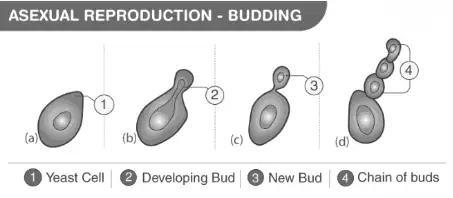
This is how yeast cells reproduce without combining genetic material from two different cells.
Budding in hydra as a form of asexual reproduction
Example:
A hydra develops a bud that grows for 3 days before detaching to become an independent organism.
Vegetative Propagation: Plant Reproduction via Vegetative Parts
In plants, asexual reproduction often occurs through vegetative propagation, where new plants grow from parts like stems, roots, or leaves. This method bypasses seed formation and allows rapid multiplication.
Examples include potato tubers, onion bulbs, and runners in strawberry plants.
Example:
A single potato tuber can produce multiple new plants, each genetically identical to the parent.
Spore Formation: Reproduction through Spores
Spore formation involves producing spores within a protective sac called a sporangium. Under unfavorable conditions, spores remain dormant, and when conditions improve, they germinate to form new organisms.
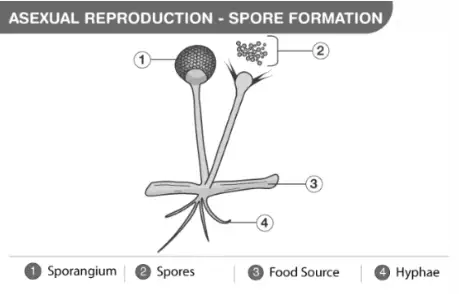
Spore formation as a reproductive strategy
Example:
A fungus produces 1000 spores in a sporangium; when released, these spores germinate to form new fungal colonies.
Benefits and Limitations of Asexual Reproduction
Advantages of Asexual Reproduction
Asexual reproduction offers several benefits that contribute to the survival and proliferation of species:
No need to find a mate, simplifying reproduction.
Rapid generation of large populations in a short time.
Genetic traits are consistently passed to offspring, preserving successful adaptations.
Can occur in diverse environmental conditions without dependence on pollinators or partners.
Example:
Bacteria can double their population every 30 minutes under optimal conditions, demonstrating rapid reproduction.
Drawbacks of Asexual Reproduction
Despite its advantages, asexual reproduction has notable disadvantages:
Genetic uniformity makes populations vulnerable to diseases and environmental changes.
Lack of genetic diversity limits adaptability and evolution.
A single adverse event can potentially wipe out an entire population due to identical susceptibility.
Example:
A disease affecting one plant in a cloned crop can rapidly spread and destroy the entire field due to genetic similarity.
Illustrative Cases of Asexual Reproduction in Nature
Binary Fission in Bacteria
Bacteria reproduce by dividing their single cell into two identical cells, each inheriting the parent's genetic material.
Fragmentation in Blackworms
Blackworms reproduce by breaking their bodies into segments, each capable of regenerating into a new worm.
Example:
If a blackworm splits into 5 fragments, it can produce 5 new worms, increasing the population rapidly.
Budding in Hydra
Hydra forms buds on its body surface that grow and detach to become independent organisms.
Example:
A hydra producing 3 buds in a week can increase its population by 3 new individuals weekly.
Parthenogenesis in Copperheads
Some species like copperhead snakes reproduce via parthenogenesis, where females produce offspring without fertilization.
Example:
A female copperhead can produce viable offspring without mating, ensuring species survival in isolated conditions.
Vegetative Propagation in Sugarcane
Sugarcane plants reproduce asexually through stem cuttings, allowing farmers to cultivate new plants efficiently.
Example:
Planting 10 sugarcane stalks can yield 10 new plants identical to the parent crop.
Quick Reference: Summary of Asexual Reproduction
Aspect | Description |
|---|---|
Parent Involvement | Single organism produces offspring |
Genetic Variation | Offspring are genetically identical clones |
Gamete Fusion | Absent |
Reproduction Speed | Generally rapid |
Common Methods | Binary fission, budding, fragmentation, vegetative propagation, spore formation |
Advantages | Fast population growth, no mate needed, consistent traits |
Disadvantages | Low genetic diversity, vulnerability to diseases and environment |
Glossary of Key Terms
Term | Definition |
|---|---|
Asexual Reproduction | Reproduction involving a single parent producing genetically identical offspring. |
Binary Fission | Cell division process where one cell splits into two equal daughter cells. |
Budding | Formation of a new organism from an outgrowth or bud on the parent. |
Fragmentation | Breaking of an organism into parts, each capable of growing into a new individual. |
Vegetative Propagation | Plant reproduction through vegetative parts like stems, roots, or leaves. |
Sporogenesis | Formation of spores that develop into new organisms under favorable conditions. |
Regeneration | Ability to regrow lost or damaged body parts, sometimes forming new individuals. |
Clone | Genetically identical copy of an organism or cell. |
Parthenogenesis | Reproduction without fertilization, producing offspring from unfertilized eggs. |
Sporangium | Structure in which spores are formed and stored. |
Frequently Asked Questions
What defines asexual reproduction?
Asexual reproduction is a process where a single organism produces offspring without gamete fusion, resulting in genetically identical progeny.
How does asexual reproduction differ from sexual reproduction?
Asexual reproduction involves one parent and no gamete fusion, producing clones, whereas sexual reproduction requires two parents and gamete fusion, leading to genetic variation.
Why is sexual reproduction considered advantageous over asexual reproduction?
Sexual reproduction increases genetic diversity, enhancing adaptability and survival in changing environments, unlike asexual reproduction which produces uniform offspring.
Can vegetative propagation be classified as asexual reproduction?
Yes, vegetative propagation is a form of asexual reproduction where new plants grow from vegetative parts without seed formation.
What are the main benefits of asexual reproduction?
Asexual reproduction allows rapid population increase, requires no mate, and is efficient in stable environments.