Understanding Water Movement in Plant Roots: Apoplast and Symplast Pathways
Mechanisms of Water Uptake in Plant Roots
Active and Passive Water Absorption Explained
Plants absorb water through their roots using two primary mechanisms: active and passive absorption. In active absorption, water enters the root cells and moves from one cell to another through the living parts of the plant tissue, involving the protoplasm. This intracellular movement is known as the symplastic pathway. Conversely, passive absorption involves water traveling through the non-living spaces outside the plasma membrane, such as cell walls and intercellular spaces, which is termed the apoplastic pathway.
Understanding these two modes is essential because they determine how water and dissolved minerals reach the vascular system for transport throughout the plant.
Example Problem
In a plant root, water moves from the soil into the root hair cells and then towards the xylem. If the active absorption pathway moves water through living cells and the passive pathway moves water through cell walls, explain which pathway would be more affected by the plant's metabolic activity and why.
Solution:
Active absorption involves the symplastic route, which passes through living cells and requires energy for selective ion uptake.
Therefore, it is influenced by the metabolic state of the root cells.
Passive absorption via the apoplast involves non-living parts like cell walls and intercellular spaces, so it is less affected by metabolism.
Hence, the symplastic pathway is more sensitive to the plant's metabolic activity.
Exploring the Apoplast Pathway in Roots
Definition and Characteristics of the Apoplast
The apoplast refers to the network of cell walls and intercellular spaces outside the plasma membrane where water and solutes can move freely without crossing any membranes. This pathway involves only the non-living components of plant tissues, allowing rapid diffusion of substances. However, the apoplastic flow is interrupted at the endodermis by a specialized structure called the Casparian strip, which blocks further movement through cell walls.
Illustration of Apoplast and Symplast pathways in plant roots
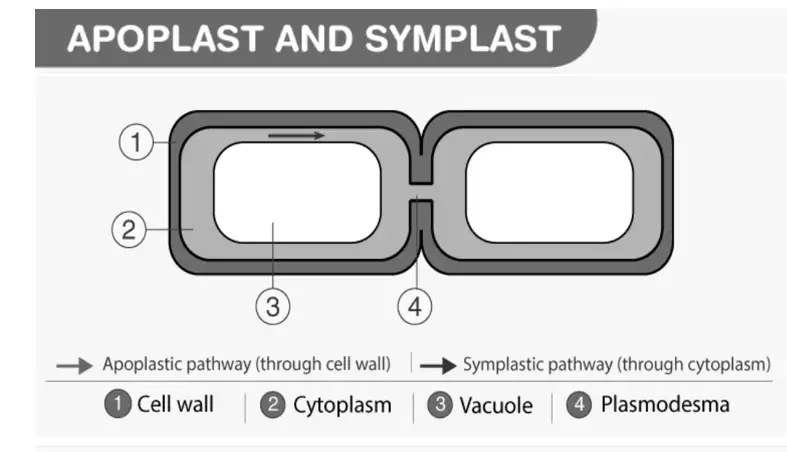
Because the apoplast consists of non-living parts, its function is largely independent of the root's metabolic condition, making it a passive route for water movement up to the endodermis.
Example Problem
Water moves through the apoplast pathway from root hairs to the xylem but is blocked at the endodermis. If the Casparian strip prevents water flow through cell walls, explain how water continues its journey to the xylem.
Solution:
The Casparian strip is a waterproof barrier in the endodermis that blocks apoplastic flow.
Water is forced to enter the symplastic pathway by crossing the plasma membrane of endodermal cells.
This ensures selective uptake of water and minerals before they reach the xylem.
Thus, water moves from the apoplast into the symplast at the endodermis to continue its ascent.
Understanding the Symplast Route for Water Transport
What Constitutes the Symplast and Its Function
The symplast is the interconnected cytoplasm of plant cells linked by plasmodesmata, allowing water and solutes to move cell-to-cell through living tissues. Unlike the apoplast, the symplastic pathway requires water to cross plasma membranes, which regulate the entry of ions and molecules. This pathway is influenced by the metabolic activity of root cells and plays a crucial role in controlling the quality and quantity of substances reaching the vascular system.
Water and solutes move through the symplast especially beyond the endodermis, where the Casparian strip blocks the apoplastic route, ensuring selective absorption.
Example Problem
Consider a plant root where the Casparian strip blocks water movement through the apoplast. If water must pass through the symplast to reach the xylem, describe the role of the plasma membrane in this process.
Solution:
The plasma membrane acts as a selective barrier controlling ion and water uptake.
Water crosses the membrane into the cytoplasm of endodermal cells, entering the symplast.
This selective passage allows the plant to regulate mineral absorption and prevent harmful substances from entering the vascular system.
Therefore, the plasma membrane is essential for maintaining the plant's internal environment during water transport.
Key Differences Between Apoplast and Symplast Pathways
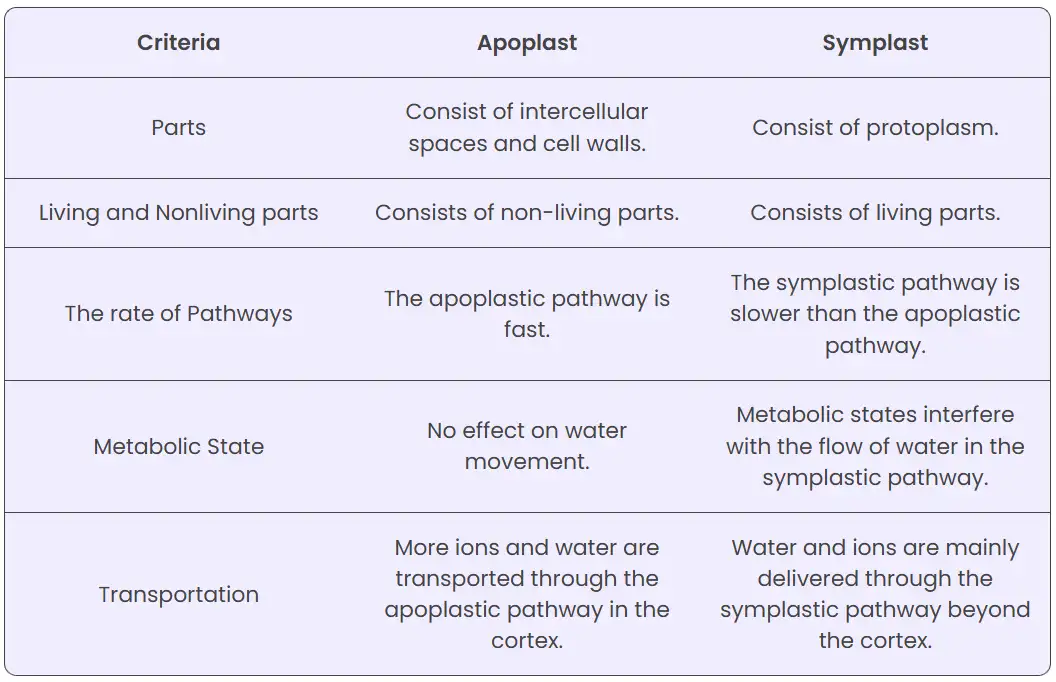
Quick Reference: Summary of Water Transport Pathways
Aspect | Apoplast Pathway | Symplast Pathway |
|---|---|---|
Components Involved | Cell walls, intercellular spaces | Cytoplasm, plasmodesmata |
Nature | Non-living parts | Living parts |
Metabolic Dependence | Independent | Dependent |
Effect of Casparian Strip | Blocks water flow | Allows regulated passage |
Water Movement | Passive | Active and selective |
Glossary of Important Terms
Term | Definition |
|---|---|
Apoplast | Network of cell walls and intercellular spaces allowing free movement of water and solutes outside plasma membranes. |
Symplast | Continuous cytoplasm of plant cells connected by plasmodesmata facilitating intracellular transport. |
Casparian Strip | A waterproof band in the endodermis that blocks apoplastic flow, forcing water into the symplast. |
Endodermis | The innermost layer of the root cortex that regulates water and mineral uptake into the vascular tissue. |
Plasmodesmata | Microscopic channels connecting the cytoplasm of adjacent plant cells. |
Root Hair | Extensions of root epidermal cells that increase surface area for water absorption. |
Vascular Bundle | Plant tissue containing xylem and phloem for transport of water, minerals, and food. |
Protoplasm | The living content of a plant cell including cytoplasm and nucleus. |
Intercellular Spaces | Gaps between plant cells that facilitate apoplastic movement. |
Selective Permeability | The ability of plasma membranes to regulate the passage of substances into and out of cells. |
Frequently Asked Questions
What is the apoplast pathway in plants?
The apoplast pathway is the movement of water through the cell walls and intercellular spaces without crossing the plasma membrane, allowing passive flow through non-living parts of the root.
How is the symplast different from the apoplast?
The symplast involves water movement through the cytoplasm of living cells connected by plasmodesmata, requiring water to cross plasma membranes, making it metabolically active and selective.
Why is the Casparian strip important in roots?
The Casparian strip blocks water movement through the apoplast at the endodermis, forcing water and solutes to enter the symplast, which allows selective uptake before reaching the xylem.
Is water absorption through the apoplast active or passive?
Water movement via the apoplast is passive, as it occurs through non-living cell walls and spaces without energy expenditure by the plant.
How does the metabolic state of the root affect water absorption?
The metabolic activity influences the symplastic pathway because it involves living cells and selective transport, whereas the apoplastic pathway is largely unaffected by metabolism.