Comprehensive Overview of the Female Ovary Structure and Functions
Structural Composition of the Female Ovary
General Morphology and Location
The ovaries are paired, flattened oval organs measuring roughly 3.5 cm in length, 1.2 cm in thickness, and 2.5 cm in width. Positioned bilaterally adjacent to the uterus within the pelvic cavity, each ovary lies in a depression called the ovarian fossa. The side facing the fallopian tube is anchored by the infundibulopelvic ligament, while the opposite side connects to the uterus through the ovarian ligament. The broad ligament of the uterus supports the ovary at the hilum via the mesovarium, which serves as a conduit for blood vessels and nerves.
Internal Regions: Cortex and Medulla
The ovary is divided into two distinct zones: the cortex and the medulla. The medulla, or zona vasculosa, forms the central core and consists of loose connective tissue rich in blood vessels, lymphatics, nerve fibers, and smooth muscle bundles near the hilum. Surrounding the medulla is the cortex, a denser outer layer composed of tightly packed cells. The cortex is covered externally by a germinal epithelium beneath a fibrous tunica albuginea. This region houses various stages of ovarian follicles and connective tissue cells, including interstitial cells derived mainly from the theca interna of follicles.
Ovarian Follicles and Their Development
The cortex contains primordial follicles formed from germinal epithelium originating in the germinal ridges. Each primordial follicle consists of an immature ovum encased by granulosa cells. These follicles mature through several stages, eventually developing into tertiary vesicular follicles characterized by a fluid-filled cavity called the antrum. The fully mature follicle, known as the Graafian follicle, ruptures during ovulation to release the ovum. Initially, the ovary contains millions of primordial follicles during fetal development, but this number drastically reduces to a few hundred thousand by puberty. Each menstrual cycle typically results in the maturation and release of a single ovum, while many follicles undergo degeneration. Post-ovulation, the residual follicle transforms into the corpus luteum, which later regresses into the corpus albicans.
Visual Representation of the Ovary
Detailed Diagram and Its Components
The ovary's anatomy can be better understood through a labelled illustration highlighting its key parts such as the cortex, medulla, follicles at various stages, and the supporting ligaments. This visual aid clarifies the spatial relationships and structural details essential for grasping ovarian function.
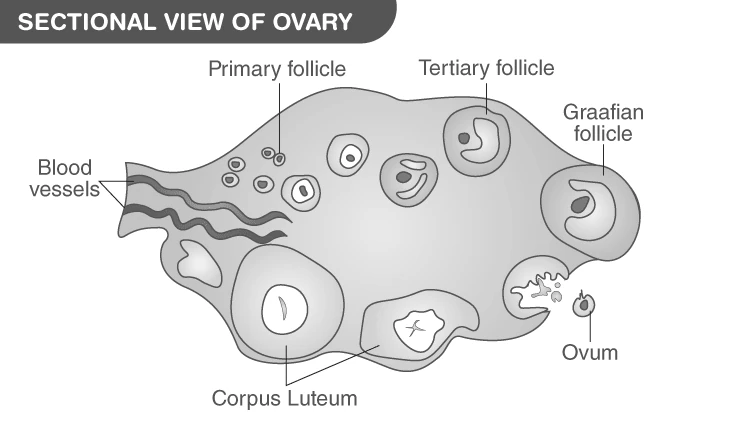
Illustration of the female ovary with labelled anatomical features
Example Question
Identify the structure in the ovary responsible for connecting it to the broad ligament and explain its significance.
Answer:
The mesovarium is the fold of the broad ligament that attaches to the ovary at the hilum.
It serves as a passageway for blood vessels, lymphatics, and nerves entering and leaving the ovary.
This connection is vital for supplying nutrients and hormonal signals necessary for ovarian function.
Physiological Roles of the Ovary
Hormonal Secretion and Regulation
The ovary functions as an endocrine gland by producing key female sex hormones such as estrogen and progesterone. Additionally, it secretes hormones like relaxin, inhibin, and small amounts of androgens. These hormones regulate the menstrual cycle, prepare the uterus for pregnancy, and maintain secondary sexual characteristics.
Oogenesis and Ovum Release
Oogenesis, the process of female gamete formation, occurs within the ovarian follicles. Starting from primordial follicles, the ovum matures through several stages until ovulation, when a mature egg is released. This cyclical release is crucial for reproduction and is tightly controlled by hormonal feedback mechanisms.
Menstrual Cycle Control
The ovary orchestrates the menstrual cycle by regulating the growth and shedding of the uterine lining. If fertilization does not occur, the corpus luteum degenerates, leading to menstruation and the shedding of the unfertilized ovum along with the endometrial lining.
Quick Reference: Ovary Essentials
Aspect | Details |
|---|---|
Shape & Size | Oval, approx. 3.5 cm × 1.2 cm × 2.5 cm |
Location | Either side of uterus in ovarian fossa |
Major Parts | Cortex (outer), Medulla (inner) |
Follicle Types | Primordial, Primary, Secondary, Tertiary (Graafian) |
Hormones Produced | Estrogen, Progesterone, Relaxin, Inhibin, Androgens |
Function | Oogenesis, hormone secretion, menstrual regulation |
Ligaments | Infundibulopelvic, Ovarian, Broad ligament (via mesovarium) |
Post-Ovulation Structure | Corpus luteum → Corpus albicans |
Number of Follicles at Birth | Approx. 1 million |
Follicles at Puberty | 300,000 to 400,000 |
Glossary of Key Terms
Term | Definition |
|---|---|
Ovary | Primary female reproductive organ producing ova and hormones |
Medulla | Inner core of ovary containing blood vessels and connective tissue |
Cortex | Outer layer of ovary housing follicles and germinal epithelium |
Germinal Epithelium | Surface layer of cells covering the ovary |
Primordial Follicle | Earliest stage of follicle containing immature ovum |
Graafian Follicle | Mature follicle ready to release an ovum during ovulation |
Corpus Luteum | Temporary endocrine structure formed after ovulation |
Corpus Albicans | Scar tissue formed after degeneration of corpus luteum |
Mesovarium | Fold of broad ligament attaching ovary to uterus |
Oogenesis | Process of ovum formation within the ovary |
Frequently Asked Questions
What roles do ovarian hormones play in the female body?
Ovarian hormones regulate the menstrual cycle, support pregnancy, develop secondary sexual characteristics, and maintain reproductive health.
Can you explain the function of the mesovarium?
The mesovarium connects the ovary to the broad ligament and allows passage of blood vessels, nerves, and lymphatics essential for ovarian function.
What composes the germinal epithelium of the ovary?
It consists of a single layer of cuboidal epithelial cells covering the ovary's surface, playing a role in follicle formation.
What is ovulation and when does it occur?
Ovulation is the release of a mature ovum from the Graafian follicle, typically occurring mid-cycle during the menstrual period.
How many eggs are released during each menstrual cycle?
Usually, only one ovum is released from one ovary per menstrual cycle, although rare cases of multiple ovulations can occur.