Comprehensive Overview of Amoeba: Structure, Movement, and Classification
Fundamentals of Amoeba and Its Unique Characteristics
Introduction to Amoeba and Its Habitat
Amoebas are single-celled organisms renowned for their remarkable ability to alter their shape continuously. These microscopic entities predominantly inhabit freshwater environments such as ponds, lakes, and sluggish rivers. Occasionally, certain amoebas can invade the human body, leading to various health complications.
The earliest documented observations of amoebas date back to the mid-18th century, credited to the German naturalist August Johann Rösel von Rosenhof, who meticulously illustrated these organisms in 1755.
Example:
Consider a freshwater pond where an amoeba is observed. If the pond's water temperature rises from 20°C to 25°C, how might this affect the amoeba's activity?
Solution:
Amoebas are more active in warmer temperatures within their tolerance range.
An increase from 20°C to 25°C typically accelerates metabolic processes.
Therefore, the amoeba's movement and feeding rate are likely to increase.
Structural Composition and Locomotion of Amoeba
Detailed Anatomy and Movement Mechanism
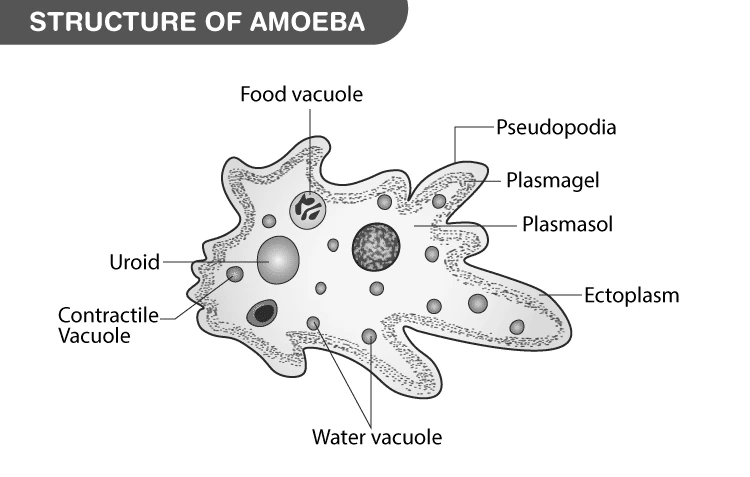
Amoebas exhibit a flexible form due to their ability to extend and retract pseudopodia—temporary, blunt projections formed by the outward flow of cytoplasm pushing the plasma membrane. Multiple pseudopodia can exist simultaneously, causing the organism's shape to change rapidly.
The amoeba's body consists mainly of three components: the cytoplasm, plasma membrane, and nucleus. The cytoplasm itself is divided into two distinct layers: the outer, clear ectoplasm and the inner, granular endoplasm. The plasma membrane is a delicate, double-layered structure made up of proteins and lipids, providing both protection and flexibility.
Besides these, amoebas contain essential organelles such as contractile vacuoles for expelling excess water, mitochondria for energy production, Golgi apparatus for processing cellular materials, and fat globules for energy storage.
Illustration of Amoeba's Cellular Structure
Classification and Reproductive Behavior of Amoeba
Taxonomy and Life Cycle Insights
Amoebas are classified under the Kingdom Protista, as they do not fit into the categories of plants, animals, or fungi. They are eukaryotic organisms, possessing a well-defined nucleus. Their reproduction occurs asexually through binary fission, where one cell divides into two genetically identical daughter cells.
Despite a typical lifespan of about two days, amoebas can be considered biologically immortal because their offspring are exact replicas, continuing the lineage indefinitely.
In unfavorable conditions, amoebas can encase themselves within a protective cyst, halting their activity. Once conditions improve, they revert to their active trophozoite form and resume feeding.
Notably, the Naegleria fowleri, often called the brain-eating amoeba, is an amoeboid organism capable of entering the human body via the nasal passage. It preys on brain neurons, causing severe and often fatal infections with a mortality rate of approximately 97%.
Quick Reference Summary
Aspect | Details |
|---|---|
Cell Type | Unicellular eukaryote |
Movement | By pseudopodia (cytoplasmic projections) |
Structure | Cytoplasm (ectoplasm & endoplasm), plasma membrane, nucleus |
Reproduction | Asexual via binary fission |
Habitat | Freshwater bodies like ponds and lakes |
Protective Mechanism | Forms cysts under adverse conditions |
Special Species | Naegleria fowleri (brain-eating amoeba) |
Lifespan | Approximately 2 days, but considered biologically immortal |
Glossary of Key Terms
Term | Definition |
|---|---|
Amoeba | A single-celled organism capable of shape change and movement via pseudopodia. |
Pseudopodia | Temporary cytoplasmic projections used for locomotion and feeding. |
Cytoplasm | The gel-like substance inside the cell, divided into ectoplasm and endoplasm. |
Plasma Membrane | A thin, double-layered membrane enclosing the cell, composed of lipids and proteins. |
Binary Fission | A form of asexual reproduction where one cell divides into two identical cells. |
Contractile Vacuole | An organelle that expels excess water to maintain osmotic balance. |
Trophozoite | The active, feeding stage of an amoeba. |
Cyst | A dormant, protective form of amoeba during unfavorable conditions. |
Naegleria fowleri | A pathogenic amoeboid organism known as the brain-eating amoeba. |
Endoplasm | The inner, granular part of the cytoplasm containing organelles. |
Frequently Asked Questions
What enables amoebas to change their shape?
Amoebas alter their shape by extending and retracting pseudopodia, which are formed by the flow of cytoplasm pushing the plasma membrane outward.
How do amoebas reproduce?
They reproduce asexually through binary fission, where one cell divides into two identical daughter cells.
What is the function of the contractile vacuole in amoebas?
It helps expel excess water from the cell to maintain osmotic balance and prevent bursting.
Why are amoebas classified under Protista?
Because they are unicellular eukaryotes that do not fit into the categories of plants, animals, or fungi.
What makes Naegleria fowleri dangerous to humans?
It can enter the human body through the nose, attack brain tissue by feeding on neurons, and cause fatal infections with a high mortality rate.