Comprehensive Overview of the Human Digestive System
Understanding the Digestive Process and Its Pathway
Fundamentals of Digestion and Its Role
Digestion is the biological mechanism where large food molecules are broken down into smaller, water-soluble components that the bloodstream can readily absorb. This process involves multiple body parts working in harmony to ensure nutrients are extracted efficiently while waste materials are expelled.
Every organ involved contributes uniquely to the transformation and absorption of food, making digestion a complex yet vital function for sustaining life.
Example Problem
Calculate the amount of glucose absorbed if 180 grams of starch (a polysaccharide) is completely digested, given that starch breaks down into glucose units.
Solution:
Starch is a polymer of glucose. The molar mass of glucose is approximately 180 g/mol.
Given starch mass = 180 g
Number of moles of glucose produced = \(\frac{180 \text{ g}}{180 \text{ g/mol}} = 1 \text{ mol}\)
Therefore, 1 mole of glucose (180 g) is absorbed after complete digestion of 180 g starch.
Structure and Function of the Alimentary Canal
The alimentary canal is a continuous, tubular passage that begins at the mouth and terminates at the anus. It serves as the primary route for food intake, digestion, absorption, and waste elimination. This muscular tube is also known as the digestive tract and is essential for processing food into usable nutrients.
Its design allows food to move sequentially through various specialized organs, each performing distinct roles in digestion.
Example Problem
Estimate the total length of the human alimentary canal if the small intestine is approximately 6 meters long, the large intestine is 1.5 meters, and the combined length of the mouth, pharynx, oesophagus, and stomach is about 1 meter.
Solution:
Total length = Length of small intestine + large intestine + other parts
\[ = 6 \text{ m} + 1.5 \text{ m} + 1 \text{ m} = 8.5 \text{ m} \]
The alimentary canal is approximately 8.5 meters long in total.
Detailed Examination of Digestive Organs
Oral Cavity: The Gateway to Digestion
The mouth initiates digestion by mechanically breaking down food and mixing it with saliva. The oral cavity includes the palate, tongue, and teeth, each playing a vital role.
The palate forms the roof of the mouth, separating the oral and nasal cavities. The tongue, a muscular organ, aids in tasting and manipulating food, featuring tiny projections called lingual papillae—classified as circumvallate, fungiform, and filiform—that house taste buds.
Teeth are specialized for cutting, tearing, and grinding food. Humans possess two sets: deciduous (milk) teeth and permanent teeth. Each tooth consists of the crown (visible part), neck (covered by gums), and root (anchored in the jawbone socket, known as thecodont).
Example Problem
Identify the type of tooth best suited for grinding food and explain its structural adaptation.
Solution:
Molars are primarily responsible for grinding food.
They have a broad, flat surface with multiple cusps to crush and grind food efficiently.
Their strong roots provide stability to withstand the pressure during chewing.
Pharynx and Oesophagus: Pathways for Food Movement
The pharynx acts as a shared passage for both air and food. A flap called the epiglottis prevents food from entering the windpipe during swallowing, ensuring it moves safely into the oesophagus.
The oesophagus is a muscular tube that transports food from the mouth to the stomach. The gastro-oesophageal sphincter at its lower end regulates the passage of food into the stomach, preventing backflow.
Example Problem
Explain the role of the epiglottis during swallowing and what might happen if it malfunctions.
Solution:
The epiglottis covers the windpipe during swallowing to prevent food from entering the respiratory tract.
If it malfunctions, food may enter the windpipe, causing choking or aspiration pneumonia.
Stomach: The Digestive Reservoir
The stomach is a muscular sac located in the upper left abdomen, divided into four regions: cardiac, fundus, body, and pyloric parts.
The cardiac region is near the heart and contains the gastro-oesophageal sphincter controlling food entry. The fundus is dome-shaped and often filled with air. The body forms the main central portion, while the pyloric region connects to the small intestine, regulated by the pyloric sphincter.
Example Problem
Describe the function of the pyloric sphincter in digestion.
Solution:
The pyloric sphincter controls the release of partially digested food (chyme) from the stomach into the duodenum of the small intestine.
It prevents backflow of intestinal contents into the stomach.
Small and Large Intestines: Nutrient Absorption and Waste Formation
Small Intestine: The Nutrient Absorber
The small intestine is the longest segment of the digestive tract, comprising the duodenum, jejunum, and ileum.
The duodenum is C-shaped and receives digestive secretions from the pancreas, liver, and gallbladder via the hepatopancreatic duct. The jejunum is the middle section, and the ileum is highly coiled, connecting to the large intestine.
Example Problem
Explain how the duodenum facilitates digestion with the help of accessory organs.
Solution:
The duodenum receives bile from the liver and gallbladder, which emulsifies fats.
Pancreatic enzymes enter here to break down carbohydrates, proteins, and lipids.
This coordinated secretion enhances chemical digestion before absorption.
Large Intestine: Water Absorption and Waste Management
The large intestine follows the small intestine and consists of the caecum, colon, and rectum.
The caecum is a pouch containing beneficial microorganisms and has the vermiform appendix attached, a vestigial organ. The colon is subdivided into ascending, transverse, descending, and sigmoid regions. The rectum stores feces before expulsion through the anus.
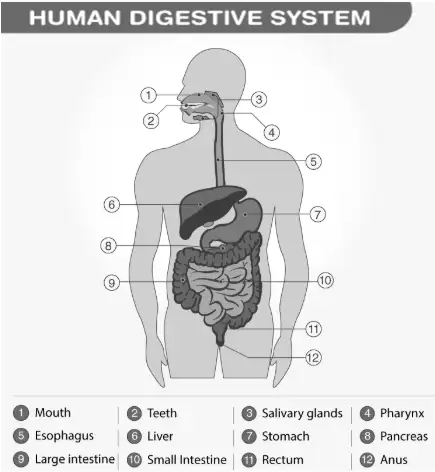
Illustration of the Large Intestine
Example Problem
What is the primary function of the colon in the digestive system?
Solution:
The colon absorbs water and electrolytes from the remaining indigestible food matter.
It compacts the waste into feces.
It also houses beneficial bacteria that aid in fermentation and vitamin synthesis.
Quick Reference: Summary of Digestive System Components
Organ | Primary Function | Key Features |
|---|---|---|
Mouth | Ingestion and mechanical digestion | Teeth, tongue, saliva |
Pharynx | Passage for food and air | Epiglottis prevents choking |
Oesophagus | Transport of food to stomach | Muscular tube with sphincter |
Stomach | Storage and chemical digestion | Regions: cardiac, fundus, body, pyloric |
Small Intestine | Digestion and nutrient absorption | Duodenum, jejunum, ileum |
Large Intestine | Water absorption and feces formation | Caecum, colon, rectum |
Anus | Excretion of waste | Opening for feces elimination |
Glossary of Key Terms
Term | Definition |
|---|---|
Alimentary Canal | The continuous muscular tube from mouth to anus through which food passes. |
Epiglottis | A flap that prevents food from entering the windpipe during swallowing. |
Gastro-oesophageal Sphincter | Muscular ring controlling food entry from oesophagus to stomach. |
Chyme | Partially digested food mixed with stomach secretions. |
Duodenum | First part of the small intestine receiving digestive juices. |
Jejunum | Middle section of the small intestine where absorption occurs. |
Ileum | Last part of the small intestine connecting to the large intestine. |
Caecum | Blind pouch at the beginning of the large intestine. |
Vermiform Appendix | A small, vestigial organ attached to the caecum. |
Pyloric Sphincter | Muscle controlling passage of food from stomach to small intestine. |
Frequently Asked Questions
What is the main function of the small intestine?
The small intestine primarily digests food chemically and absorbs nutrients into the bloodstream.
How does the epiglottis protect the respiratory tract?
It acts as a valve that closes over the windpipe during swallowing, preventing food from entering the lungs.
Why is the large intestine important in digestion?
It absorbs water from undigested food and compacts waste into feces for elimination.
What role do teeth play in digestion?
Teeth mechanically break down food into smaller pieces, increasing the surface area for enzymes to act.
What is the significance of the pyloric sphincter?
It regulates the flow of stomach contents into the small intestine, ensuring proper digestion timing.