Comprehensive Overview of the Adrenal Glands: Structure, Function, and Disorders
Positioning and Surrounding Anatomy of the Adrenal Glands
Precise Location and Anatomical Relations
The adrenal glands are paired endocrine organs situated directly atop each kidney. Their name derives from Latin roots: "ad-" meaning "near" and "renes" meaning "kidneys," highlighting their proximity. They are also referred to as suprarenal glands, emphasizing their position above the kidneys.
On the right side, the adrenal gland lies adjacent to the inferior vena cava and the liver's right lobe anteriorly, while the diaphragm's right crus lies posteriorly. Conversely, the left adrenal gland is bordered anteriorly by the stomach, pancreas, and spleen, with the left crus of the diaphragm positioned behind it.
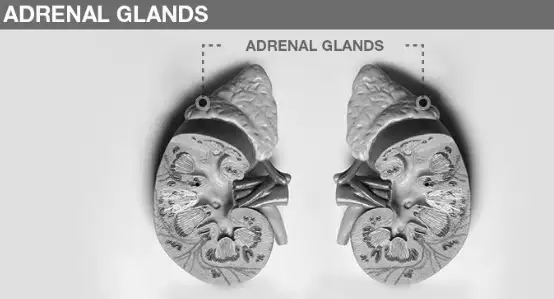
Diagram depicting the adrenal glands positioned above each kidney
Example Problem
Question: If a patient has a tumor compressing the right adrenal gland, which major blood vessel and organ are most likely to be affected due to their close proximity?
Solution:
The inferior vena cava lies anterior to the right adrenal gland, so it may be compressed, potentially affecting venous return to the heart.
The right lobe of the liver is also anterior, so liver function could be indirectly impacted.
Therefore, the tumor could influence both vascular and hepatic structures due to anatomical closeness.
Structural Composition and Layers of the Adrenal Glands
Detailed Anatomy and Functional Zones
The human body contains two adrenal glands: the right gland is pyramid-shaped, while the left is crescent-shaped and slightly larger. Each gland measures approximately 5 cm by 3 cm, with a combined weight between 7 and 10 grams. Their healthy coloration is typically yellowish.
Each adrenal gland consists of three main layers:
Adrenal Capsule: A fatty protective sheath enveloping the gland, safeguarding it from physical damage.
Adrenal Cortex: The outer region responsible for producing steroid hormones. It is subdivided microscopically into three zones:
Zona glomerulosa: Secretes mineralocorticoids like aldosterone, which regulate salt and water balance.
Zona fasciculata: Produces glucocorticoids such as cortisol, vital for metabolism and stress response, and small amounts of androgens.
Zona reticularis: Generates dehydroepiandrosterone (DHEA), a precursor to sex hormones.
Adrenal Medulla: The innermost part containing chromaffin cells that synthesize catecholamines, including adrenaline and noradrenaline, which are critical for acute stress reactions.
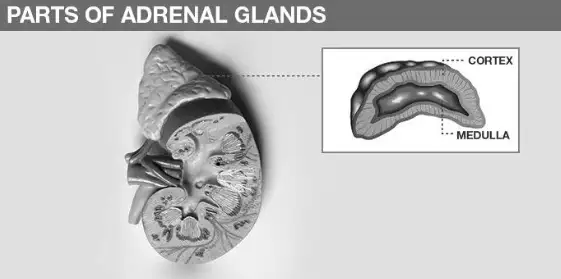
Anatomical layers and zones of the adrenal glands
Example Problem
Question: Identify which adrenal cortex zone is primarily responsible for producing cortisol and explain its significance.
Solution:
The Zona fasciculata is the middle layer of the adrenal cortex that synthesizes cortisol.
Cortisol is essential for regulating metabolism, reducing inflammation, and helping the body respond to stress.
Therefore, damage to this zone can impair stress response and metabolic balance.
Physiological Roles and Hormonal Secretions of the Adrenal Glands
Key Functions and Hormone Actions
The adrenal glands play a pivotal role in maintaining homeostasis by releasing hormones that regulate metabolism, immune response, blood pressure, and stress adaptation. One of their most critical functions is initiating the "fight or flight" response through hormone secretion during stressful situations.
Major hormones produced include:
Epinephrine (Adrenaline): Quickly elevates heart rate and blood glucose to prepare the body for immediate action.
Norepinephrine (Noradrenaline): Works alongside epinephrine to enhance alertness and mobilize energy.
Cortisol (Hydrocortisone): Regulates metabolism by converting fats and carbohydrates into usable energy and modulates immune function.
Corticosterone: Supports cortisol in controlling immune responses and reducing inflammation.
Common Disorders Affecting the Adrenal Glands
Health Conditions and Their Implications
Adrenal gland dysfunction arises when hormone production is either excessive or insufficient, or when abnormal growths develop. These imbalances can lead to various medical conditions:
Cushing’s Syndrome: Characterized by elevated cortisol levels, often due to tumors in the adrenal or pituitary glands, leading to symptoms like weight gain and high blood pressure.
Adrenocortical Carcinoma: A malignant tumor originating in the adrenal cortex, frequently diagnosed after metastasis to other organs.
Congenital Adrenal Hyperplasia (CAH): A genetic disorder causing deficient cortisol production and abnormal androgen levels, sometimes accompanied by low aldosterone.
Addison’s Disease: Results from insufficient cortisol and aldosterone secretion, causing fatigue, low blood pressure, and nausea. Often autoimmune in origin, it impairs hormone synthesis.
Example Problem
Question: A patient with Addison’s disease has low aldosterone levels, leading to decreased sodium retention. Explain how this affects blood pressure.
Solution:
Aldosterone promotes sodium retention in the kidneys, which helps maintain blood volume.
Low aldosterone causes sodium loss, reducing blood volume.
Reduced blood volume leads to lower blood pressure, causing symptoms like dizziness and weakness.
Quick Reference: Summary of Adrenal Gland Essentials
Aspect | Details |
|---|---|
Location | Above each kidney (suprarenal position) |
Shape | Right: pyramidal; Left: semilunar |
Size | Approximately 5×3 cm; combined weight 7–10 grams |
Layers | Capsule, Cortex (3 zones), Medulla |
Major Hormones | Aldosterone, Cortisol, Androgens, Epinephrine, Norepinephrine |
Primary Functions | Stress response, metabolism regulation, blood pressure control, immune modulation |
Common Disorders | Cushing’s Syndrome, Addison’s Disease, CAH, Adrenocortical Carcinoma |
Glossary of Key Terms Related to Adrenal Glands
Term | Definition |
|---|---|
Adrenal Cortex | Outer layer of the adrenal gland producing steroid hormones |
Adrenal Medulla | Inner part of the adrenal gland that secretes catecholamines |
Aldosterone | Mineralocorticoid hormone regulating sodium and water balance |
Cortisol | Glucocorticoid hormone involved in metabolism and stress response |
Chromaffin Cells | Cells in the adrenal medulla that produce adrenaline and noradrenaline |
Zona Glomerulosa | Adrenal cortex zone that secretes mineralocorticoids |
Zona Fasciculata | Middle adrenal cortex zone producing glucocorticoids |
Zona Reticularis | Innermost adrenal cortex zone producing androgens |
Epinenphrine | Hormone that increases heart rate and blood glucose during stress |
Congenital Adrenal Hyperplasia | Genetic disorder causing hormone imbalances in adrenal glands |
Frequently Asked Questions About the Adrenal Glands
What are the adrenal glands and their primary role?
The adrenal glands are endocrine organs that produce hormones essential for metabolism, stress response, and maintaining blood pressure.
Where exactly are the adrenal glands located in the body?
They are positioned directly above each kidney, hence the name suprarenal glands.
How do adrenal glands contribute to the body's fight or flight response?
They release adrenaline and noradrenaline, which increase heart rate and energy availability to prepare the body for immediate action.
What symptoms might indicate a problem with the adrenal glands?
Signs include fatigue, abnormal blood pressure, weight changes, and symptoms related to hormone imbalances, often caused by tumors or autoimmune conditions.
Why is cortisol important, and which part of the adrenal gland produces it?
Cortisol regulates metabolism and immune responses; it is produced by the zona fasciculata of the adrenal cortex.