Understanding Nutrient Absorption in the Human Body
Mechanisms of Nutrient Uptake After Digestion
Movement of Molecules by Simple Diffusion
Simple diffusion is the natural movement of molecules from an area of higher concentration to one of lower concentration across a membrane without the use of energy. After digestion, certain nutrients such as monosaccharides, amino acids, and ions like chloride passively diffuse into the bloodstream following their concentration gradients.
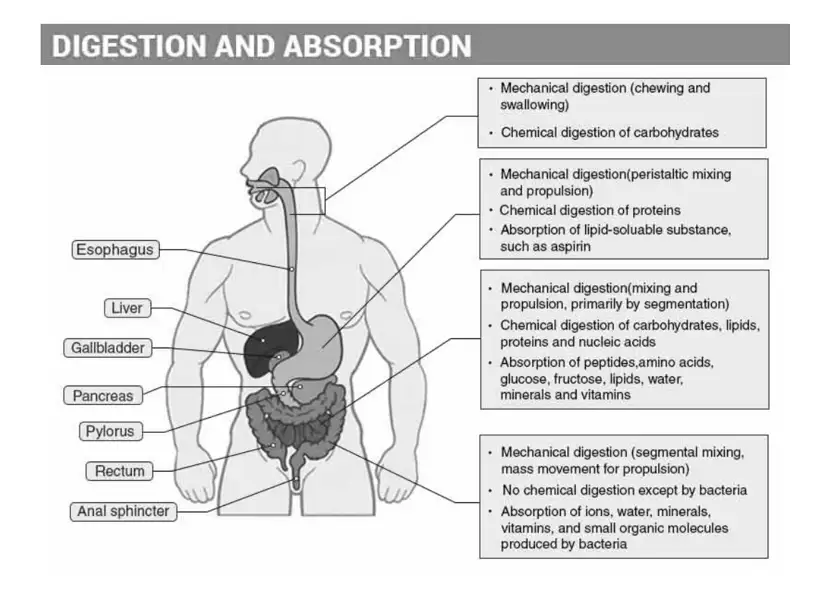
Illustration of digestion and absorption in the human digestive system
Energy-Dependent Active Transport of Nutrients
Active transport involves the movement of substances from a region of lower concentration to a higher concentration, which requires cellular energy in the form of ATP. This mechanism is essential for absorbing electrolytes such as sodium ions against their concentration gradient into the bloodstream.
Facilitated Transport Using Carrier Proteins
Facilitated transport is a passive process where specific carrier proteins assist the movement of molecules like glucose and certain amino acids across the cell membrane. This method does not require energy but depends on the presence of these transport proteins to help molecules cross membranes efficiently.
Passive Transport and Fat Absorption via Lymphatic System
Passive transport allows certain digested nutrients to cross membranes without energy use. However, some fat digestion products like fatty acids and glycerol cannot enter the bloodstream directly. Instead, they bind to micelles—tiny droplets that transport these molecules to form chylomicrons, which are protein-coated fat globules. These chylomicrons enter lymphatic vessels and eventually release fats into the bloodstream for distribution to tissues. This entire process is known as assimilation.
Example: Explain how fatty acids are absorbed and transported to body tissues after digestion.
Solution:
Fatty acids and glycerol combine with micelles in the intestine.
Micelles transport these fats to the intestinal cells where they are reassembled into chylomicrons.
Chylomicrons enter lymph vessels instead of blood capillaries.
They travel through the lymphatic system and eventually enter the bloodstream.
Finally, fats are delivered to tissues for energy or storage.
Summary Table of Absorption Methods
Absorption Mechanism | Description | Examples of Nutrients | Energy Requirement |
|---|---|---|---|
Simple Diffusion | Movement from high to low concentration without energy | Glucose, amino acids, chloride ions | No |
Active Transport | Movement from low to high concentration using energy | Sodium ions (Na+) | Yes (ATP) |
Facilitated Transport | Carrier protein-assisted movement along concentration gradient | Glucose, some amino acids | No |
Passive Transport (Fat Absorption) | Fatty acids and glycerol transported via micelles and chylomicrons | Fatty acids, glycerol | No |
Key Terms and Definitions
Term | Meaning |
|---|---|
Absorption | The process of nutrients passing from the digestive tract into the blood or lymph |
Simple Diffusion | Movement of molecules from higher to lower concentration without energy |
Active Transport | Energy-dependent movement of substances against their concentration gradient |
Facilitated Transport | Passive movement of molecules assisted by carrier proteins |
Passive Transport | Movement of substances across membranes without energy use |
Micelles | Small lipid droplets that help transport fat digestion products |
Chylomicrons | Protein-coated fat globules formed in intestinal cells for fat transport |
Assimilation | Utilization of absorbed nutrients by body tissues |
Electrolytes | Mineral ions like sodium and chloride involved in absorption |
Carrier Proteins | Membrane proteins that assist in transporting specific molecules |
Frequently Asked Questions
What is the main difference between simple diffusion and active transport?
Simple diffusion moves substances from high to low concentration without energy, while active transport moves substances from low to high concentration using energy.
Why can't fatty acids be absorbed directly into the blood?
Fatty acids are insoluble in water and form micelles, which are converted into chylomicrons that enter the lymphatic system before reaching the blood.
How do carrier proteins assist in nutrient absorption?
Carrier proteins facilitate the passive movement of specific molecules like glucose across membranes without energy expenditure.
What role does ATP play in nutrient absorption?
ATP provides the energy required for active transport to move nutrients against their concentration gradient.
What is assimilation in the context of digestion?
Assimilation is the process where absorbed nutrients are utilized by body cells for growth, repair, and energy.