Comprehensive Guide to Washing Soda and Its Industrial Preparation
Understanding Washing Soda: Composition and Characteristics
Fundamentals of Washing Soda and Its Chemical Identity
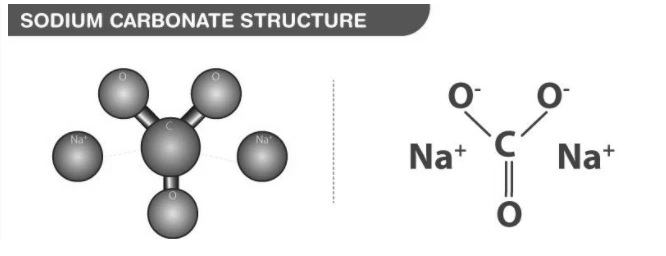
Washing soda is chemically known as sodium carbonate decahydrate, with the formula \( \mathrm{Na_2CO_3 \cdot 10H_2O} \). It is an inorganic salt that contains water molecules integrated into its crystalline structure, making it a hydrated compound. Historically, washing soda was derived from the ashes of plants grown in sodium-rich soils, which is why it is sometimes referred to as soda ash. This compound appears as a white, crystalline solid and readily dissolves in water, exhibiting basic properties.
Example Problem
Question: Identify the chemical formula of washing soda and explain why it is classified as a hydrated salt.
Solution:
- The chemical formula of washing soda is \( \mathrm{Na_2CO_3 \cdot 10H_2O} \), indicating it contains ten water molecules per formula unit.
- It is classified as a hydrated salt because these water molecules are part of its crystalline lattice, influencing its physical properties such as solubility and melting point.
- When heated, washing soda loses its water of crystallization, converting into an anhydrous form known as soda ash.
Industrial Production of Sodium Carbonate via the Solvay Method
Stepwise Process of Manufacturing Sodium Carbonate
The Solvay process is the principal industrial method for synthesizing sodium carbonate. It involves a series of chemical reactions starting from common salt (sodium chloride) and ammonia. The process is divided into four main stages:
- Brine Purification: A concentrated saltwater solution, called brine, is purified by removing impurities such as calcium and magnesium ions through precipitation and filtration.
- Formation of Sodium Bicarbonate: Carbon dioxide gas is bubbled through the purified brine saturated with ammonia, resulting in the precipitation of sodium bicarbonate and formation of ammonium chloride in solution.
- Conversion to Sodium Carbonate: The sodium bicarbonate precipitate is heated to approximately 300°C, decomposing it into sodium carbonate, carbon dioxide, and water vapor.
- Recovery of Ammonia: Ammonia is regenerated by treating the ammonium chloride solution with calcium hydroxide, producing ammonia gas and calcium chloride as a by-product.
Example Problem
Question: Write the balanced chemical equations for the formation of sodium bicarbonate and the recovery of ammonia in the Solvay process.
Solution:
The formation of sodium bicarbonate occurs as:
\[ \mathrm{NH_3 (aq) + CO_2 (g) + NaCl (aq) + H_2O \rightarrow NaHCO_3 (s) + NH_4Cl (aq)} \]
Ammonia recovery is achieved by:
\[ \mathrm{2 NH_4Cl (aq) + Ca(OH)_2 (aq) \rightarrow 2 NH_3 (g) + CaCl_2 (aq) + 2 H_2O (l)} \]
Properties and Applications of Sodium Carbonate
Physical and Chemical Traits of Sodium Carbonate
Sodium carbonate exists in multiple hydrated forms including monohydrate (\( \mathrm{Na_2CO_3 \cdot H_2O} \)), heptahydrate (\( \mathrm{Na_2CO_3 \cdot 7H_2O} \)), and decahydrate (\( \mathrm{Na_2CO_3 \cdot 10H_2O} \)). It is a white crystalline solid with a melting point around 851°C. Upon heating, it loses its water molecules sequentially, ultimately forming an anhydrous salt known as soda ash. The compound is alkaline in nature and reacts with acids to form carbon dioxide and corresponding salts.
Practical Uses of Washing Soda in Various Industries
Washing soda is widely utilized due to its cleansing and water-softening properties. Its applications include:
- As a detergent and cleaning agent in households and industrial settings.
- In the manufacture of glass, where it acts as a flux to lower melting temperatures.
- In textile and paper industries for processing and bleaching.
- Softening hard water by precipitating calcium and magnesium ions.
- As a key ingredient in laundry detergents to enhance cleaning efficiency.
Example Problem
Question: Calculate the mass of sodium carbonate produced when 150 g of sodium bicarbonate is heated according to the reaction:
\[ 2 \mathrm{NaHCO_3} \rightarrow \mathrm{Na_2CO_3} + \mathrm{CO_2} + \mathrm{H_2O} \]
Solution:
Molar masses: \( \mathrm{NaHCO_3} = 84 \text{ g/mol} \), \( \mathrm{Na_2CO_3} = 106 \text{ g/mol} \)
Number of moles of sodium bicarbonate:
\[ n = \frac{150}{84} \approx 1.79 \text{ mol} \]
From the balanced equation, 2 moles of \( \mathrm{NaHCO_3} \) produce 1 mole of \( \mathrm{Na_2CO_3} \), so moles of sodium carbonate formed:
\[ n_{\mathrm{Na_2CO_3}} = \frac{1.79}{2} = 0.895 \text{ mol} \]
Mass of sodium carbonate produced:
\[ m = 0.895 \times 106 = 94.87 \text{ g} \]
Quick Reference: Key Facts About Washing Soda
| Aspect | Details |
|---|---|
| Chemical Formula | \( \mathrm{Na_2CO_3 \cdot 10H_2O} \) |
| Physical Appearance | White crystalline solid |
| Melting Point | 851°C |
| Hydrated Forms | Monohydrate, Heptahydrate, Decahydrate |
| Solubility | Highly soluble in water |
| Nature | Basic (alkaline) |
| Industrial Preparation | Solvay Process |
| Major Uses | Cleaning agent, water softener, glass manufacturing |
| By-product of Solvay Process | Calcium chloride (\( \mathrm{CaCl_2} \)) |
| Dehydration Temperature | Approximately 373 K (100°C) |
Glossary of Important Terms
| Term | Definition |
|---|---|
| Washing Soda | Sodium carbonate decahydrate, a white crystalline salt used in cleaning and industrial processes. |
| Solvay Process | Industrial method for producing sodium carbonate from salt, ammonia, and carbon dioxide. |
| Brine | A concentrated aqueous solution of sodium chloride (common salt). |
| Hydrated Salt | A salt that contains water molecules within its crystal structure. |
| Soda Ash | Anhydrous sodium carbonate obtained by heating washing soda. |
| Ammonium Chloride | A salt formed as a by-product in the Solvay process. |
| Calcium Hydroxide | A chemical used to recover ammonia in the Solvay process. |
| Carbon Dioxide | A gas used to react with ammoniated brine to form sodium bicarbonate. |
| Water of Crystallization | Water molecules that are chemically bound within a crystal lattice. |
| Decomposition | A chemical reaction where a compound breaks down into simpler substances. |
Frequently Asked Questions
What is the chemical formula of washing soda?
The chemical formula of washing soda is \( \mathrm{Na_2CO_3 \cdot 10H_2O} \), indicating it is a decahydrate form of sodium carbonate.
By what other name is washing soda commonly known?
Washing soda is also referred to as soda ash, especially in industrial contexts.
Which industrial process is primarily used to produce sodium carbonate?
The Solvay process is the main industrial method for manufacturing sodium carbonate.
Can you list the main stages involved in the Solvay process?
The four key steps are: purification of brine, formation of sodium bicarbonate, conversion to sodium carbonate, and recovery of ammonia.
What are two significant applications of washing soda?
Washing soda is extensively used for softening hard water and as a cleaning agent in detergents and household products.