Understanding Spherical Mirrors and Their Image Formation
Fundamentals of Mirrors and Their Types
Defining Mirrors and Their Reflective Properties
A mirror is a surface designed to reflect nearly all the light that strikes it. When an object is placed before a mirror, the light rays emanating from the object hit the mirror and reflect, forming an image. These images can be either real, where reflected rays converge and intersect, or virtual, where rays appear to diverge from a point behind the mirror.
To visualize how light behaves with mirrors, ray diagrams are used. These diagrams trace the paths of incident and reflected rays, helping us understand the nature and position of the images formed.
Comparing Plane and Spherical Mirrors
Plane mirrors have flat reflective surfaces, producing virtual images that are upright and identical in size and shape to the object. In contrast, spherical mirrors have curved surfaces with a fixed radius of curvature, enabling them to form both real and virtual images depending on the object's location.
Spherical mirrors are categorized into two types: concave mirrors, which curve inward, and convex mirrors, which curve outward. Each type exhibits unique image formation characteristics.
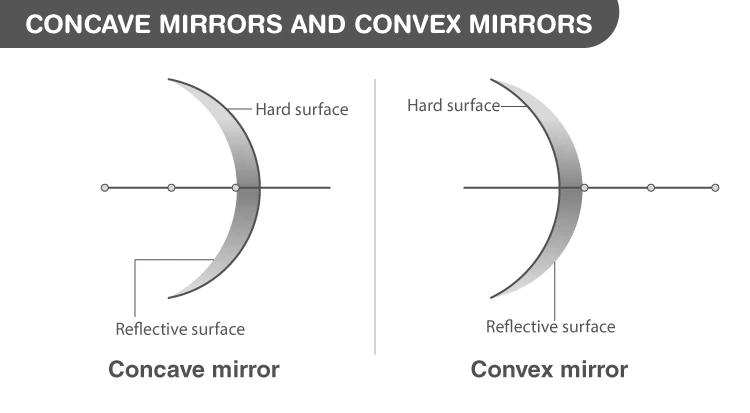
Exploring Concave and Convex Mirrors
Understanding Concave Mirrors
A concave mirror features a reflective surface that curves inward, resembling the inside of a hollow sphere. Known as converging mirrors, they cause parallel light rays to meet at a focal point after reflection. Depending on the object's position relative to the mirror, concave mirrors can produce both real and virtual images.
Key traits of concave mirrors include their ability to magnify images when the object is close, and to form inverted real images when the object is farther away. This versatility makes them useful in devices like telescopes and shaving mirrors.
Characteristics of Convex Mirrors
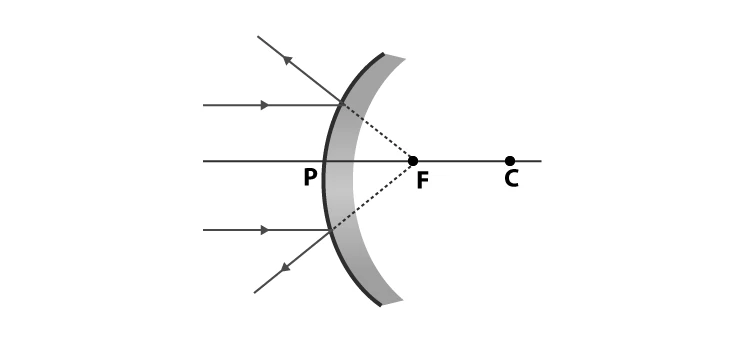
Convex mirrors have reflective surfaces that bulge outward, similar to the exterior of a sphere. These diverging mirrors cause light rays to spread out after reflection, always producing virtual, upright, and smaller images regardless of the object's distance.
Convex mirrors provide a wider field of view, making them ideal for applications such as vehicle rear-view mirrors and security surveillance.
Principles of Ray Behavior and Image Formation in Spherical Mirrors
Rules Governing Ray Reflection on Curved Mirrors
To predict image formation, certain rules about how rays reflect on concave and convex mirrors are essential:
- At the Pole: A ray hitting the mirror's pole reflects at the same angle to the principal axis.
- Parallel Rays: Rays parallel to the principal axis reflect through the focal point (concave) or appear to diverge from the focal point (convex).
- Through the Focus: Rays passing through the focus reflect parallel to the principal axis.
- Through the Centre of Curvature: Rays passing through the centre of curvature reflect back along the same path.
Image Formation by Concave Mirrors Based on Object Position
The nature and size of images formed by concave mirrors depend on where the object is placed:
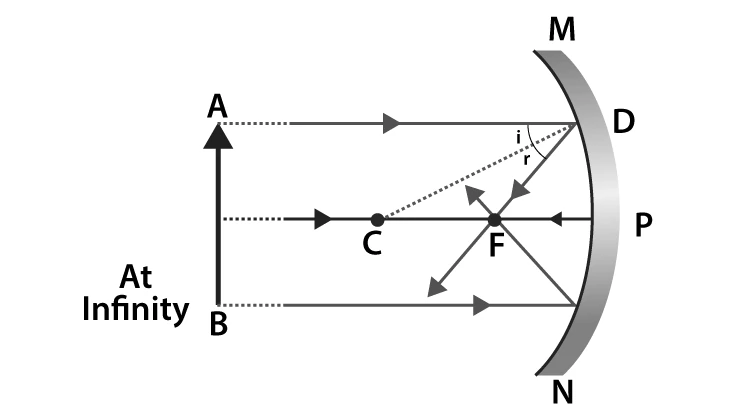
Object at Infinity
When the object is extremely far, the reflected rays converge at the focal point, producing a highly diminished, real, and inverted image.
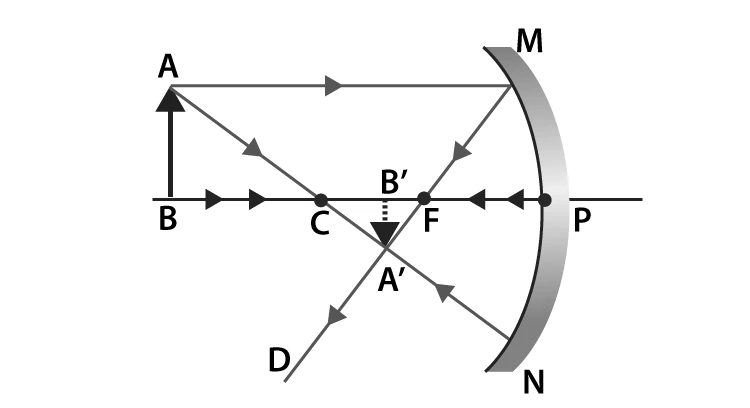
Object Beyond Centre of Curvature
Placing the object beyond the centre of curvature results in a real, inverted image located between the centre of curvature and the focus, smaller than the object.
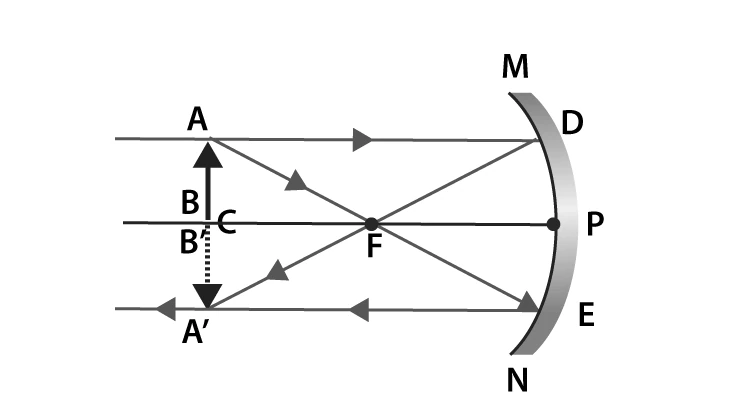
Object at Centre of Curvature or Focus
When the object is at the centre of curvature, the image forms at the same point, real, inverted, and equal in size. If placed at the focus, the image forms at infinity, highly enlarged and real.
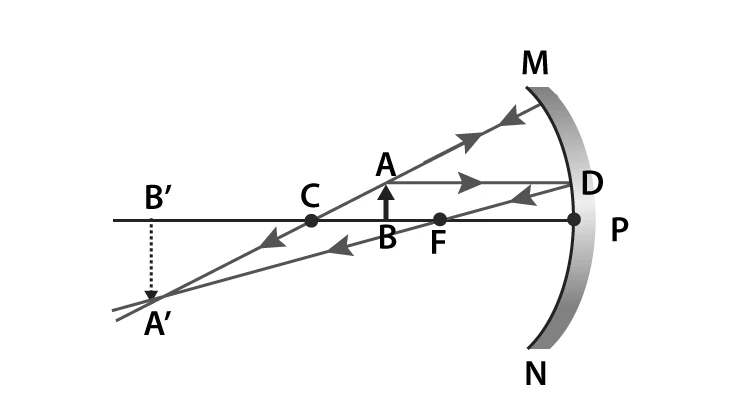
Object Between Centre of Curvature and Focus
Here, the image is real, inverted, and magnified, appearing beyond the centre of curvature.
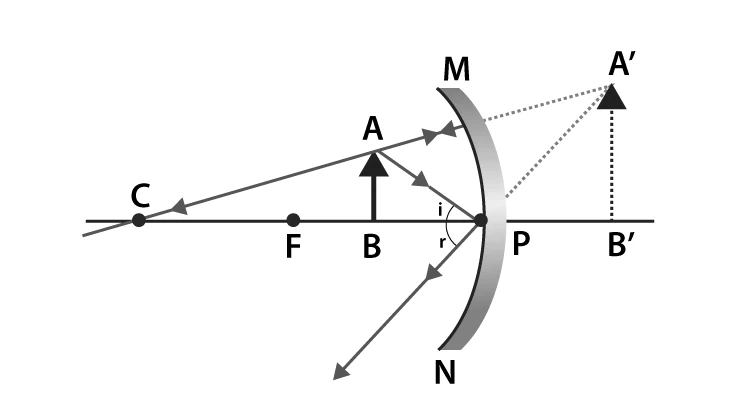
Object Between Focus and Pole
In this case, the image is virtual, upright, and magnified, appearing behind the mirror.
\[ \frac{1}{f} = \frac{1}{v} + \frac{1}{u} \]
where \( f = -15 \text{ cm} \) (concave mirror), \( u = -30 \text{ cm} \) (object distance),\[ \frac{1}{v} = \frac{1}{f} - \frac{1}{u} = \frac{1}{-15} - \frac{1}{-30} = -\frac{1}{15} + \frac{1}{30} = -\frac{2}{30} + \frac{1}{30} = -\frac{1}{30} \]
\[ v = -30 \text{ cm} \]
The negative image distance indicates a real image formed 30 cm in front of the mirror, inverted and same size as the object.Image Formation by Convex Mirrors
Convex mirrors always produce virtual, upright, and reduced images regardless of the object's position. The images appear behind the mirror between the pole and the focus.
Object at Infinity
When the object is very far, the image forms at the focal point behind the mirror, virtual and highly diminished.
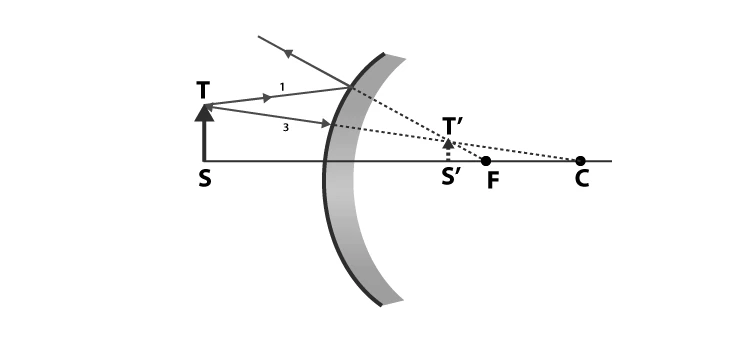
Object at Finite Distance
For objects placed closer, the image remains virtual, upright, and smaller, located between the pole and the focus behind the mirror.
\[ \frac{1}{f} = \frac{1}{v} + \frac{1}{u} \]
where \( f = +20 \text{ cm} \) (convex mirror), \( u = -40 \text{ cm} \),\[ \frac{1}{v} = \frac{1}{f} - \frac{1}{u} = \frac{1}{20} - \left(-\frac{1}{40}\right) = \frac{1}{20} + \frac{1}{40} = \frac{3}{40} \]
\[ v = \frac{40}{3} \approx 13.33 \text{ cm} \]
The positive image distance indicates a virtual image 13.33 cm behind the mirror, smaller and upright.Summary Table of Image Formation by Concave and Convex Mirrors
| Object Position | Image Position | Image Size | Image Nature | Mirror Type |
|---|---|---|---|---|
| At Infinity | At Focus | Highly Diminished | Real, Inverted | Concave |
| Beyond Centre of Curvature | Between Centre of Curvature and Focus | Diminished | Real, Inverted | Concave |
| At Centre of Curvature | At Centre of Curvature | Same Size | Real, Inverted | Concave |
| Between Centre of Curvature and Focus | Beyond Centre of Curvature | Enlarged | Real, Inverted | Concave |
| At Focus | At Infinity | Highly Enlarged | Real, Inverted | Concave |
| Between Focus and Pole | Behind Mirror | Enlarged | Virtual, Erect | Concave |
| At Infinity | At Focus (Behind Mirror) | Highly Diminished | Virtual, Erect | Convex |
| At Finite Distance | Between Pole and Focus (Behind Mirror) | Diminished | Virtual, Erect | Convex |
Key Terms and Definitions
| Term | Meaning |
|---|---|
| Mirror | A surface that reflects light to form images. |
| Plane Mirror | A flat mirror producing virtual, upright images. |
| Spherical Mirror | A mirror with a curved reflecting surface. |
| Concave Mirror | A mirror with an inward curved reflecting surface. |
| Convex Mirror | A mirror with an outward curved reflecting surface. |
| Focal Point (F) | The point where parallel rays converge or appear to diverge. |
| Centre of Curvature (C) | The centre of the sphere of which the mirror is a part. |
| Real Image | An image formed by actual convergence of rays. |
| Virtual Image | An image formed by apparent divergence of rays. |
| Principal Axis | The line passing through the pole and centre of curvature. |
Frequently Asked Questions
How do convex mirrors form images?
Convex mirrors cause light rays to diverge after reflection, producing virtual, upright, and smaller images behind the mirror regardless of object distance.
What is the working principle of concave mirrors?
Concave mirrors converge light rays to a focal point, forming real or virtual images depending on the object's position relative to the mirror.
Can you give examples of concave and convex mirrors?
Concave mirrors are used in shaving mirrors and telescopes, while convex mirrors are commonly found in vehicle rear-view mirrors and security mirrors.
What distinguishes a concave mirror from a convex mirror?
Concave mirrors curve inward and converge light rays, while convex mirrors curve outward and diverge light rays.
Is it possible to identify concave and convex mirrors without touching them?
Yes, by observing the image formed: concave mirrors can produce magnified or inverted images, whereas convex mirrors always produce smaller, upright images.