Comprehensive Insights into Soaps and Detergents
Fundamentals of Soaps and Detergents
Understanding the Nature and Composition of Soaps
Soaps are chemical compounds formed as potassium or sodium salts of long-chain carboxylic acids. These molecules possess a dual nature: a hydrophilic (water-attracting) carboxylate head and a hydrophobic (water-repelling) hydrocarbon tail. This amphiphilic structure enables soaps to act as surfactants, reducing surface tension between water and oils, thereby facilitating the emulsification of greasy substances in water.
Typically, soaps are synthesized through the saponification process, where fats or oils react with a strong alkali, producing soap, glycerine, and water.
Example: A soap is prepared by heating 100 g of a triglyceride with 40 g of sodium hydroxide. Calculate the mass of soap produced if the reaction is 90% efficient, assuming the triglyceride has a molar mass of 860 g/mol and produces 3 moles of soap per mole of triglyceride.
Solution:
Step 1: Calculate moles of triglyceride:
\[ \text{Moles of triglyceride} = \frac{100 \text{ g}}{860 \text{ g/mol}} \approx 0.1163 \text{ mol} \]
Step 2: Calculate moles of soap produced (3 moles per mole triglyceride):
\[ 0.1163 \times 3 = 0.3489 \text{ mol} \]
Step 3: Calculate theoretical mass of soap (assuming average molar mass of soap = 300 g/mol):
\[ 0.3489 \times 300 = 104.67 \text{ g} \]
Step 4: Adjust for 90% efficiency:
\[ 104.67 \times 0.9 = 94.20 \text{ g} \]
Therefore, approximately 94.20 g of soap is produced.
Detergents: Composition and Advantages
Characteristics and Chemical Structure of Detergents
Detergents are synthetic surfactants, commonly potassium or sodium salts of long alkyl chains terminating with sulfonate groups. Unlike soaps, detergents maintain solubility in hard water because their sulfonate groups do not form insoluble salts with calcium or magnesium ions present in such water.
Anionic detergents, such as alkyl benzene sulfonates, are widely used in household cleaning due to their strong cleansing power and resistance to water hardness.
Example: A detergent molecule has an alkyl chain of 12 carbon atoms. Calculate the approximate molecular formula of the alkyl benzene sulfonate detergent and explain why it remains soluble in hard water.
Solution:
Step 1: Alkyl chain formula is \( \mathrm{C}_{12}\mathrm{H}_{25} \).
Step 2: Adding benzene ring \( \mathrm{C}_6\mathrm{H}_5 \) and sulfonate group \( \mathrm{SO}_3^- \), the approximate formula is:
\[ \mathrm{C}_{12}\mathrm{H}_{25} - \mathrm{C}_6\mathrm{H}_4 - \mathrm{SO}_3^- \text{ (with sodium or potassium counter ion)} \]
Step 3: The sulfonate group forms soluble salts with sodium or potassium ions and does not precipitate with calcium or magnesium ions, ensuring solubility in hard water.
Manufacturing Processes and Cleaning Mechanisms
Methods of Soap Production
The predominant method for soap production is saponification, where triglycerides from fats or oils react with a strong alkali such as sodium hydroxide. This reaction yields soap, glycerine, and water. Alternatively, fatty acids obtained by hydrolyzing fats under high pressure can be neutralized with alkali to form soap.
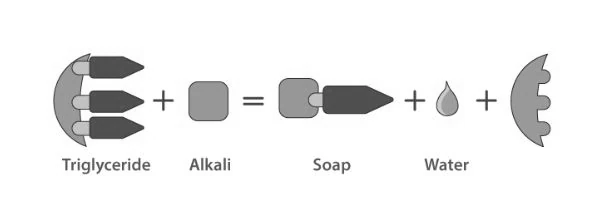
Saponification Process
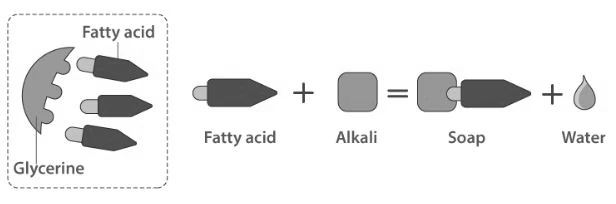
Soap Preparation via Fatty Acid Neutralization
Example: Calculate the amount of sodium hydroxide required to completely saponify 200 g of a fat with an average molar mass of 850 g/mol, assuming the fat contains three fatty acid chains per molecule.
Solution:
Step 1: Calculate moles of fat:
\[ \frac{200 \text{ g}}{850 \text{ g/mol}} = 0.2353 \text{ mol} \]
Step 2: Each mole of fat reacts with 3 moles of NaOH:
\[ 0.2353 \times 3 = 0.706 \text{ mol NaOH} \]
Step 3: Calculate mass of NaOH (molar mass = 40 g/mol):
\[ 0.706 \times 40 = 28.24 \text{ g} \]
Therefore, 28.24 g of sodium hydroxide is needed for complete saponification.
How Soaps and Detergents Remove Dirt
The cleaning action of soaps and detergents involves a four-step process:
Initially, water wets the dirty surface.
Next, soap or detergent molecules adsorb onto the surface, reducing water's surface tension and allowing better wetting.
During agitation, the hydrophobic tails of these molecules attach to grease and dirt, breaking them away from the surface.
Finally, the dirt particles are encapsulated by soap or detergent molecules, suspending them in water and preventing redeposition.
Example: Explain why soap is less effective in hard water compared to detergents.
Answer:
Hard water contains calcium and magnesium ions.
Soap molecules react with these ions to form insoluble salts (scum), reducing cleaning efficiency.
Detergents contain sulfonate groups that do not form insoluble salts with these ions.
Therefore, detergents remain soluble and effective in hard water.
Summary Table for Quick Review
Aspect | Soaps | Detergents |
|---|---|---|
Chemical Nature | Potassium or sodium salts of long-chain fatty acids | Potassium or sodium salts of alkyl benzene sulfonates |
Source | Natural fats and oils | Synthetic chemicals |
Effectiveness in Hard Water | Forms scum, less effective | Remains soluble, highly effective |
Biodegradability | Generally biodegradable | Some are non-biodegradable |
Common Uses | Personal care, mild cleaning | Household cleaning, heavy-duty washing |
Glossary of Key Terms
Term | Definition |
|---|---|
Amphiphilic | Molecules having both hydrophilic and hydrophobic parts. |
Carboxylate | The negatively charged ion formed from a carboxylic acid. |
Detergent | Synthetic surfactants used for cleaning, soluble in hard water. |
Emulsification | Process of mixing two immiscible liquids like oil and water. |
Hard Water | Water containing high concentrations of calcium and magnesium ions. |
Hydrophilic | Water-attracting part of a molecule. |
Hydrophobic | Water-repelling part of a molecule. |
Saponification | Chemical reaction of fats with alkali to produce soap and glycerine. |
Surfactant | Substances that reduce surface tension between two liquids or a liquid and a solid. |
Triglyceride | A fat molecule composed of glycerol and three fatty acids. |
Frequently Asked Questions
What chemical reaction is involved in soap production?
Soap is produced through saponification, where fats or oils react with a strong alkali like sodium hydroxide, yielding soap, glycerine, and water.
Are soaps and detergents alkaline in nature?
Yes, soaps and detergents are salts of fatty acids or sulfonic acids and generally exhibit basic properties due to their formation from alkalis.
How do soaps differ from detergents in cleaning action?
Soaps are less effective in hard water due to scum formation, while detergents maintain strong cleaning ability and solubility in hard water.
What is the environmental impact of soaps and detergents?
Soaps are mostly biodegradable, breaking down naturally, whereas some detergents may persist in the environment and cause pollution.
Why do soaps form scum in hard water?
Soaps react with calcium and magnesium ions in hard water to form insoluble salts called scum, which reduces their cleaning efficiency.
Additional Visual References
Comparison of Soap and Detergent Molecules
Biodegradability of Soap Explained
Environmental Considerations of Soap Use
Access to Educational Resources on Chemistry